Lynda Benglis explores latex paint as a material creating works that sit somewhere between painting and sculpture. Explore her approach and working processes.
American artist Lynda Benglis (b. 1941) is best known for her wax paintings, poured latex sculptures. Daring and sometimes outrageous, her intense and provocative practice has produced some of the most iconic pieces of art from the late twentieth century, not forgetting her posing naked but for a pair of sun glasses and a giant dildo in Art Forum magazine to advertise a show. (Richmond, 2015)
In the late 1960s, many sculptors emphasised the process of making, and explored ideas of energy in their work. Artists began to use a diverse range of everyday materials rather than those associated with fine art. Benglis was one of a group of artists working during this period who embraced the term ‘anti-form’, applied to their work. (Tate, 2020). Her abstract investigation of materials, surface and format not only allowed her to experiment and examine the definition of art but also to question how its perceived, and ‘redefine what painting was.’ (Walsh, 2015)

As Jackson Pollock had dripped and poured paint onto a canvas, Benglis extended this ‘drip’ technique by spilling liquid rubber directly onto the floor, creating her celebrated pours that rested between the genres of painting and sculpture. (Walsh, 2015)
Although the artist see’s herself as a painter, the obscured distinction between painting and abstract sculpture is illustrated through her use of materials, moving from latex to used metals as the final pour medium. This is exemplified further by dispensing with the canvas meaning that the size of her artworks is governed by the working environment. Benglis articulates that this allows her artwork to evolve and create a contextual relationship with the space in which it sits. (Benglis, 2009)
Notwithstanding that her metal pours are created from a latex mould, by the nature of pouring the artist relinquishes control of the final appearance of the artwork, making each piece unique.
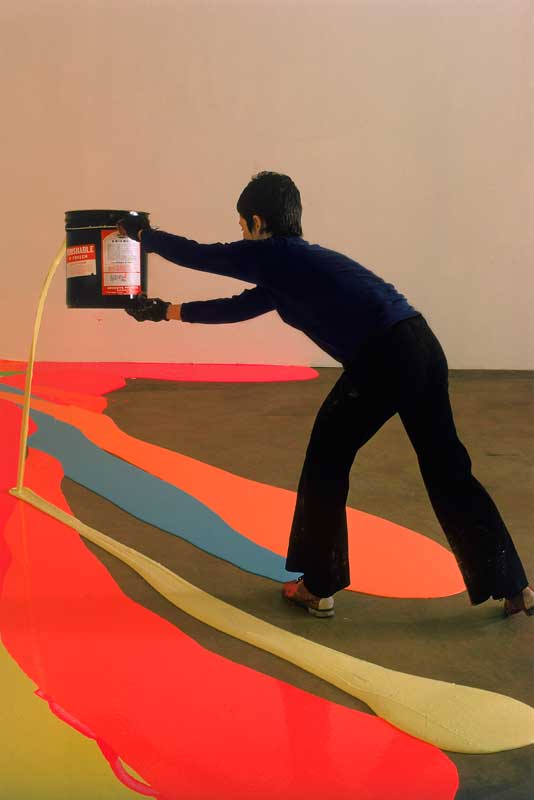
It was fascinating to observe the artists’ experimentation with latex pours over polyurethane supported by wire mesh to create three-dimensional sculptural forms. The dilemma of a known – unknown as to how much control the artist relinquishes during this process. The artist discusses the process of creating Contraband, 1969 by pigmenting rubber latex and pouring it on the floor of her studio, explaining how her materials relate to nature, chemistry, and cooking. (Benglis, 2009)
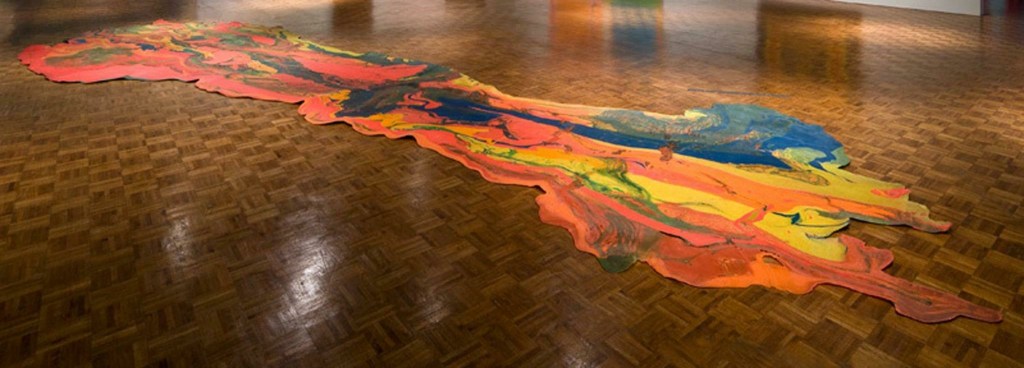
Installed at the New Museum, New York http://www.artnet.com
References
Baldessari, J., 2015. Lynda Benglis – Interview Magazine. [online] Locksgallery.com. Available at: <http://www.locksgallery.com/attachment/en/558176bf278e1af86c88ecaf/Press/55b146a7c5aa2cad2915aeb0> [Accessed 5 June 2020].
Benglis, L., 2009. Whitney Focus Presents Lynda Benglis. [online] Youtube. Available at: <https://www.youtube.com/watch?v=Yq7VkLUhY18> [Accessed 5 June 2020].
Benglis, L., 2012. Form And Texture Create The Magic – Tateshots | Tate. [online] Tate. Available at: <https://www.tate.org.uk/art/artists/lynda-benglis-7290/lynda-benglis-form-and-texture-create-magic> [Accessed 5 June 2020].
Benglis, L., 2015. Lynda Benglis Discusses Adhesive Products. [online] Youtube. Available at: <https://www.youtube.com/watch?v=7igJ08xWH-8> [Accessed 5 June 2020].
Locksgallery.com. n.d. Free Fall – Exhibitions – Locks Gallery. [online] Available at: <http://www.locksgallery.com/exhibitions/free-fall> [Accessed 5 June 2020].
Richmond, S., 2015. Lynda Benglis: Beyond Process. London: Bloomsbury Academic.
Tate. n.d. Anti-Form – Art Term | Tate. [online] Available at: <https://www.tate.org.uk/art/art-terms/a/anti-form>> [Accessed 5 June 2020].
Tate. n.d. Arte Povera And Anti-Form | Tate. [online] Available at: <https://www.tate.org.uk/whats-on/tate-modern/display/arte-povera-and-anti-form> [Accessed 5 June 2020].
Walsh, T., 2015. Lynda Benglis. [online] The Museum of Modern Art. Available at: <https://www.moma.org/artists/471> [Accessed 5 June 2020].
 Painting 2 - Studio practice