Exercise 1.3: The mirror as a stage
Explore the cut or incision made in space by reflective surfaces, considering these as a stage.
Sketchbook 2. Pages 17-19
Using a mirror as a stage to make a series of painted sketches that document the various images or performances that appear in the mirror proved somewhat challenging. I read the brief in the course material a dozen times to see how I might exploit it to incorporate my own artistic perspective, but the ideas did not flow naturally.
Staring into my computer screen I caught my own reflection and some of the lighter coloured objects from around the studio. Taking this as my start point and anticipated the ideas would come thereafter. (See figure 1)

I started with some preliminary sketches. (See figure 2) Once I had developed the idea in my sketchbook, I expanded this to a painted sketch with transparent acrylic paints. (See figure 3)
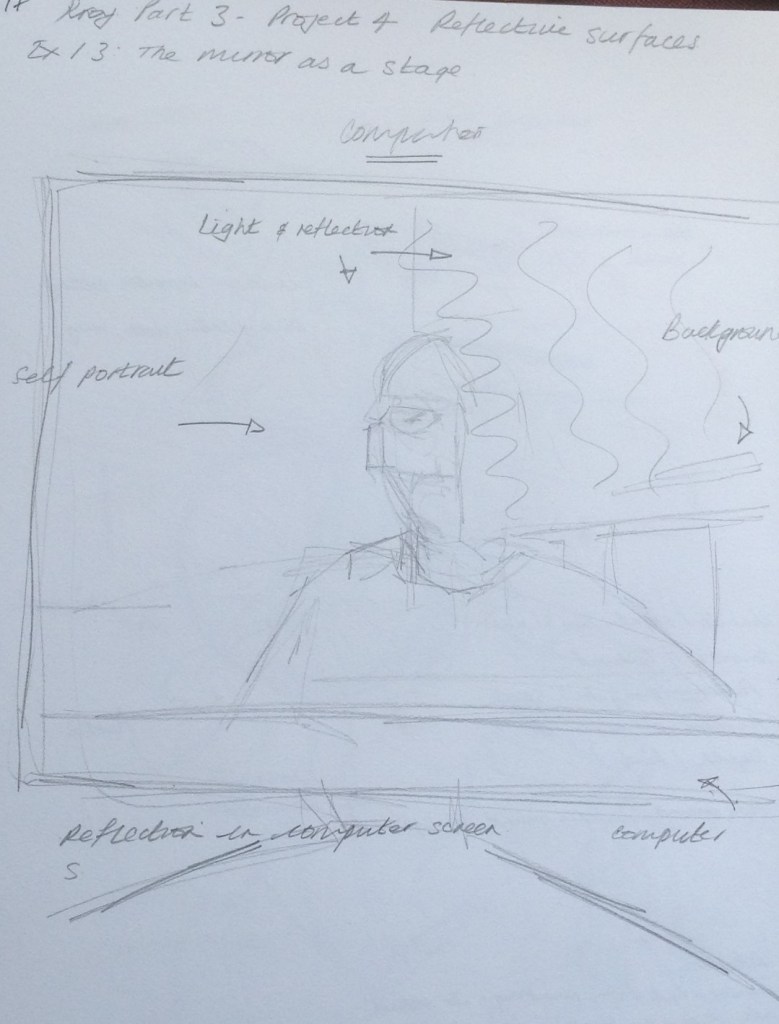

The initial painted sketch was too large, the colours opaque and no there was no indication of context. It looked more cyborg than my own reflected image merged with the image on the computer screen. Rather than trying to recover it, I took it off the easel and put it to one side. (See figure 3)

acrylic paint on paper
Noting the points from my earlier effort, to develop a series of painted sketches I divided a piece of oil paper into four squares, each 24×18 cm. Starting with the original concept of the reflection in the computer screen, the challenge was that the scene would not change a great deal – less the light conditions. In the process of developing the first scene I caught my distorted reflection in a large heavy-duty clip attached to the edge of the painting board and liked the idea of introducing this into my painted sketch.
The only ‘portable’ mirror I had was 13×10 cm which I attached to the painting board using a heavy-duty clip. I produced a collage of quick sketches. However, the concept turned out to be better than the outcome. The outcome was pasty rather than reflective. (See figure 4)

Returning to the original painting I want to see if I could resolve some of the issues previously identified by applying transparent layers of oil paint and thinning medium over a series of days. It was better but remained unresolved
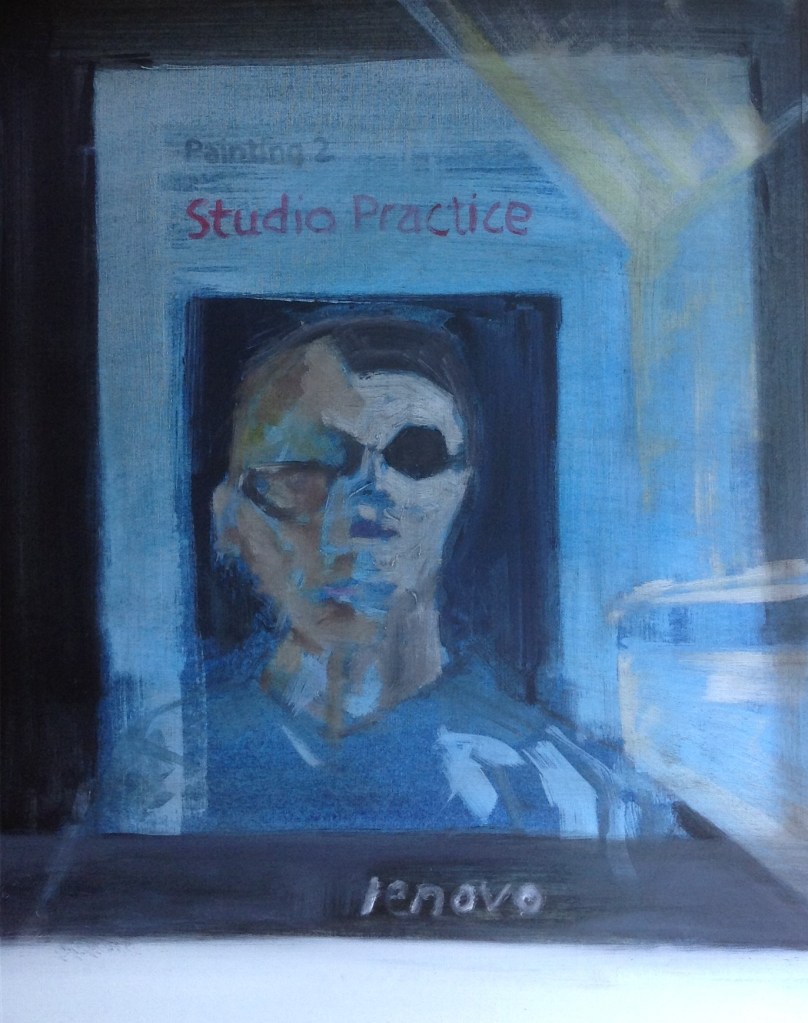
Reflection
I really found it difficult to get going with this exercise – and my sketches reflect this. Even when something doesn’t work out, I normally enjoy the process – but I can’t even say that about this exercise. I was comfortable with failure as a learning process and this is one of those exercises.
Reflecting on what I would do differently if I was to repeat this exercise, layering the objects (a picture within a picture), and reflecting the computer and mirror as an image of each other may have produced a more pleasing outcome. If time permits through the course I shall return to this exercise, but there is no time to dwell.
Contextual Focus
Lyle Rexer: “The Multiplication of being or a reflective abyss?”
In this discussion facilitated by Lyle Rexer, he along with artists Susan Rankaitis and James Welling, and UCLA Associate Professor of Art History George Baker examine the use of mirrors and reflective surfaces in relation to their use in art and photography.
Rexer argues that photography is an ambiguous medium, reasoning that a photograph can constitute a memory, something which captures and therefore replicates an image. To articulate this, he draws comparison on the daguerreotype of 9/11 by Jerry Spagnoli and an installation by Silvio Wolf, of black squares floating against illuminated backgrounds.
It could be reasonably argued that a daguerreotype is a both photograph and mirror, given that the surface on which the image is captured is reflective. Furthermore, a second mirror could be added to reverse the image to restore it to ‘reality’, as if looking through a lens. In comparison Silvio Wolf’s – backlit black squares are a reflective abyss, less the reflected image of the viewer in its momentary passing.
At the centre of Rexer’s argument is an image produced in 1979 by Jeff Wall called Picture for Women (1979), a re-enactment of Manet’s Folies-Bergère. Rexer states that this presented a “problematic relation of representation, the body and the subjective gaze had shifted from painting to photography.” I would argue that it is subjective to suggest the emphasis had moved from painting to photography or that the viewer may not be able appreciate the importance of each media. Although the image is viewed as a reflection, how it is interpreted by the viewer is through using our senses and logical reasoning.

Picture for Women 1979
Transparency in lightbox 1425 x 2045 mm
Courtesy Marian Goodman Gallery, New York
© The artist
As a metaphor and an instrument of the art of painting, the mirror has long been used to convey themes of identity, illusion and narcissism. It has been widely used to manipulate space or distort perspective of an image or scene. Its use and utility in art has drawn conflicting opinions between artists, art historians and critics. In Western art the mirror stood for vanity and narcissism whilst theorists such as Freud, René Girard and Jacques Lacan argued that imitation and the mirror played an important role in art and photography.
Throughout art history, artists have had a fascination of capturing their own image in their work, be that as a self-portrait (the modern-day selfie), a cameo role, or subtlety in a reflective surface or as a shadow.
In the Arnolfini Portrait, the mirror is placed in the centre of the picture like an eye, reflecting the image of two other figures in the room standing before the couple. Is one the artist? The images captured in the mirror pose more questions than they offer solutions.
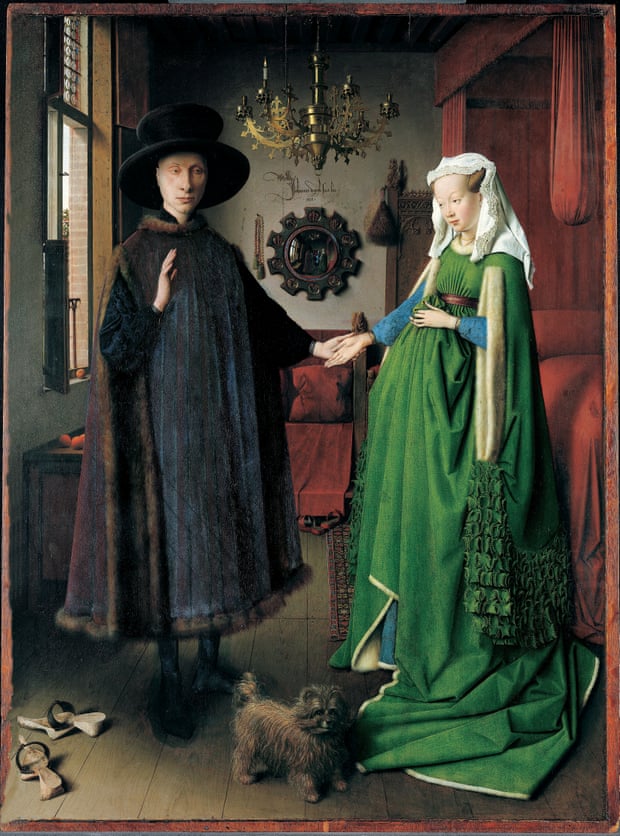
1434. Photograph: Thames & Hudson
@ (https://www.theguardian.com, 2020)
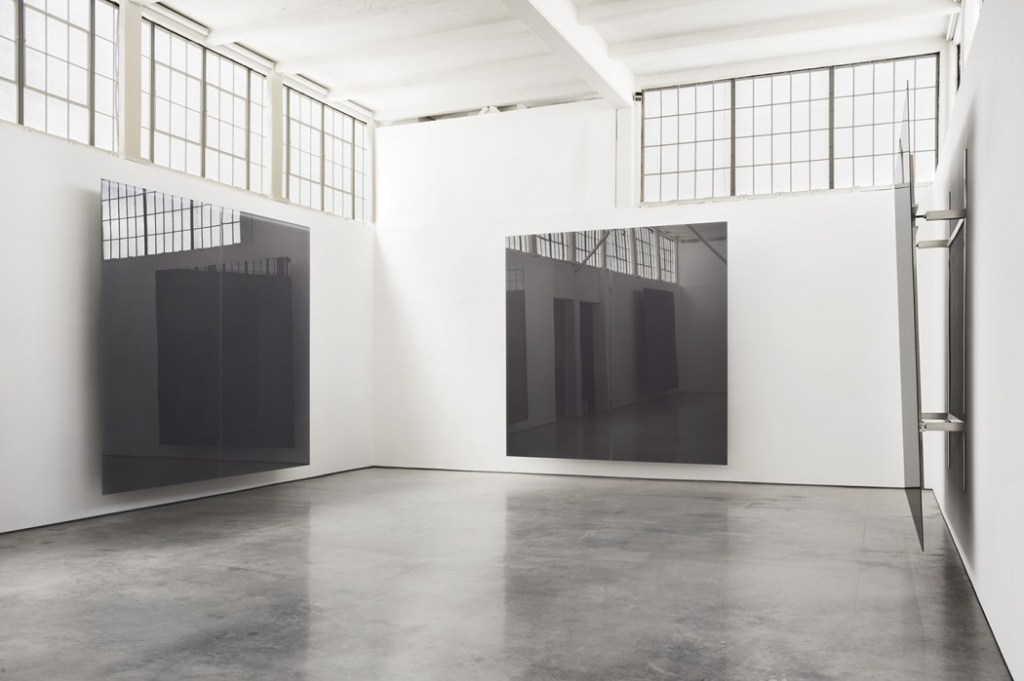
The artist Gerhard Richter moved between styles and media, yet once stated that ‘photographs were the way forward to emphasize painting’s meaning’ (Weigel, 2009) (Dia Foundation, 2020) His blurred photographs and the scraping of wet paint on his paintings fuses photograph and painting mediums. His photorealistic view of a room, Self Portrait, Three Times (1990), with repeated reflections, further fuses the connection between, painting, photography and the use of mirrors. In 2002 Richer’s Eight Grey installation displayed eight grey mirrors in a white cube shaped room. Richer conveyed that being grey they were neither visible or invisible and in an illusionist way – were like photography

In theatre the mirror often represents a symbolic prop. Hamlet’s dictum that the purpose of playing is “to hold, as ‘t were, the mirror up to nature” (Watson, 1993, p-26) Perhaps an archetypal example comes at the end Act IV of Richard II, when Shakespeare’s narcissistic protagonist calls for a looking glass. (Alder, 1980)
There are numerous myths why the mirror is now considered bad luck on a theatre stage. The fear of the mirror breaking, resulting in seven years of bad luck, or the old superstition that mirrors are a gateway for evil spirits to cross over to the world of the living? There is a more tangible explanation which correlates to the development of stage lighting and reflected light creating havoc with the lighting design of a production. Of course, it can be done, but a wrong hit with a spotlight and you could easily have a blinded actor who might just walk off the edge of the stage. (Robinson, 2017)
The word ‘mirror’ in the title of a play may also be used as a metaphor for reflection such as Charles Smith’s “Objects in the Mirror”, a play built on conflict: global, regional, interpersonal and internal relationships, or Rachel Wagstaff’s The Mirror Crack’d. Where mirrors form part of the storey, it often requires an imaginative approach to create the illusion of a reflective surface to make it believable to the audience. The Picture of Dorian Gray, by Oscar Wilde, Dorian is in the habit of taking a mirror up to the locked room containing his portrait and comparing his reflection with the increasingly horrid image on the canvas. When he realises what a monster he has become, he becomes another mirror-smasher. Ironically, the mirror is only a frame, that whilst not always inhabited does not detract from the play.
In classical literature, One of the earliest references to a mirrored reflection comes from Greek mythology c. 8 AD. This story is of Narcissus, who falls in love with his own reflection.
In religion, speculum sine macula, is traditionally associated with Mary, as a symbol of her divinity and purity (sinlessness). Mary is a reflection of the eternal light, and a stainless mirror (speculum sine macula) of God’s majest – Wisdom 7:26-8:1. (Common English Bible)
Literature has long had the autonomy to present and described mirrors as many different vectors and symbols. The mystical and spiritual connotations echoed through the novels of writer Johann Wolfgang von Goethe and the poet Rainer Maria Rilke, to Lewis Carroll’s Through the Looking-Glass(1865), all transported through many spectrums of learning.
The poet Thomas Hardy reflects upon his growing awareness of age and the reality age has on the body in a short and simple poem called I Look into My Glass, (1898):
I look into my glass,
And view my wasting skin,
And say, ‘Would God it came to pass
My heart had shrunk as thin!
Psychology tends to be more critical of mirrors which represent the barrier between conscious and unconscious and therefore, by looking deep into a mirror, we look deep inside ourselves in a conscious way, following a thoughts process without adoration or vanity to stand before a mirror mute in humility
References:
Alder, T., 1980. The Mirror as Stage Prop in Modern Drama. Comparative Drama, [online] 14(4), pp.355-373. Available at: <https://www.jstor.org/stable/41152917?seq=1> [Accessed 7 May 2020].
Art Mirrors Art. 2020. Speculum Sine Macula, Postmodo: Memling, Madonna, Apple, Mirror. [online] Available at: <https://artmirrorsart.wordpress.com/2011/12/12/speculum-sine-macula-postmodo-memling-madonna-apple-mirror/> [Accessed 7 May 2020].
Artobserved.com. 2020. New York – Gerhard Richter “Painting After All” At The Met Breuer Through July 5Th, 2020. [online] Available at: <http://artobserved.com/2020/03/new-york-gerhard-richter-painting-after-all-at-the-met-breuer-through-july-5th-2020/> [Accessed 6 May 2020].
Cash, J., 2017. Symbolism | The Drama Teacher. [online] The Drama Teacher. Available at: <https://thedramateacher.com/symbolism/> [Accessed 7 May 2020].
Destrée, P. and Murray, P., 2015. A Companion To Ancient Aesthetics (Ebook, 2015) [Worldcat.Org]. [online] Worldcat.org. Available at: <https://www.worldcat.org/title/companion-to-ancient-aesthetics/oclc/905450335> [Accessed 5 May 2020].
Dia Foundation, 2020. Gerhard Richter | Exhibitions & Projects | Exhibitions | Dia. [online] Diaart.org. Available at: <https://www.diaart.org/exhibition/exhibitions-projects/gerhard-richter-exhibition/komar-melamid-the-most-wanted-paintings-web-project/painting.html/page/2> [Accessed 6 May 2020].
Encyclopedia Britannica. 2020. Daguerreotype | Photography. [online] Available at: <https://www.britannica.com/technology/daguerreotype> [Accessed 2 May 2020].
Lutter, V., 2007. Vera Lutter On Gerhard Richter | Watch & Listen | Dia. [online] Diaart.org. Available at: <https://www.diaart.org/media/watch-listen/video-vera-lutter-on-gerhard-richter/media-type/video> [Accessed 6 May 2020].
Mirrorworld.co.uk. 2018. The Symbolism Of Mirrors In Literature – Mirrorworld Blog. [online] Available at: <https://www.mirrorworld.co.uk/news/index.php/symbolism-mirrors-literature/> [Accessed 7 May 2020].
Robinson, M., 2017. 13 Theater Superstitions | Broadway Direct. [online] Broadway Direct. Available at: <https://broadwaydirect.com/13-theater-superstitions-halloween/> [Accessed 7 May 2020].
Tate. 2020. ‘Self-Portrait, Three Times, 24.1.90’, Gerhard Richter, 1990 | Tate. [online] Available at: <https://www.tate.org.uk/art/artworks/richter-self-portrait-three-times-24-1-90-t06514> [Accessed 6 May 2020].
Tate. n.d. Jeff Wall: Room Guide, Room 1 | Tate. [online] Available at: <https://www.tate.org.uk/whats-on/tate-modern/exhibition/jeff-wall/jeff-wall-room-guide/jeff-wall-room-guide-room-1> [Accessed 6 May 2020].
Tearle, D., 2020. A Short Analysis Of Thomas Hardy’s ‘I Look Into My Glass’ – Interesting Literature. [online] Interesting Literature. Available at: <https://interestingliterature.com/2016/12/a-short-analysis-of-thomas-hardys-i-look-into-my-glass/> [Accessed 7 May 2020].
The National Gallery, L., 2020. Jan Van Eyck | The Arnolfini Portrait | NG186 | National Gallery, London. [online] Nationalgallery.org.uk. Available at: <https://www.nationalgallery.org.uk/paintings/jan-van-eyck-the-arnolfini-portrait> [Accessed 6 May 2020].
Watson, W., 1993. The Architectonics Of Meaning. Chicago: The University of Chicago Press, p.26.
Weigel, M., 2009. The Painted Illusions Of Gerhard Richter. [online] the Guardian. Available at: <https://www.theguardian.com/artanddesign/2009/apr/25/gerhard-richter-painting> [Accessed 6 May 2020].

