Review work completed for Part Five to develop one final piece or a series of pieces, based around these ideas, approaches and reflections.
Sketchbook 1. Pages 60-65


The objective of Part 5 was to explore text as a subject, or vehicle from which to develop an ability to talk and write about your own practice and the role and potential of a title. I felt Part 5 was somewhat fragmented, in that it did not flow as I had anticipated. As a result, I found myself bouncing between each element – as if each had remained unresolved, but without knowing why.
The relationship between text (in a piece of work) and the title was interesting. In a dialogue between artist and viewer, imagery and text, I felt it could reinforce or dilute a viewer’s interest in equal measures.
Having explored the use of text using the cut-up technique, removing text from poems and incorporating text within an image, I had tried to investigate the relationship between text, image and title which I felt had remained unresolved.
In project 1- working with text I produced two works that incorporated layered imagery and text. The prominence of the text had been deliberately varied between the two pieces, a small but significant experiment to test my theory that given the time someone is likely to view an artwork, the impact of a pictorial image was likely to be more powerful and remain vivid in the memory of the viewer for longer.
In making this assumption a sub-text to this assignment was to explore if combining a pictorial image and written text would support this theory. A second but equally significant experiment was to show a small circle of friends a picture and image from the front page of a daily newspaper. They were asked to try and remember the image and headline. All could remember the image, but only one could recall the headline.
Imants Tillers work ‘juxtaposes layers of imagery and text that result in a convergence of ideas and a multiplicity of references that cite art, history, literature, politics, society and the artist’s personal history’. His work explores diaspora and displacement, landscape and place, and metaphysics which resonated with my own ideas for this assignment. (Blackall, 2020)

Synthetic polymer paint, gouache on 72 canvasboards, 216 x 268.8 cm
University of Newcastle – Australia

synthetic polymer paint, gouache on 132 canvas boards nos. 109427–109558 280 x 427 cm
Art Gallery of NSW’s
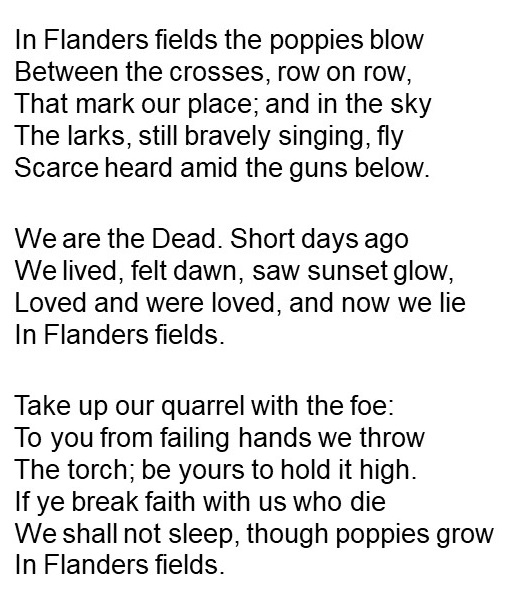
Expanding on ideas developed during Project 1, the subject matter for this assignment was inspired by the works of war artists Paul Nash, John Nash and Adrian Hill, depicting the desolation of no-man’s land between opposing forces during World War I. I also searched the internet for images of World War I battlefields. The text is ‘In Flanders Fields’, a war poem in the form of a rondeau, written during the First World War by Canadian physician Lieutenant-Colonel John McCrae. (See Figure 3)
Inspiration and ideas were also influenced by the works of Despina Stokou and Brian Hubble, both of whom use imagery and text innovatively in their artwork. Stokou’s use of the HTML of the images as the text of her drawings and paintings to communicate specific concepts, ideas, or feelings was an innovative and unique approach. Hubble’s work challenges the viewer to search through layered text and images for satirical commentary or meaning. In doing so he blurs the lines between reality and imagination – leaving the viewer to draw their own conclusion.
As opposed to layering imagery and text, the intent was to blend and merge both elements to become one narrative from different perspectives.


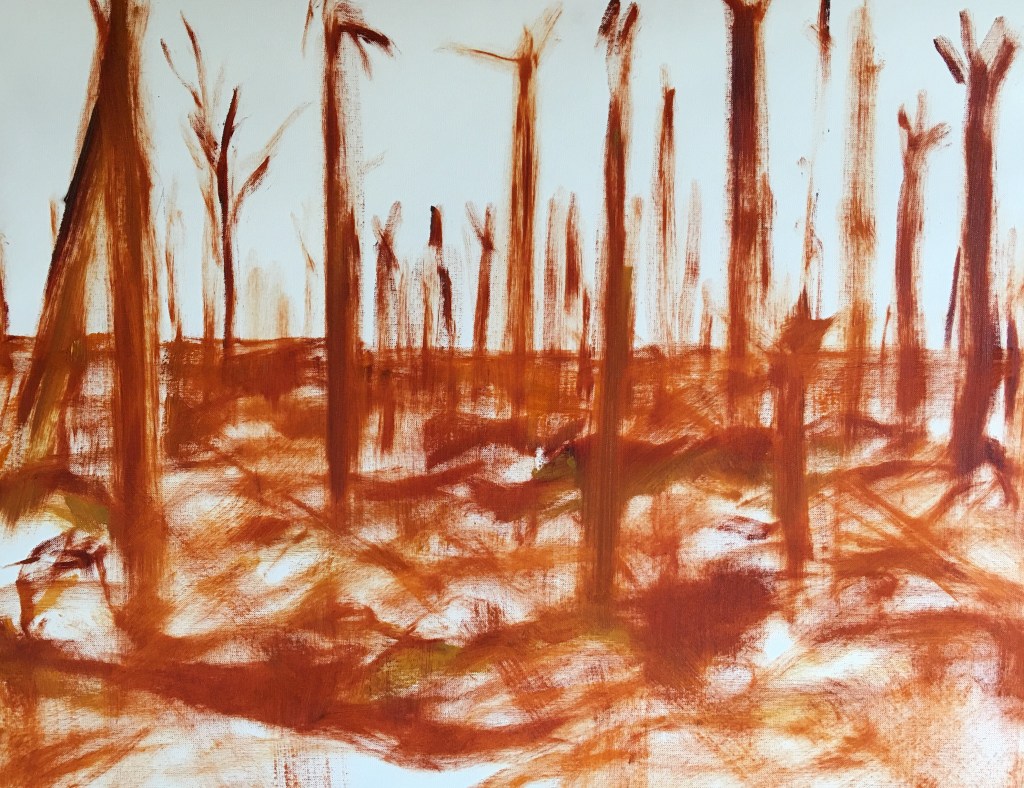
With a limited palette of burnt sienna and Naples yellow, and a linseed oil medium, I produced an outline drawing on a canvas support. For visual impact, I chose the largest support I had available. (See Figure 4)
Having experimented with integrating the text vertically within the form of the tree stumps, I felt this somehow separated the text from the image. I also observed that the straight edges of the text paper were inapposite to the landscape. (See Figure 5)

Lines from the poem were randomly selected and jumbled before the font size was changed to create the illusion of depth once applied to the support. These were torn and applied to the support using PVA glue. (See Figure 6)
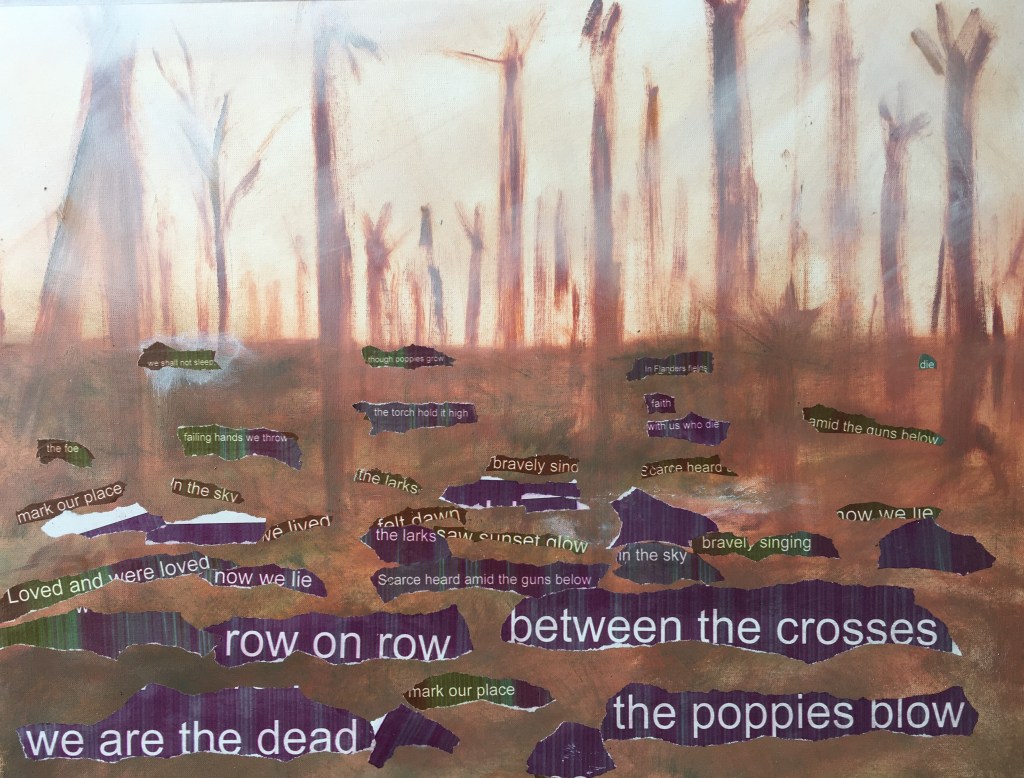
At this juncture I took time to revisit previous exercises and consider how I might merge the text with the landscape, using a limited colour palette, hue and tones.
The image is devoid of the human form, barricades or military weapons and arguably, (without a title) it could convey several scenarios such as the bushfires in Australia, the felling of tropical rain forests, or as I discovered when in Jamaica, the aftermath of a hurricane that has stripped the yield of plantations bare. As such, the text in the foreground row on row, crosses, poppies and dead, work with the image to create a narrative. The receding text offers a perspective that mirrors the landscape but also draws the viewer to search for the more concealed words of the poem. Not all words of the poem were included, giving thought to what is buried or lies within the craters.
In an interview with BBC Arts, Nash recalled that he “tried to paint trees as though they were human beings”. People were absent from his paintings, but his trees were full of life. This metaphor made me think of the tree stumps drawing blood from the saturated earth in which they were rooted, a rebirth of lost souls. (Cook, 2016)

Oil and mixed media on canvas 62×48 cm
Reflection
Through a process of research, reflection and experimentation I had produced a piece of work that I was reasonably content with. That said, I felt that I had been a brush stroke away from over-working the painting, but I recovered somewhat after removing the paint to expose the text where required. On reflection I can still see areas that I would now change. Overall, I felt that the power of the image and text worked well in this context.
I did not approach this exercise with a title in mind. However, I was mindful of the relationship between painting and viewer, what I wanted to communicate and how the title could enhance this. The sense of loss and regardless of how bad things may seem, there is always hope, and through resilience – recovery to make things better.
References
Blackall, J., 2020. Imants Tillers | MCA Australia. [online] Mca.com.au. Available at: <https://www.mca.com.au/artists-works/artists/imants-tillers/> [Accessed 23 August 2020].
Chambers, E. and Nash, P., 2016. Paul Nash. London: Tate Publishing | Tate Enterprises Ltd.
Cook, W., 2016. BBC Arts – BBC Arts – From Trees To Trenches: Why Paul Nash Was The Most Important Landscape Painter Since Constable. [online] BBC. Available at: <https://www.bbc.co.uk/programmes/articles/4MsMkFbpw5tGKnwPMJxhpYX/from-trees-to-trenches-why-paul-nash-was-the-most-important-landscape-painter-since-constable> [Accessed 1 September 2020].
Derekeller.com. 2020. Despina Stokou. [online] Available at: <https://www.derekeller.com/artists/despina-stokou/featured-works> [Accessed 27 August 2020].
Hubble, B., 2020. Brian Hubble. [online] Brianhubbleillustration.com. Available at: <http://www.brianhubbleillustration.com/> [Accessed 27 August 2020].
Pereira, L., 2015. Conceptual Art Movement And Examples You Need To Know | Widewalls. [online] Widewalls.ch. Available at: <https://www.widewalls.ch/magazine/conceptual-art-movement-and-conceptual-art-examples> [Accessed 27 September 2020].
Tillers, I., 2010. Melancholy Landscape V. [Synthetic polymer paint, gouache on 72 canvasboards, 216 x 268.8 cm].
Tillers, I., 2020. Imants Tillers. [online] Imants Tillers. Available at: <https://www.imantstillers.com/> [Accessed 22 August 2020].
Tolson, R., 2014. Art From The First World War. London: IWM, Lambeth Road.
Tolson, R., n.d. Art From The Second World War. London: IWM.
Review against Assessment criteria
Demonstration of technical and visual skills: Having never previously included words in my artwork, or used the cut-up technique, it took time to consider how I could use this exercise to stretch my learning experience. Viewing assignment 5 within the scope of my parallel project, I was able to approach it from a different perspective to achieve the desired outcome. Despite my initial apprehensions, through research and engagement, I found the use of words to create a piece of art enlightening. Using a varied range of materials and techniques, some of which were new or less familiar, that were adapted to reflect my own style and practice, I was able to develop several works – albeit with mixed results. The intent was to merge imagery and text to create a parallel narrative. Choosing the text, cutting up randomly selecting, and then considering how it would be used was the start of the process. Visualising and creating the imagery was a process of experimenting with ideas. The first work produced during Project 1, Advance (20202) was one that I repeatedly returned to. The text became the underlayer, emphasising the brush marks and imagery that required the viewer to look from afar and close up.
Quality of Outcome: Following my research, ideas were developed (most of which are captured in my sketchbook) to form an outline of desired outcomes, although this was a continuous process as ideas emerged. The results were varied, and I was left contemplating what and how pieces may communicate with the viewer, or how they could be viewed. As part 5 ventured into new territory; both technical application and developing my own voice through an ‘artist statement’, it required extensive research of artists, movements and techniques. As an artist, I find that I become more connected and content with my work with time – hard to explain! My artist statement will inevitably be a work in progress.
Demonstration of Creativity: The concept of using words in artwork and using the cut-up technique were not areas I envisaged straying into. As such, this required an innovative approach to look for a different way of creating something original, or at least different. The intent was to merge imagery and text to create a parallel narrative from different perspectives, or a language that juxtaposed the image, despite their connection. In addition to the text, this included incorporating printed imagery, such as the pieces produced during Project 1; the mapping used in The Road Not Taken; colour and line as used in Advance; and the merging of text within a landscape in We will recover from assignment 5.
Context: At this juncture of the course I felt it was an appropriate time to reflect on my work and the research conducted throughout Studio Practice. Discovering new artists and alternative use of materials has developed my understanding of new concepts and ways of working. Despite any inhibitions, I have embraced and enjoyed being challenged. It would have been nice to explore artists and artworks further, but I needed to balance the use of my time effectively. This includes a deeper analytical view which I will continue to develop.

