As the United Kingdom has been locked down to prevent the spread of the pandemic coronavirus – these are unprecedented times during our lifetime. Social and media outlets convey the government’s approach and direction, acts of selflessness and the stoicism of the NHS. These are often tempered by those who seek to exploit the situation for their personal gain, expose the greed of those who feel the need to bulk buy and deprive those who need it most, and those who openly flout government direction. With a spectrum that covers social, economic and political boundaries, I felt it just that my final piece should reflect the changing social, political and economic landscape.
Being confined to one’s own home required innovative thinking and resourcefulness to produce a piece of art to reflect the changing landscape. During my research I came across artists from whom I took inspiration to expand my own thinking and concept as to how I might convey this.
Artists of the Italian arte povera movement, such as Mario Merz (1925–2003), made artworks using an assemblage of throwaway natural and everyday materials including, soil, rags and twigs to express concerns on the impact of natural history, energy, growth, sustenance and shelter. I felt that he challenged the viewer to reflect on our own values in a commercial and materialistic environment, probing the counterpoint between individuals and society that are at the heart of modern democracy. I personally like works such as Tavola a spirale (Spiral Table) (1982) (see figure 1) the way its stripped back to expose the core and natural elements, the repetition and its scale of his installations (Mangini, 2019) and (Sperone Westwater Gallery, 2016).

Aluminium, glass, fruit, vegetables, laurel branches, tar paper and beeswax,
216 inches diameter
@newyorkarttours.com
Sarah Lucas often uses found objects in her artwork to make confrontational, bawdy sculptures and installations. Like Marcel Duchamp, she explores the relationship potential in everyday items, explaining: “Things acquire, accrue a kind of powerfulness to them” (Sarah Lucas – 70 Artworks, Bio & Shows on Artsy, n.d.). Her use of everyday ‘readymade’ objects – furniture, food, tabloid newspapers, tights, toilets and cigarettes but to name but a few may be seen as humour, but in a society where a toilet roll had become a scarce commodity, her work appears more relevant now than perhaps when it was created (Sarah Lucas – Sadie Coles HQ, n.d.).
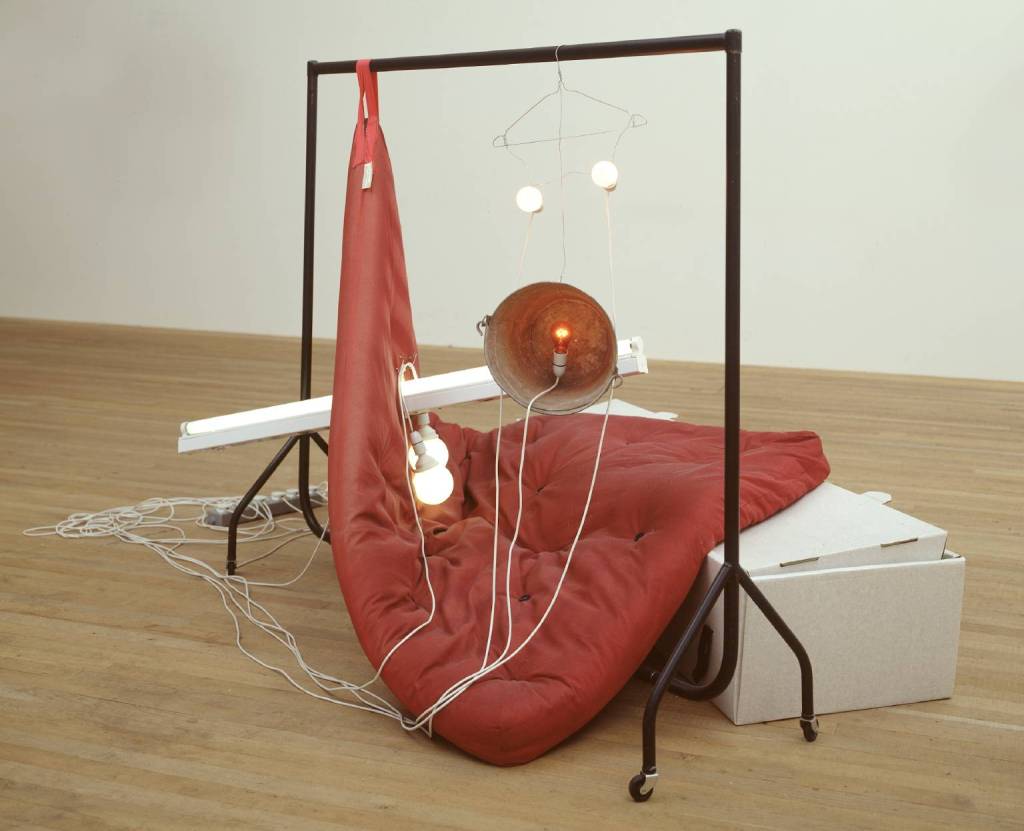
Sarah Lucas
Presented by the Patrons of New Art 2002
http://www.tate.org.uk/art/work/T07820
During earlier research of Combines, I reflected on the works of Kurt Schwitters (1887–1948). I was drawn to Mz 601 (1923), the meticulous layering of paper, fabric and everyday materials that suggested an in-grained self-control to convey calmness and order where there may otherwise be chaos.
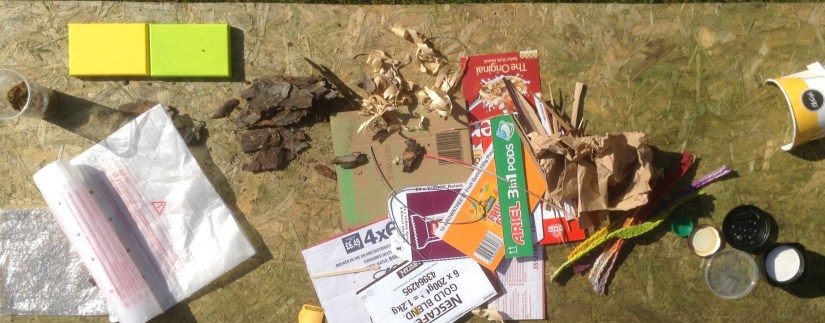
I started with a new table of objects that I had collated from my studio, garage, garden and recycling bin. Such items included weathered MDF board that had been stowed behind the garden shed for over two-years, wood shavings, cardboard, an old fence panel, bark, wire and dry waste (see figure 3).
Further to my research I did take inspiration from artist Jessica Stockholder, who talks about material as a paint, “I use material like paint … all materials have a particular quality like a brush stroke” (Jessica Stockholder in A world undone – Works from the Chartwell Collection, 2020).
AT this point I would like to say that I had a plan – but I didn’t. But I did have a concept to what I wanted to convey.
I started by painting the MDF board with an emulsion house paint and then immediately regretted doing so as it had covered the texture and grain of board. I set about washing it off with the pressure of the water from a hose pipe. As the sun was casting my shadow on the grass, I drew my own figure as the force of the water removed the paint (see figure 4 and 5).
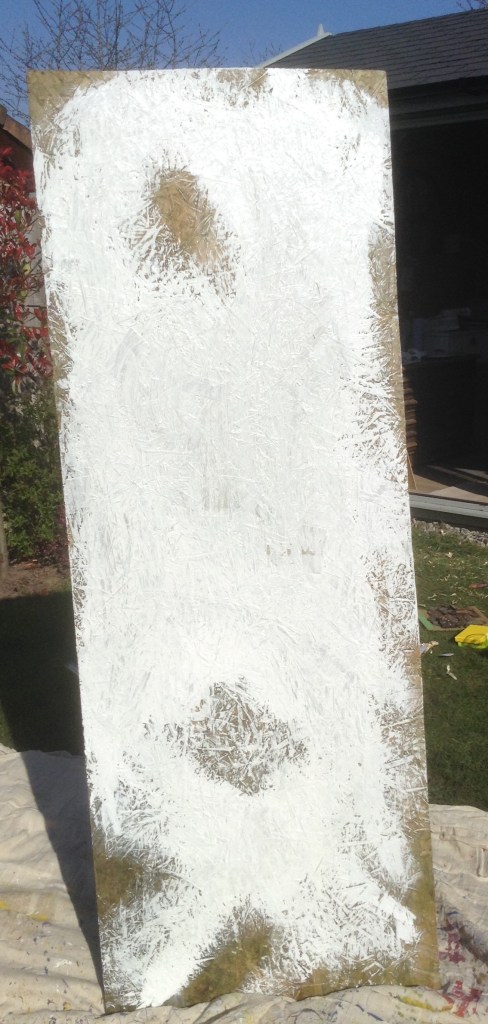
Fig. 4 
Fig. 5
With no sketches, no preconceived ideas or perception as to how this would turn out, I responded to the size, texture and grouping of materials to inform my decisions. This approach was far removed from my day job where I was required to identify risks and the secondary effect that actions or events may present. This was so liberating.
Taking stock and reflecting on what I wanted to convey, I attached wooden batons (the remnants of an old fence panel) vertically and horizontal to the bottom of MDF board, some of which extended beyond the edges to convey that this was not restricted to the boundaries of the frame. The boards conveyed confinement.
The cardboard boxes with commercial brands reflect the greed – the bulk buying, stripping supermarket shelves, with little or no regard for anyone else. I found this attitude of so many quite disturbing.
Who would have thought toilet rolls would have become such a scarce commodity. The queueing to rush the isles as stores and supermarkets opened their doors was akin to a black Friday deal – and all to buy toilet rolls. I have elevated the value of this consumable item by attaching it with wire and caging it behind secure fencing like a high security prison.

Fig. 6 
Fig. 7 
Fig. 8
The demand for prescription medicines resulted in Pharmacies being depleted of supplies. Routine medicines and pills were rationed like a country devasted by war.
The washers and coloured boards replicate money. Faceless values, yet everything has its price.
Objects were grouped like families, maintaining social distancing from other people.
Having completed my final piece I felt that I had responded to the current political, social and economic environment to create and innovative and spontaneous artwork.

65 x 178 cm
Reflection
To my surprise, I really enjoyed this part of studio practice. Exploring artists and artworks that I was perhaps familiar with from a distance (no pun intended) but had not taken the time to explore in detail due to my own preconceptions. Whilst I may have only skimmed the surface it has challenged my thinking and spawned ideas. When life gets back to normal, I will endeavour to see such works in person.
Shaking off my own inhibitions with each exercise, I manged to let my imagination run wild to be inventive and experimental. This was the first time I had experimented with such an array of mixed media for a single artwork. I don’t recall making art from found objects, using materials as paint, or creating a three-dimensional structure. For the first time I felt that I was developing my own voice by interpreting the brief and being prepared to fail.
The outcome was that I felt inspired and confident to experiment with found objects and materials as I would with paint. I have surprised myself!
References:
Mangini, E., 2019. Mario Merz. [online] Artforum.com. Available at: <https://www.artforum.com/print/reviews/201901/mario-merz-78015> [Accessed 20 March 2020].
Newyorkarttours.com. n.d. Mario_Merz – New York Art Tours. [online] Available at: <https://newyorkarttours.com/blog/?attachment_id=5410> [Accessed 21 March 2020].
Sadie Coles HQ. n.d. Sarah Lucas – Sadie Coles HQ. [online] Available at: <https://www.sadiecoles.com/artists/27-sarah-lucas/> [Accessed 27 March 2020].
Speronewestwater.com. 2016. Sperone Westwater Gallery. [online] Available at: <https://www.speronewestwater.com/exhibitions/mario-merz_9/installations> [Accessed 21 March 2020].
Tate. 2000. ‘Beyond The Pleasure Principle’, Sarah Lucas, 2000 | Tate. [online] Available at: <https://www.tate.org.uk/art/artworks/lucas-beyond-the-pleasure-principle-t07820> [Accessed 21 March 2020].
Review against Assessment criteria
Demonstration of technical and Visual Skills: Initially I struggled with my own inhibitions and methodical approach to work in general. As I progressed through each exercise, I felt that I had been able to demonstrate my technical and visual skills, to interpret the brief of the course handbook and develop my ideas with a degree of confidence. I particularly enjoyed developing ‘painting in the round’, based off my personal experience of working in Asia, and Assignment 2, in response to current affairs. I felt this demonstrated innovative and visual skills to work with available materials to produce a piece of work.
Quality of Outcome: I was both apprehensive and excited by the prospect of tackling the contemporary approach to still life. I felt that this was reflected in the progression and outcomes of my work. As a result, Assignment 2 was a natural response to the changing social and economic landscape, embracing creativity by chance, using found objects and seeing how spontaneous ideas developed to convey my emotional thoughts.
Conceptualisation of thoughts, communication of ideas: I had made a conscious effort to demonstrate my thought process through my sketchbook, but as I had mentioned previously, many of these ideas expand in the studio. That said, I hope that I have been able to demonstrate the conceptualisation of thoughts and progress through the exercises. Feedback from my tutor highlighted the need to narrow down ideas which I feel I managed to do without restricting creativity. Some of my work during Part 2 was developed from my time in Asia and is therefore personal to me. I am not sure how this would be interpreted by the viewer. In contrast, Assignment Two was my response to a global pandemic. It would be interesting to know this would be interpreted without explanation.
Demonstration of Creativity: I felt that I had used my imagination to explore and develop ideas, both in a thematic and responsive sense. This was the first time I had used such an array of mixed media in a single artwork or used found objects to assemble or combine in such a manner. I had been pushed way beyond the comfort of my own inhibitions which I hope is evident through my progress, culminating in Assignment 2.
Context: I feel that my research has been comprehensive and referenced in my learning log. Although time consuming – its value is evident.

