Explore the works Shen Wei and Tony Orrico and make notes on their approaches to work.
Shen Wei 沈伟 (b. 1968)
Renowned as an artist and choreographer Shen Wei relates similarities between the two artistic disciplines, noting that they both involve “space, timing, textures, quality”… “structures and rhythms… the flow and energy of movement”. (Burke, 2015)
Preferring to work on canvases up to 30 feet long he is able to create ‘big movements’ with the gesture and fluidity of a dancer. Unconstrained by the limitations of canvas size his work is dynamic, expressive and full of energy and movement. (Shen Wei, 2019).

Oil, house paint on linen. 79″ x 216″
In Shen Wei’s words, his studio is as a sanctuary for meditation and escape from the outside world where time to prepare mentally and physically becomes an important part of his process for creativity, expression and imagination.
For Wei, painting and dance are entwined either as inspiration or as a means to apply paint. He once commented that, “I have been studying and practicing how my energy and movement affect my brushstrokes, or whatever I use to touch the canvas, including my feet, my arms, my fingers, all my body parts,” Shen Wei says. “As a way to connect to the canvas, I like the energy of a human being … my human body touching something. It makes the paintings so alive. I am a dancer, I like to use my body for expression — why not work not just with the brush, but with my body?” (Levin, 2014)

Oil & Acrylic on Linen Canvas, 86″ x 392″
Shen Wei’s exposure to Chinese culture when growing up may have influenced his work, but his art does not conform to a recognisable style. Instead his creations are unified by his sensitivity to the expressive possibilities of gesture, colour and shape. This may explain why his art is often untitled – allowing the viewer to interpret without influence.
Before researching Shen Wei I was unfamiliar with the artist, although I did recognise his artwork. Understanding the artist’s personal mantra in fusing art and dance to become one, presents a different perspective to his work. This also goes some way to understanding why he works on such a large canvas, replicating the physical exertion of dance to create paintings. This is best demonstrated by Connect Transfer II, excerpts from which can be found on You Tube at this LINK. Dance and painting become one as dancers use sponges held in their hands, or rags attached to their feet to leave marks as they dance across the canvas. Some dancers are covered in paint, using their body as the tool to apply paint. The outcome is an abstract piece of work, marking the dancer’s movements and their interaction with the support. This is a remarkable form of art which I found both mesmerising and exhilarating.

(New York Times, 2008)
Tony Orrico
Tony Orrico is a visual artist, performer and choreographer who by combining a passion for dance and interest in drawing creates large-scale drawings by using his own body as a physical tool for illustration.
Orrico’s interest in performance stems from his background and earlier career in dance choreography and most recently he has been compared to a contemporary “da Vinci’s Vitruvian Man”. (Wade, 2019)
Orrico’s work includes Penwald Drawings, a series of bilateral drawings in which Orrico explores his body as a measurement tool and inscribes geometries through various movements. Lying face down to his paper support with a graphite stick clenched in each hand, he makes precise choreographed movements to create marks on the support. By utilising the symmetry of the body he produces either similar adjacent marks or a series of interlocking arcs describing. By rotating his body on a small arc, and moving his body position across the support, a large patterned series of marks are formed. A visual perspective of his performance can be found on you tube at this LINK.

From a personal perspective the beauty is in the performance and process which provides a contextual understanding of the artwork. I am not that I would have had the same feeling for the finished artwork had I not seen the conception. I would have loved to have witnessed the performance first-hand to truly appreciate to two elements as a whole.
Orrico’s Signs and Sybols continues to explore the relationships between movement and mark-making. In addition to using graphite he uses rope, reclaimed wood, foam, glue and plaster to sculpture and build frames to support, suspend, present, and intervene with his drawings. (Orrico, “Signs and Symbols”, 2014)
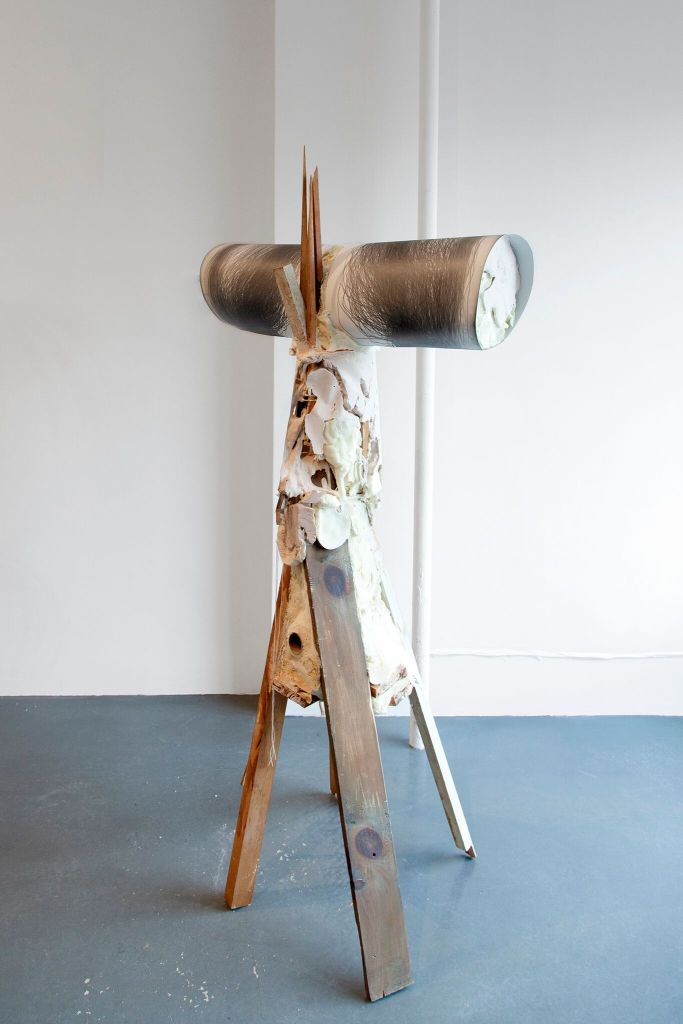
New York @ https://whitehotmagazine.com/
Creating an artwork with ones teeth may appear unconventional, but in 2015 Orrico did just that. Chewing an eight-by-eight-foot sheet of paper for eight and a half hours, creating marks with his teeth. Orrico explained “there’s personal backstory in my curiosity about the jaw… It started six months into my undergraduate dance studies at Illinois State University, when my jaw started dislocating several times a week. The first time it happened it really shocked me and landed me in the hospital. I couldn’t close my mouth. My chin was against my chest and I was stuck — wide open — for hours.” (Axton, 2015) Like Orrio’s other art works, I feel the viewer needs to understand the conception, or see the performance to fully appreciate the artwork. What is does demonstrate is that art can be created with many different mediums and many different tools.
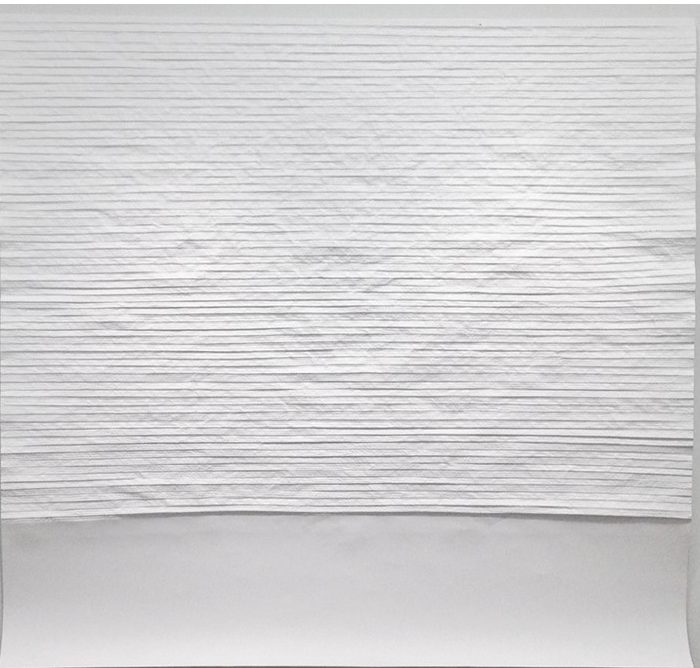
Courtesy of PPOW Gallery, NY @
Compare and contrast Shen Wei and Tony Orrico
Both artists combine dance, theatre, drawing and performance art to create in dynamic and physical manner to create their works. Whilst both choreograph their performances to one degree or another, the outcomes are different. Wei, through the flow and fluidity of dance creates a more abstract painting. Orrico is more measured and controlled, with deliberate strokes to create marks.
Both explore the boundaries of mark-making, choreography and improvisation, to present performative drawings.
Using the body as a tool (by laying on the paper) they create multi-dimensional and sculptural work, thus defying the conventional definition of drawing as a two-dimensional work.
Whilst there are similarities in the work, their approach and outcomes are individual and distinctive.
Heather Hansen
Heather Hansen is another contemporary performance artist and dancer. Like Wei and Orrico her dancing motions are captured on paper as she marks it with charcoal; creating a diagram of her seemingly ritual dance. Hansen invites observers to watch her dance and routinely performer in open public forums. She has also created a video called “Emptied Gestures” that features studio recordings of her graceful and dramatic work for those that cannot see it live.
Hansen says of her work, “Emptying Gestures is an experiment in kinetic drawing. In this series, I am searching for ways to download my movement directly onto paper, emptying gestures from one form to another and creating something new in the process” (Hansen, 2019)

References:
Axton, N. (2015). A Performance Artist Draws with His Teeth. [online] Hyperallergic. Available at: https://hyperallergic.com/241489/a-performance-artist-draws-with-his-teeth/ [Accessed 10 Jan. 2020].
At Judson Church, Performers as Paintbrushes, Steps as Strokes. (2008). The New York Times. [online] 6 Dec. Available at: https://www.nytimes.com/2008/12/06/arts/dance/06conn.html [Accessed 8 Jan. 2020].
Burke, S. (2015). Shen Wei: Making Art Move. [online] Dance Magazine. Available at: https://www.dancemagazine.com/making-art-move-2306957296.html [Accessed 7 Jan. 2020].
Crow Collection. (2014). Shen Wei – Crow Collection. [online] Available at: https://crowcollection.org/exhibition/shen-wei/ [Accessed 8 Jan. 2020].
Kisselgoff, A. (1983). DANCE VIEW; HOW DANCE AND OTHER ARTS INFLUENCE EACH OTHER. [online] Nytimes.com. Available at: https://www.nytimes.com/1983/01/16/arts/dance-view-how-dance-and-other-arts-influence-each-other.html [Accessed 7 Jan. 2020].
Levin, J. (2014). Chinese choreographer Shen Wei to debut painting & dance show during Art Basel Miami Beach. [online] miamiherald. Available at: https://www.miamiherald.com/entertainment/ent-columns-blogs/jordan-levin/article4167726.html [Accessed 8 Jan. 2020].
Shen Wei Dance Arts (2012). Connect Transfer excerpt. YouTube. Available at: https://www.youtube.com/watch?v=xGeXlD-1Pd0 [Accessed 8 Jan. 2020].
Wei (2014). Shen Wei. [online] Shen Wei. Available at: http://www.shenwei.art/performances-1 [Accessed 8 Jan. 2020].
YouTube. (2007). Shen Wei Dance Arts (Performance/Demonstration). [online] Available at: https://www.youtube.com/watch?v=sZMCk9f3J2o [Accessed 7 Jan. 2020].
Burke, S. (2015). Shen Wei: Making Art Move. [online] Dance Magazine. Available at: https://www.dancemagazine.com/making-art-move-2306957296.html [Accessed 7 Jan. 2020].
Hansen, H. (2019). Heather Hansen. [online] Heather Hansen. Available at: http://www.heatherhansen.net/ [Accessed 10 Jan. 2020].
Kisselgoff, A. (1983). DANCE VIEW; HOW DANCE AND OTHER ARTS INFLUENCE EACH OTHER. [online] Nytimes.com. Available at: https://www.nytimes.com/1983/01/16/arts/dance-view-how-dance-and-other-arts-influence-each-other.html [Accessed 7 Jan. 2020].
Lynn McGowan, B. and Becker, N. (2019). Orrico on the threshold: a review. [online] Whitehot Magazine of Contemporary Art. Available at: https://whitehotmagazine.com/articles/orrico-on-threshold-review/4139 [Accessed 10 Jan. 2020].
Orrico, T. (2017). Biography – Tony Orrico. [online] Tony Orrico. Available at: https://tonyorrico.com/biography/ [Accessed 10 Jan. 2020].
Wade, S. (2019). Meditative Large-Scale Performance Drawings By Tony Orrico – IGNANT. [online] IGNANT. Available at: https://www.ignant.com/2019/01/21/meditative-large-scale-performance-drawings-by-tony-orrico/ [Accessed 10 Jan. 2020].
Wei, S. (2014). No.6. [Oil, house paint on linen. 79″ x 216″] Miami, USA: Art Basel. http://www.miamiherald.com.
YouTube. (2007). Shen Wei Dance Arts (Performance/Demonstration). [online] Available at: https://www.youtube.com/watch?v=sZMCk9f3J2o [Accessed 7 Jan. 2020].
Illustrations:
Figure 1: Shen Wei Untitled No.6. (2014). Oil, house paint on linen. 79″ x 216”. Miami, USA: Art Basel. http://www.miamiherald.com.
Figure 2: Shen Wei Untitled No. 9. (2014). Oil & Acrylic on Linen Canvas, 86″ x 392″. http://www.shenwei.art/mdc
Figure 3: Jessica Harris of Shen Wei Dance Arts in “Connect Transfer II.”Available at New York Times (2008) Photo by Julieta Cervantes.
Figure 4: Tony Orrico, 8 Circles – Penwald (2014) 40″ x 26” Graphite on paper. Photo by Michael Hart.
Figure 5: Tony Orrico, A continued gesture towards us, solo exhibition of performance and graphite drawings — signs and symbols. (2019) www.signsandsymbols
Figure 6: Tony Orrico Prepare the Plane (2012). Performance, dental occlusions on paper 240 x 240 cm]. PPOW New York.
Figure 7: Heather Hansen, Heather Hansen (2019). . http://www.heatherhansen.net

