Sketchbook 1. Pages 32-35 | Sketchbook 2. Pages 21-26
The aim of Assignment 3 was to develop a series of pieces, based around the ideas, approaches and reflections explored in Part Three.
For this assignment I developed my initial mind-map in parallel to reviewing and reflecting on each exercise in part-three, including research, reading points, and finally a reflection on my tutors’ feedback from the previous assignments. (See slides below)
From my mind-map, I was drawn to ideas from across each exercise; the use of household everyday objects, personal identity, using my own body, distortion, layering and spatial awareness.
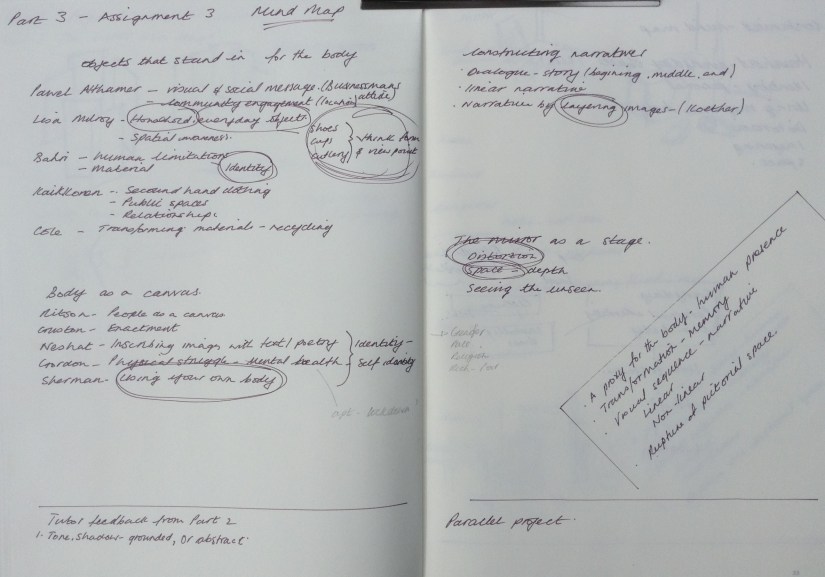
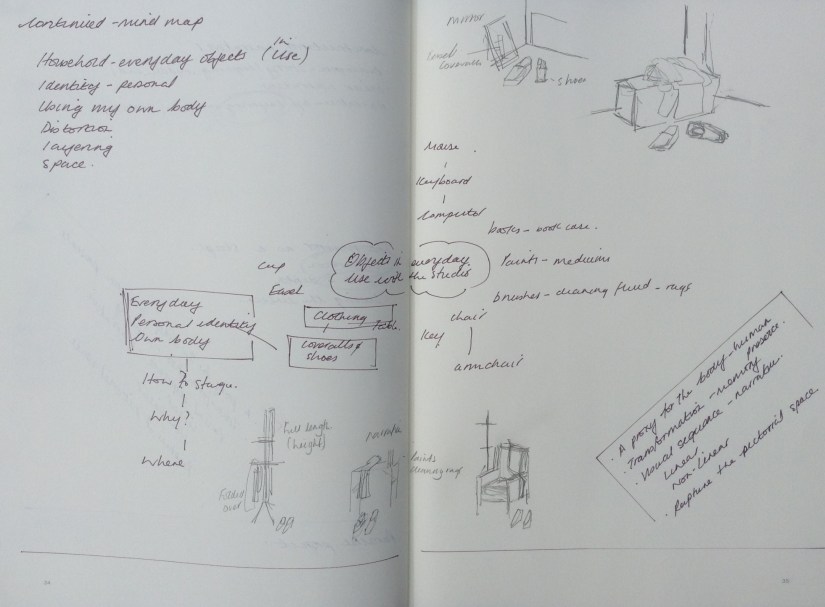
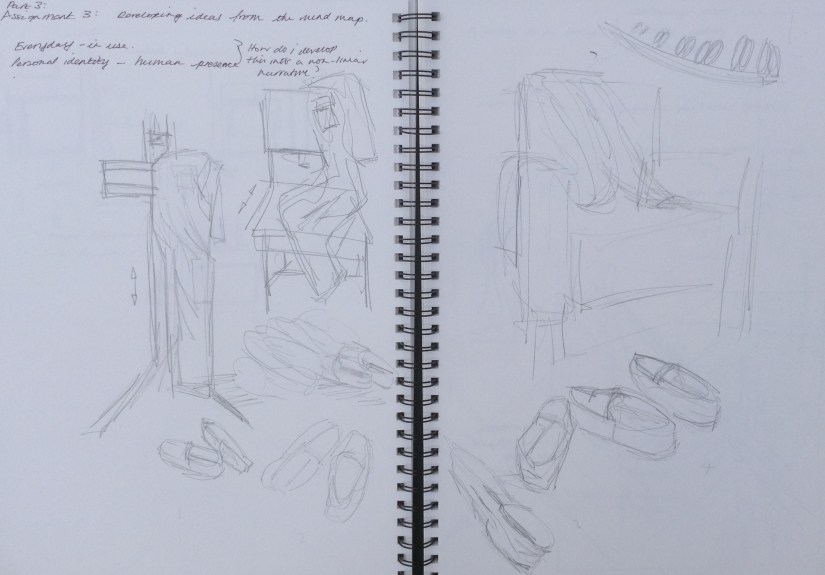
My tutor had previously suggested observing what was in my studio and how I might use this as inspiration to develop ideas. As this resonated with my initial ideas, mind-map 2 explored how I might develop this narrative further, especially objects acting as proxy or stand-in for the human body to signify human presence, or absence.
My art studio, paint splattered coveralls and loafer shoes, easel, armchair and painting materials all became the subjects of compositions as I worked through ideas in my sketchbook. However, when it came to taking these ideas off the page to develop the concept as a piece of artwork, it didn’t work. It was hard to identify one single reason as to why but a combination of staging, narrative and space were possibly contributing factors why I felt it important to go back to the drawing board.
During a previous exercise I had made a hat and scarf as props. Having made a new oversized scarf, I placed these around the garden in search of ideas, and more importantly – inspiration. During this process, I found myself lying on the grass under the rotary clothesline looking up towards the sky.
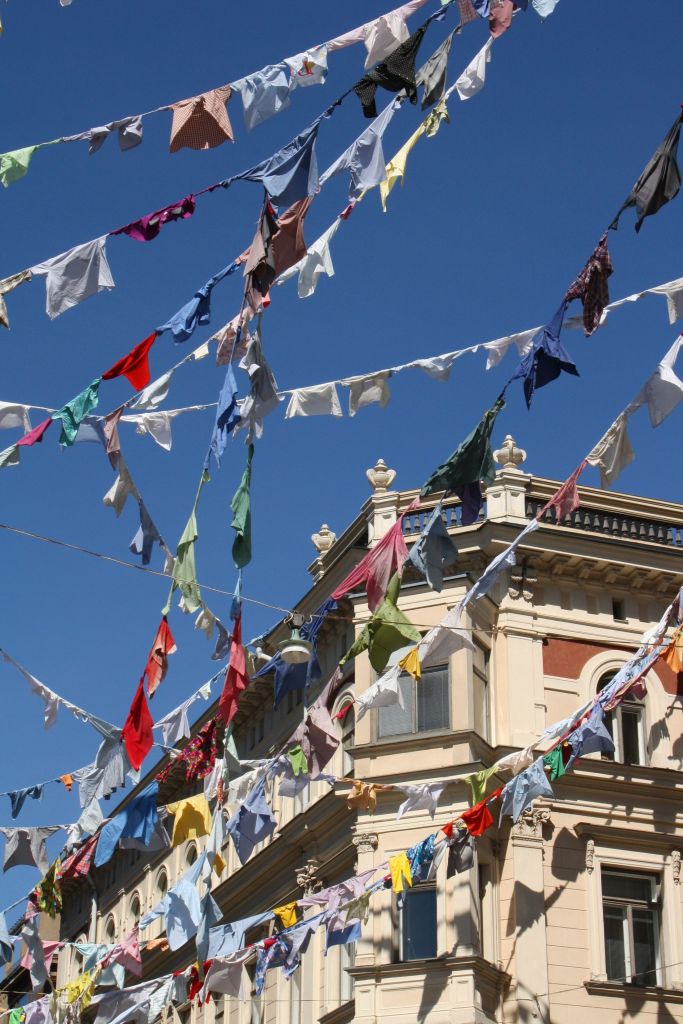
Whilst looking up through the clothes I contemplated on Kaarina Kaikkonen’s use of second-hand clothing to transform public spaces, and the relationship between the past and present (See figure 1). The idea of using clothing and how I might expand on this idea felt pertinent to the current global coronavirus pandemic and caught my imagination as a theme/narrative.
Pawel Althamer’s Self-Portrait as a Businessman (2002) explored themes of alienation and isolation. This was very pertinent to the current climate, a metaphor I used to reflect on a collapsed economy as the thousands of workers who were furloughed, and the self-employed who feel they have been hung out to dry.
I initially experimented with suits, but shirts and knotted ties hanging from coat hangers created a sense of individuality. In addition, with the slightest breeze of wind the shirts swirled and swayed freely like commuters rushing along crowed streets – with no clear direction of travel, as shown in this short video clip which I have called rushing nowhere.
In the process of composing some initial sketches I required a different viewpoint to obtain a more vertical angle. Resorting to my iPad, I took photographs which I later referenced to develop a series of charcoal studies (See figure 2).


Jutta Koether, talking about her work ‘Seasons and Sacraments’ shown at Dundee Contemporary Art in 2013, speaks about her approach of layering images one on top of the other (rather than in sequence, one after the other) as “a performance that only painting can do”.
During Project 3 I explored the use of a linear and layered approach to creating a narrative. The latter resulted in an abstract piece of work that I found visually and emotionally appealing and felt I could explore this further.
In the first of a series of studies I produced a line drawing using a charcoal stick and soft coloured pastels on a large sheet of fabriano paper measuring 85×52 cm. The intent was to simplify lines to create form. The criss-cross of straight lines (the rotary line) some of which connect to create geometric shapes, pulls the whole thing together as one drawing. These geometric shapes also create the illusion boundaries and the distortion of space and depth (See figure 3).
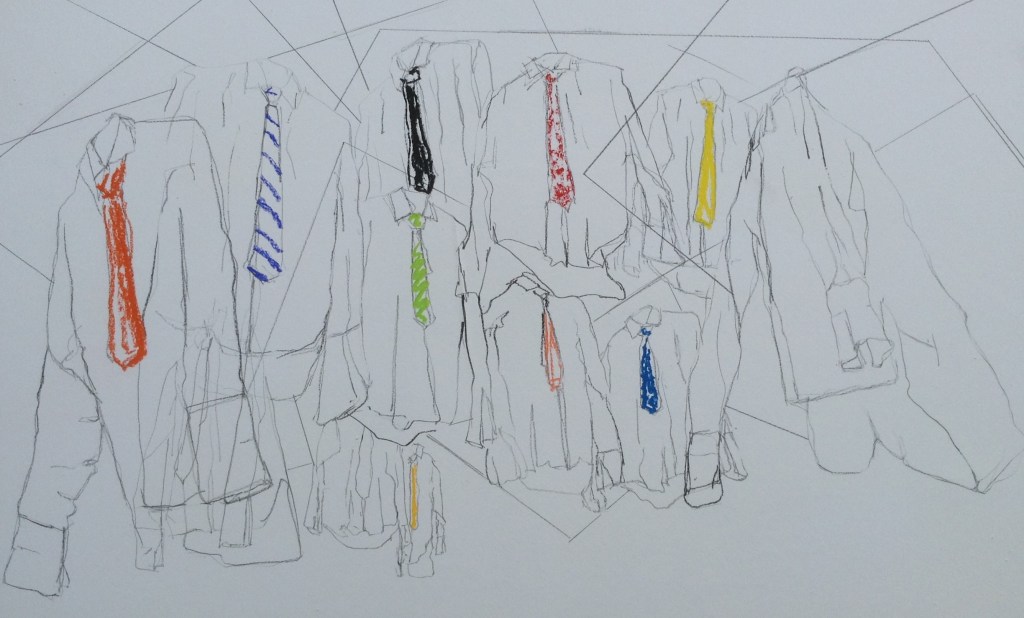
Charcoal and soft pastel on Fabriano paper
85×52 cm
To explore the themes of alienation, and isolation and the stand-in for the human body to signifying human presence or absence, my train of thought was to distort the lines between shirts, clothes line and sky (foreground, middle ground and distance) whilst merging the concept of a linear and layered approach.
Having previously stretched an oil paper support over MDF hardboard, once dry a blue acrylic wash was applied as an undercoat. Referencing my earlier studies and the pictures on my iPad I used a charcoal stick to make an outline sketch. Feint parallel lines helped to maintain a linear perspective (See figures 2 and 3).

Charcoal on oil paper 48×37 cm
Using the charcoal drawing as a template, oil paint was applied and removed as if it was a whiteboard – hence, it became somewhat of a muddy canvas (See figure 3).

Oil on oil paper 48×37 cm
As part of this series of studies I explored the outcomes of using different medium, including conté stick, charcoal, watercolour and acrylic paints. The support for this study was water colour paper stretched over MDF board.
With different coloured conté sticks I produce line drawings of each shirt. A white conté stick was used to create a barrier around the shirts and thereby restrict the bleed of colours when watercolour paint was applied.
Watercolour paints were applied using a #10 round brush. The intent was to keep the painting loose and create a sense of movement whilst the irregular angles of straight lines indicate the presence of a man-made physical structure (See figure 4).

Mixed media on watercolour paper, 56×39 cm
I decided not to produce a final painting as a focussed outcome for this body of work. Instead, I consolidated unresolved elements from the previous studies, which I used to feel my way through to resolve issues.
The support is oil paper stretched over MDF board. Once dry a blue acrylic wash was applied as an under layer. A limited colour palette of oil paints consisted predominantly of titanium white, French ultramarine, Parisian blue, cerulean blue and ivory back.
To create an outline of the shirts and frame of the rotatory line I used oil paint and a #4 flat brush. Using a wet-on-wet technique I built up the background, dragging paint into the middle ground to create an atmospheric perspective. Due to the angle of the viewpoint this has distorted the spatial between foreground and background.
A few days later, and still tacky to touch, tone and line was added to create further definition, along with colour to highlight each tie (See figure 5).
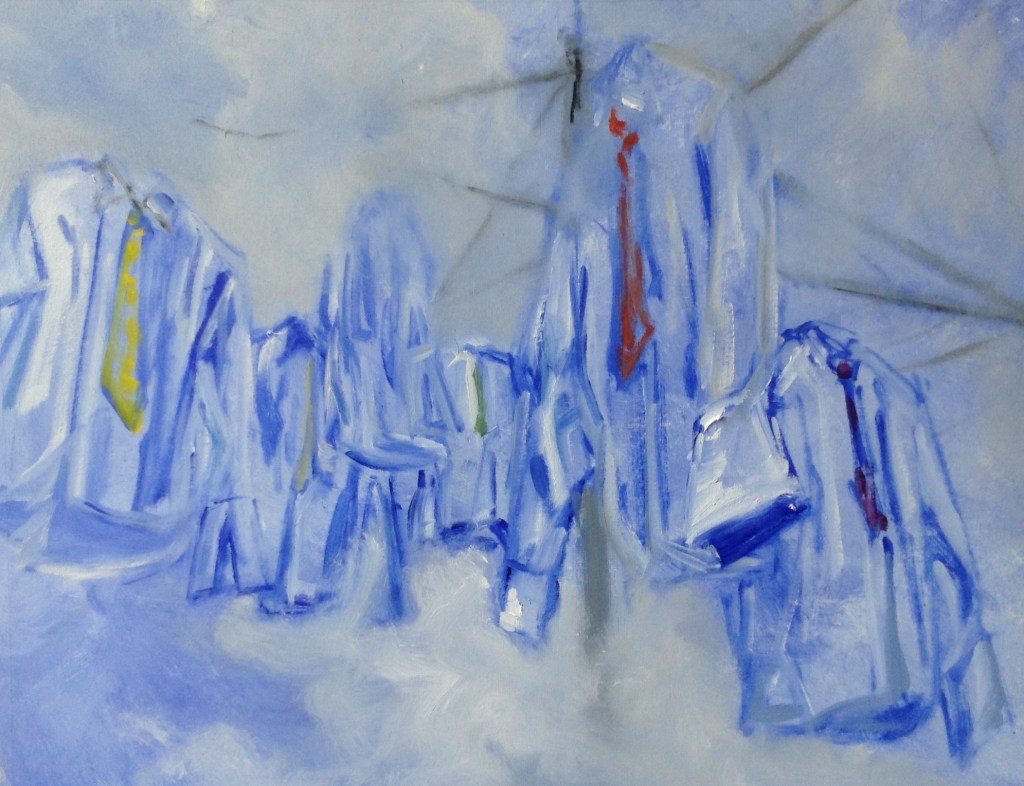
Oil on oil paper, 48×38 cm
Reflection
By using mind maps and preliminary sketches I was able to set the parameters and feel my way through a process to develop a series of works for assignment three. Reflecting on the works of artists such as Peju Alatis, Kaarina Kaikkonen, Jutta Koether and Pawel Althamer, I was inspired to look at imaginative ways in which to explore the concepts of identity, the use of my own body, and common everyday objects to create a narrative that implied the presence or absence of human form. The matter of absence of presence, emotions and memories is becoming a recurring theme in my thought process, both in the content of the course handbook and my parallel project. This in turn is shaping my essay.
My initial planning steered me to combining clothing and materials in my art studio. The placing of paint splattered coveralls across the stand of the easel or armchair engendered a narrative that in theory worked as a starting point. However, when it came to staging objects and composing preliminary sketches, I found that it was not working. It was hard to pinpoint any one reason but a combination of staging, narrative and spatial awareness were possibly contributing factors. There was no emotional connection, maybe it lacked a shared experience to evoke memories.
The theme of using objects as a stand-in for the human body to signifying human presence, or absence led me to reflect on a previous exercise where I had made a hat and scarf. Using wallpaper and mesh wire fencing I made another supersized scarf (approx. 8’ when laid flat). In the process of staging these objects in various poses around my garden, I found myself lying on the grass looking up through the clothes on a rotary clothesline. A light bulb moment!
Pawel Althamer’s Self-Portrait as a Businessman (2002) explored themes of alienation and isolation. I felt that this was pertinent to the current climate, people isolated at home, a collapsed economy, furloughed workforce and for some the feeling of being hung out to dry.
Hanging suits on coat hangers from the clothesline did not create the desired intent. However, it did lead me to using shirts, and then eventually shirts with different coloured ties, knotted as if being worn.
The prospect of replicating this in a more thematic setting, such as a street or bus stop was really appealing, although in the current circumstances, that was not an option. Conveying this narrative without written text may have been difficult so I took inspiration from Sillmans’s animation Draft of a Voice-Over and created a short video which was hyperlinked to the assignment blog.
Although my preferred medium is oil paint, I intentionally used different mediums for each study. These included a charcoal study using line and geometric shapes, watercolour and mixed medium, and an oil painting with a limited colour palette. The intent was to understand the effect each medium had on a coherent theme and how this might translate visual information. The strongest was the oil painting, but this may be a conscious bias.
I was pleased with the process and outcome of this assignment as a series of studies. The concept of layering and distortion in an abstract manner created atmosphere, which I felt could be incorporated in other works, such as the parallel project. Having a personal or meaningful connection with my artwork, be that the objects, an experience or a memory is another aspect that appears to have developed naturally in my artwork. I feel that this reveals a strength in my artwork as I something that I am keen to retain and develop.
References
AFRICANAH.ORG. 2020. Peju Alatise – AFRICANAH.ORG. [online] Available at: <https://africanah.org/peju-alatise-2/> [Accessed 5 May 2020].
Contemporary-african-art.com. 2020. Contemporary African Art, Issue #003 — Wrapture – In Western Nigeria A Cloth Is Called A ‘Wrapper’. [online] Available at: <https://www.contemporary-african-art.com/Contemporary_African_Art-African-Art-newsletter3.html> [Accessed 6 May 2020].
Kaarina Kaikkonen. 2020. Kaarina Kaikkonen. [online] Available at: <https://kaarinakaikkonen.fi/> [Accessed 6 May 2020].
Smith, S., 2016. Francis Bacon: Creating Order From Chaos. [online] the Guardian. Available at: <https://www.theguardian.com/artanddesign/2016/jun/24/francis-bacon-catalogue-art-historian-stephen-smith> [Accessed 5 May 2020].
Review against Assessment criteria
Demonstration of technical and Visual Skills: By interpreting the brief of the course handbook, I felt that I was able to develop ideas that demonstrated both technical and visual skills. I really enjoyed project 2 – becoming an image, despite my initial reservations. Creating an image whilst trying to visualise how my own body and a directed light source could be integrated to create the illusion of a three-dimensional enactment was technically challenging, and certainly tested my visual skills. I also enjoyed Assignment 3 – reflecting on the exercises from part three and developing a series of studies. The process of experimenting with readymade everyday objects and clothing to create a composition and narrative, that felt pertinent to the current political, social and economic landscape took me on a journey that extended my technical and visual skills. The outcome was a series of works and video clip. This is the first time that I had used a video medium to support my studies. Being confined to one’s own property has presented several challenges, but also opportunities to demonstrate technical and visual skills in a more creative manner
Quality of Outcome: I was content with the quality of outcome for the assignment, and most exercises. Given the apprehension I had for tackling project 2 – becoming an image, I was delighted with the outcome. The painting, staging and lighting culminated to produce a realistic enactment whereby I felt part of the scene. In complete contrast I found it difficult to apply myself to project 4 – reflective surfaces and framed views. This is reflected in the quality of outcome, which although disappointing, I did not have the time to dwell on this failure. That said, this unsuccessful exercise did generate ideas that I was able to take forward to Assignment 3. I was particularly pleased with the series of studies developed during Assignment 3 – which took many twists and turns before the ideas materialised beyond the pages of the sketchbook.
Conceptualisation of thoughts, communication of ideas: I feel confident in using my sketchbook in a manner that allows me to develop ideas that reflect of my though process. It’s not always neat or very pretty but it communicates the development of ideas from the sketchbook to the canvas. I really enjoyed the challenge of thinking through ideas and how these might be portrayed – and as previously articulated, not all good ideas make it off the pages of the sketchbook. Using
Demonstration of Creativity: Assignment 3 presented an opportunity to develop on the ideas, approaches and reflections explored in Part Three. By setting the parameters using a mind map I felt that I was able to be creative both in a thematic and responsive sense. Subsequently, I used my initiative and imagination to develop these ideas to explore the composition of materials to create a sense of human presence or absence. Mindful that I am now developing a self-awareness as to what stimulates and interests me artistically, I see materialising through my parallel project.
Context: Throughout this module I have conducted comprehensive research and studied the works of other artists, which are referenced in my learning log. This is a proven means to help my learning and has no doubt provided sources of inspiration from which to develop my own ideas, notably during part three are the works of artists Peju Alatis, Kaarina Kaikkonen, Jutta Koether and Pawel Althamer. With greater exposure to such artists’ works I felt that this continues to underpin my personal development. I have been able to critically appraise my own personal development whilst continuing to develop my own personal voice.

