Think about areas of your practice that you would like to develop further. Visually map out initial ideas using your experience of the previous exercises to help think about possibilities for a self-directed project. Identify at least 3 possible routes that this project could take. Think about what you might do rather than what you think you will create; remember you are mapping out possibilities not outcomes.
Visual Mapping
During the process of thinking through the structure for the parallel project, several threads started to emerge, such as texture, scale, layering, process and perhaps most significantly, that of identity or a personal connection. The latter is shaping my critical review.
Keeping an open mind as my project evolves, I have contemplated how identity and/or past significance might be translated in my work. A physical act; movement and mobility such as the artists Rebecca Horn or Tony Orrico. Equally, using the body or body parts, such as Yves Klein or Jenny Saville, or the body as the canvas akin to Antony Gormley.
A personal connection could also be a state of mind or response to something (good or bad). Consequently, the outcome may be unpredictable, gestural, irrational, or calm and considered. This led me to consider the element of control – and how much control did I want (or need) over the outcome. The influence of technology, music, hypnosis or even an image that could be painted over such as Gerhard Richter’s overpainted photographs.
The thought process of initial mind-mapping can be viewed below. Going forward I now need to narrow my thoughts as to what I might do and then expand my research.
Sketchbook 3. Pages 1-4


Reflection and research
Review your documentation of the process so far; have you recorded and reflected on the materials, equipment, methods and sources you have used? Does your sketchbook and learning log reflect your decision making process as you navigate your way through this project?
Since scoping potential ideas for a parallel project, it somewhat stalled because of everyday life and having to re-submit practice of painting 1 for digital assessment. Suffice to say that this reflective exercise came at a convenient moment to re-engage and reflect on what I had done so far, and more importantly, understand where and how the project would develop.
A combination of coursework projects, experiments and research helped shape my ideas and although the process had been challenging, I sensed emerging themes in material memory through my travels and the implied presence of human form through objects and materials. Whilst I had by no means resolved the dilemma, the field of view was narrowing to a point from which to develop ideas through sketches and small studies.
To locate this Parallel Project in the broader context of the course I reviewed mind maps, tutor feedback and previous coursework. Previous experiments, the use of materials, tools, mediums and techniques were also revisited. What had I enjoyed and what could (and would enjoy) developing further?
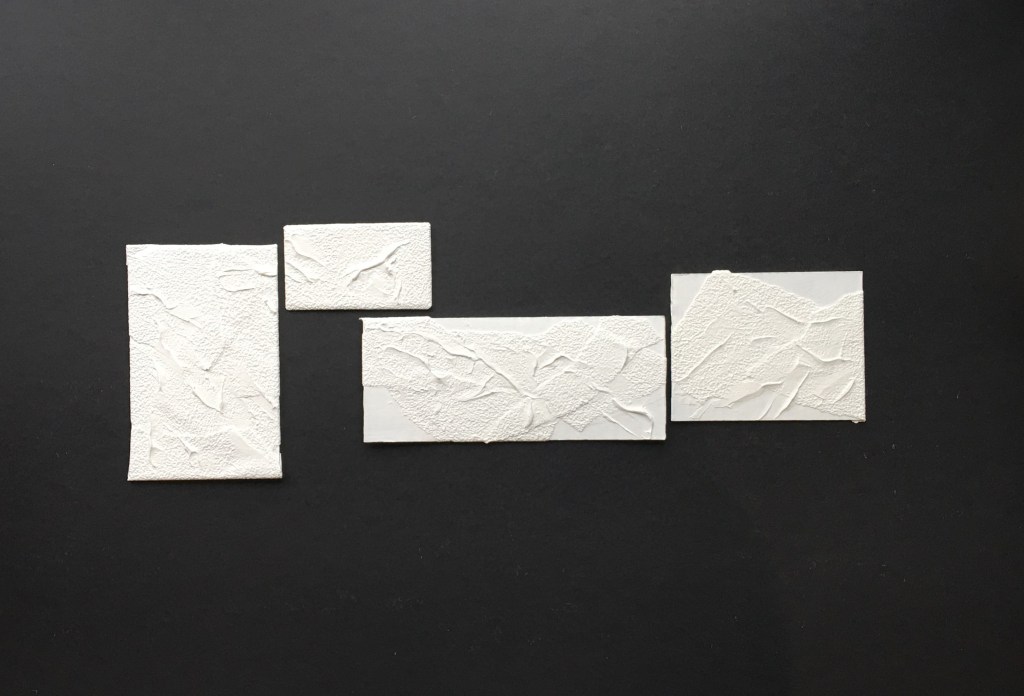
I had become somewhat immersed in the use of textured wallpaper lining (textured and not patterned). Used with other media, such as modelling paste it creates a tactile texture that reminded me of the scorched earth and mud huts I had encountered on my travels in East Africa. A somewhat romantic view of a tough existenc (see figure 1).
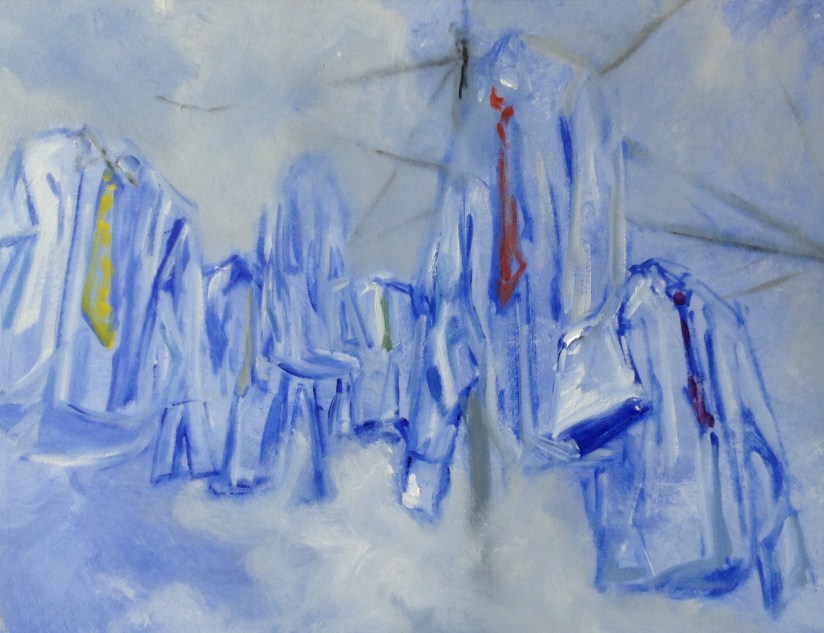
During Assignment 1 I had used an electric drill fitted with different tools to apply paint. It explored mark making and the amount of control an artist has on the outcome. The larger pieces conveyed a galactic translucency and spatial form that I felt suggested a fleeting spiritual presence, like a gust of wind through a subway, or feeling a cold chill on your body for no logical reason. This was heightened further by the scale of the support (see figure 2).

Mixed medium on paper 170×100 cm
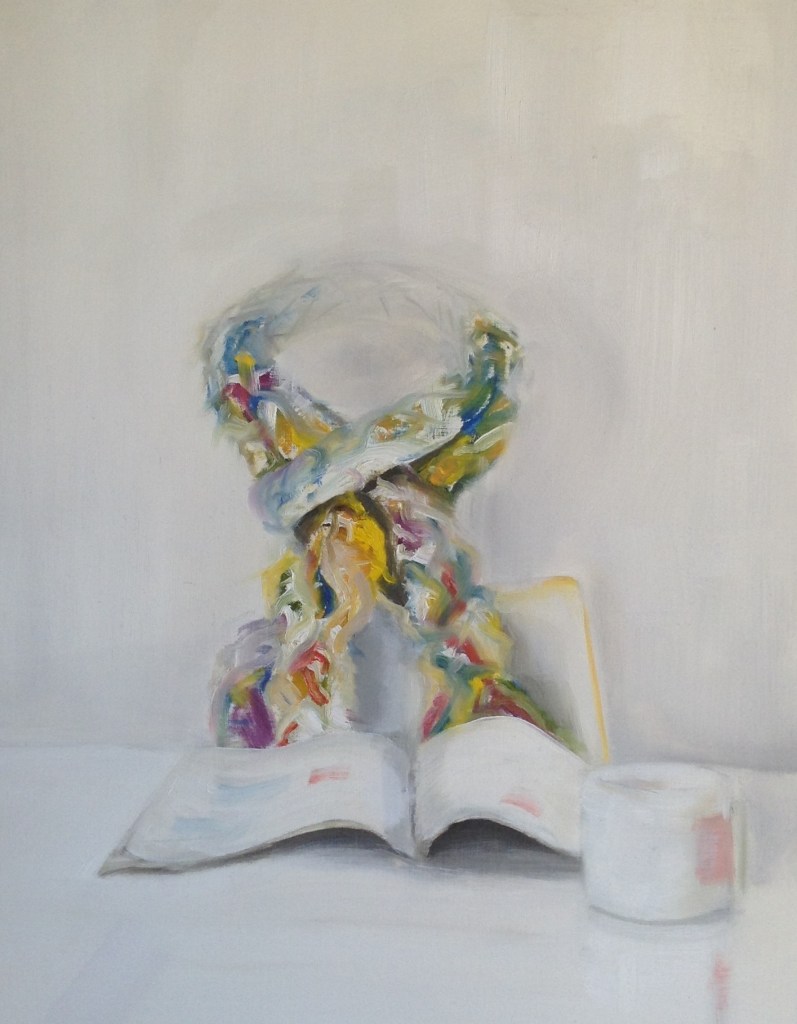
During Assignment 3 I explored the concepts of identity, the use of my own body, and common everyday objects to create a narrative that implied the presence or absence of human form. I felt that the outcome conveyed a sensitivity through my loose handling of materials; a style which was becoming evident in my work and one I was keen to retain and develop further (see figure 3).
Oil on oil paper, 48×38 cm
In creating an object as a stand in for the body (project 3) I once again used objects that I had used on my travels as the source of inspiration. The process of creating and working from props can be found at this link whilst the final outcome is enclosed as figure . In addition to creating props that signify human presence I also felt the setting (at the dining table) and other props enhanced this illusion. On reflection, the composition was too central to the picture plan (see figure 4).
Oil on canvas
49×37.5 cm
The colour exercise in Part 4 added a different element – a three-dimensional colour chart. I really enjoyed the process of creating an image using rectangle blocks of colour. Spatial uniformity, shadows and viewpoint combined to create a three-dimensional form (see figure 5).

Further research of the artworks of Kaarina Kaikkonen and her use of used clothing to create installations, Liz Rideal’s Touch and Identity and Mike Ryczek’s interiors that appear dismantled and reassembled to make sense of their contents have added further context from which to explore ideas. This led to discovering other artists and artworks, such as Ana Mendieta, Matteo Lucca and Chiharu Shiota.
Chiharu Shiota (b. 1972) is a Japanese performance and installation artist. She draws on personal experiences, emotions and memories to represent what it means to be human. The emotional presence of real people is loud and vibrant – despite their physical absence. Spanning sketchbook to conception and installation she encourages the viewer to explore and reflect on their own personal experiences, emotions and memories. It becomes personal to the viewer (see figures 6 – 8.
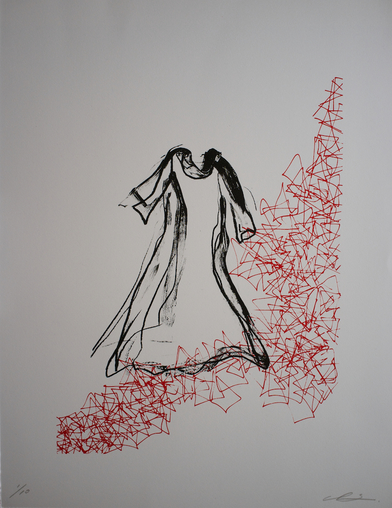
https://www.artsper.com

Images courtesy of the artist, SCAD Museum of Art, and Blain | Southern, Berlin


Steel, wood, dress
250 x 160 x 140 cm (98 3/8 x 62 7/8 x 55 1/8 in.)
https://www.invaluable.com
Studies and development
Understanding what conveys human presence, emotion and memories is what I was left toiling with. Was it colour, texture, intimate or common objects or my own artistic brush marks? Having spent many years working in remote parts of the world with few home comforts I had contemplated if I was seeking to capture and express this through my art. By producing a series of small studies that combined these elements along with techniques and methods used previously, I started to investigate how each might enhance or detract from this theme (see figures 9 – 11).
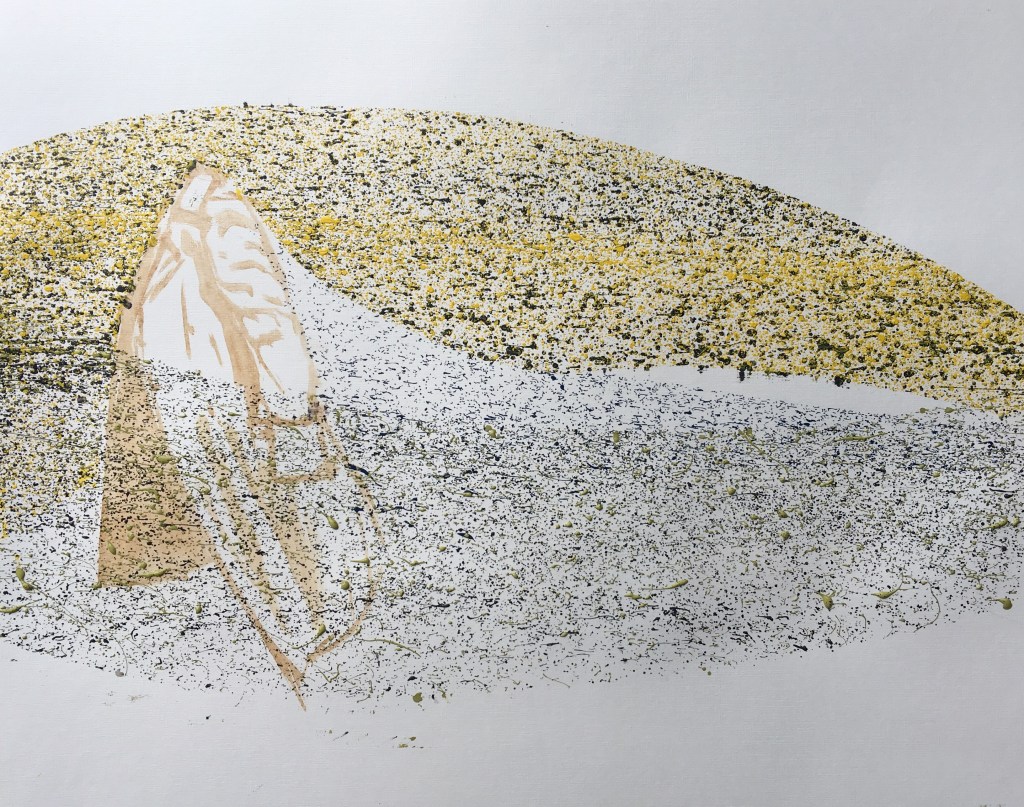
Fig. 9 
Fig. 10


Consideration had also been given to how my work might be viewed; the lighting, dimensions of artwork, how it might be hung and even the room. With so much still to explore I felt that ideas should remain fluid, hopefully becoming clearer as I start to develop this project and produce pieces for a major project at level 3.
Planned visits to galleries and exhibitions had been postponed until further notice, and although the internet is a wonderful tool, it is by no means a replacement for seeing artwork in the flesh.
Sketchbooks
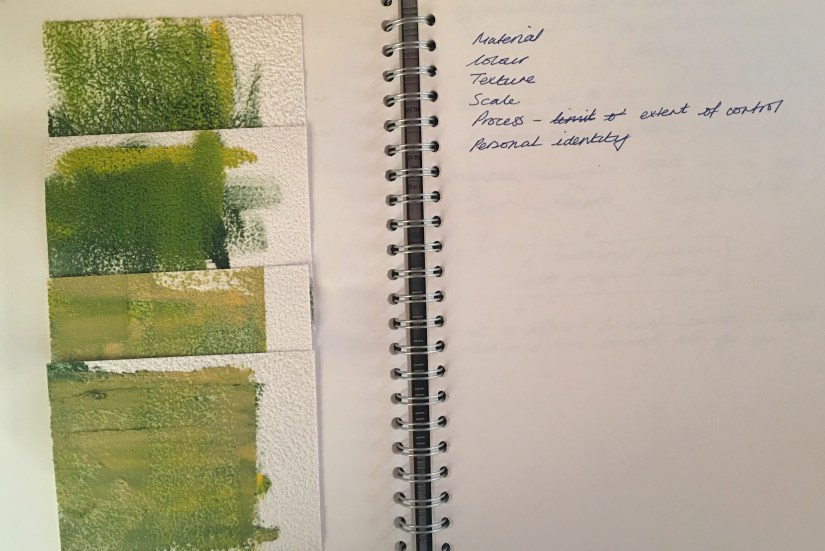
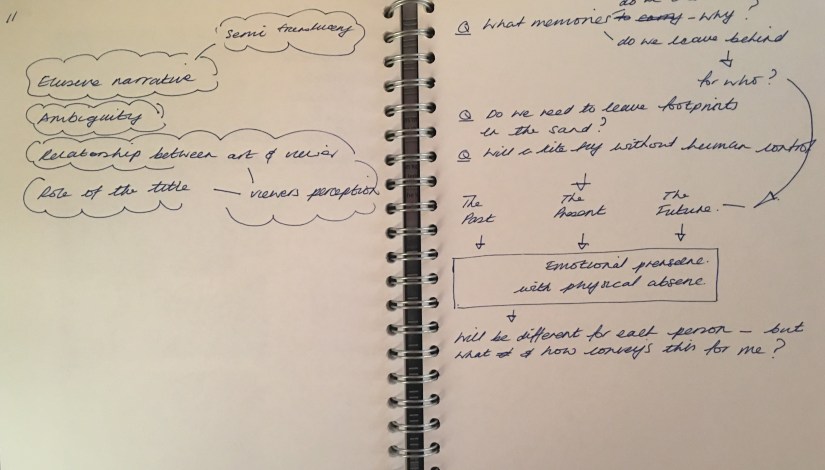
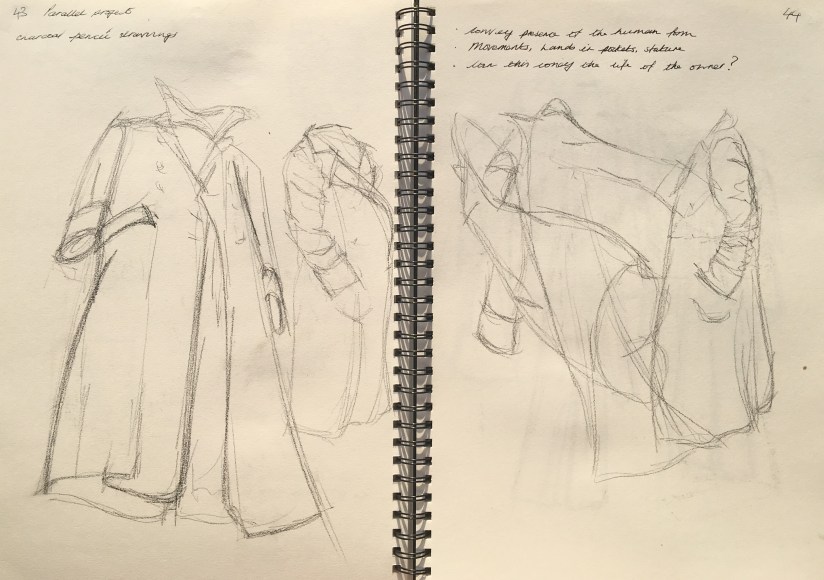
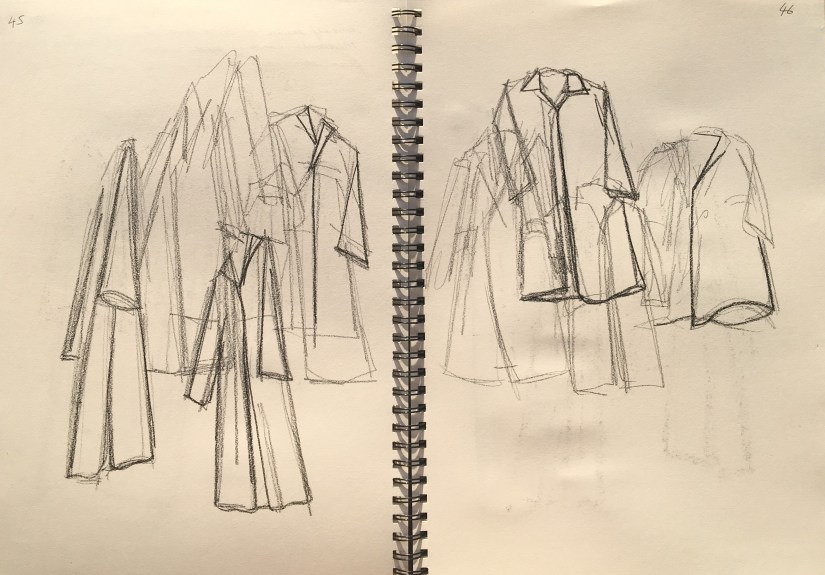
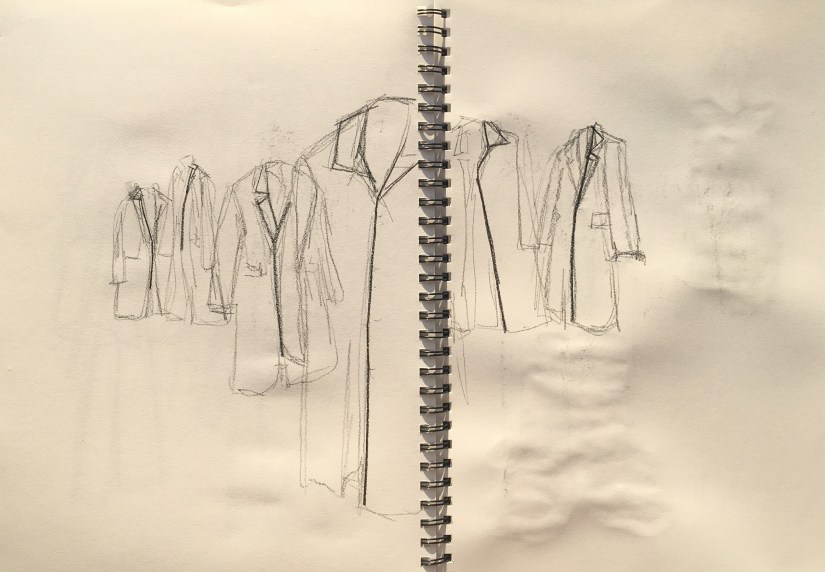
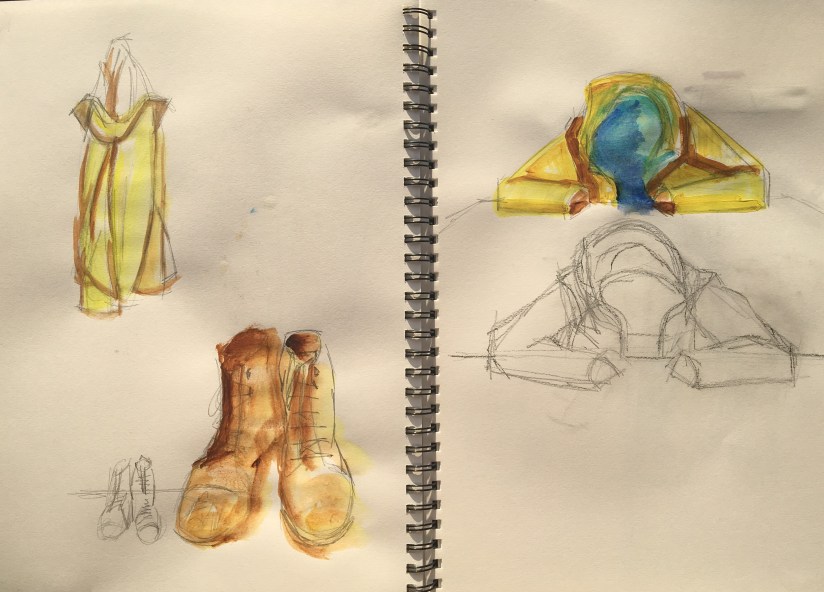
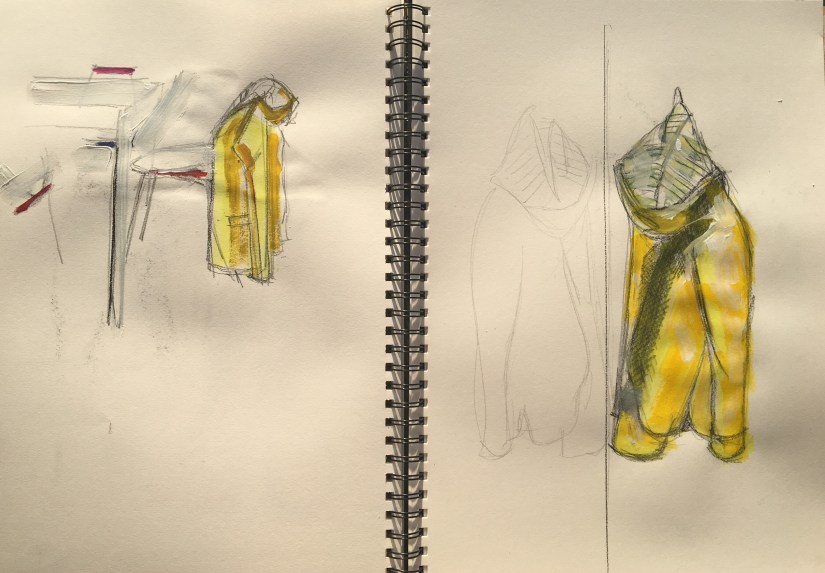
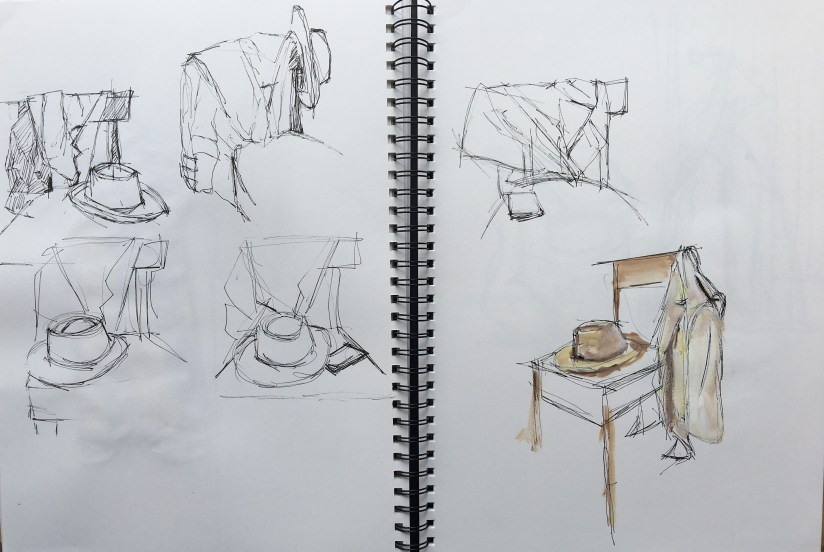
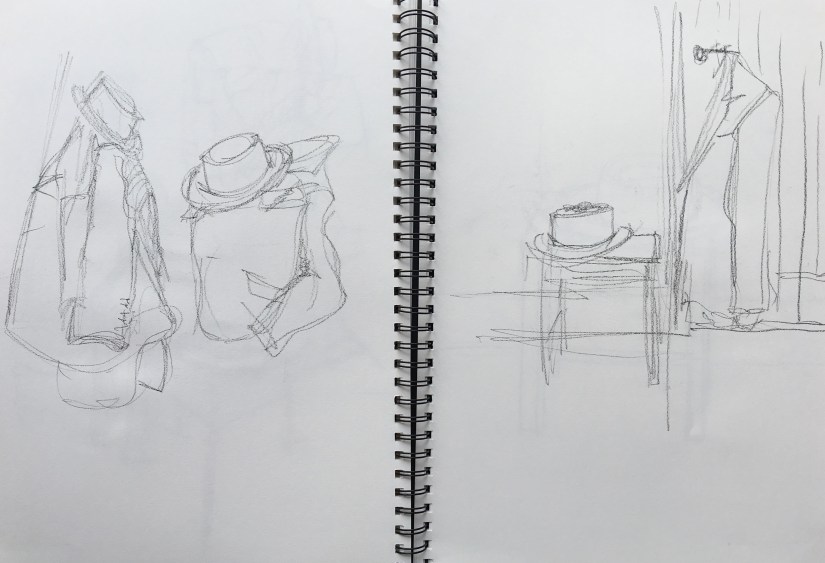

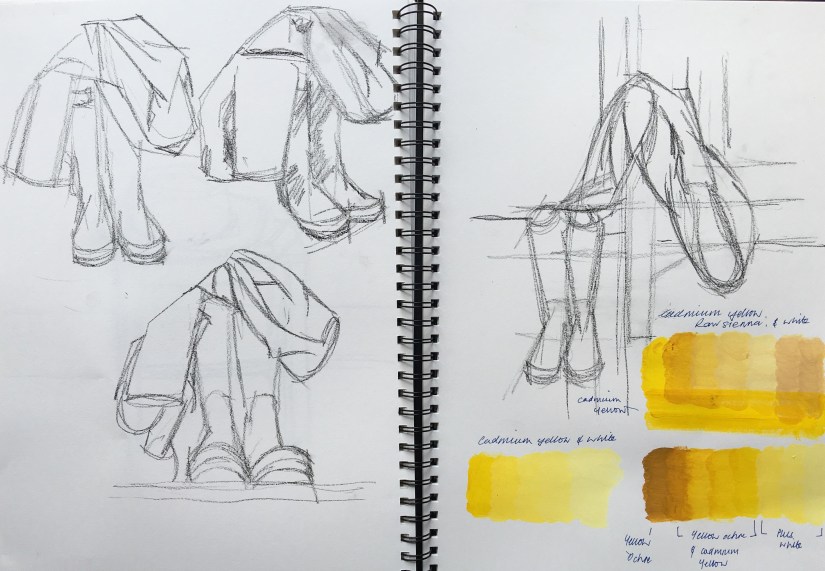
Developing studies
An aspect of my parallel project that had been a tenet throughout was the space in which the subject inhabits. In this case the space around the subject becomes key to contextualising the narrative of human presence in its absence. However, as spatial awareness relates to knowing where your body is in space this needed to be in relation to objects or other people.
To try and understand what creates a presence through absence further research led me to artists such as Siebren Versteeg, Naomi Safran-Hon and Nancy Spero who reflect on cultural and historic events to convey displacement, loss, and struggle toward acceptance, and the artist Riitta Päiväläinen who uses garments to create installations from which to produce images (see figure 12). As a painter I also looked at the works of artist such as Alison Watt, Andrew Mcneile Jones (see figure 13) and Maggie Sinner to understand how they arrange garments or material, and how this communicates absent presence of a human life. In an online video, Alison Watt reflects on how her painting female nudes led on to a series of works exploring the properties of fabric to convey absent presence – an aspect I wanted to capture and convey.

100 x 125 cm, ed 7, c-print/ Diasec
Image available at http://riittapaivalainen.com

Oil , 50.80 x 73.66 cm
Image available at https://artgallery.co.uk
My research helped clarify my thought process; the use of used garments, the setting, positive and negative space to create spatial awareness to communicate absence, and retaining my own artistic style.

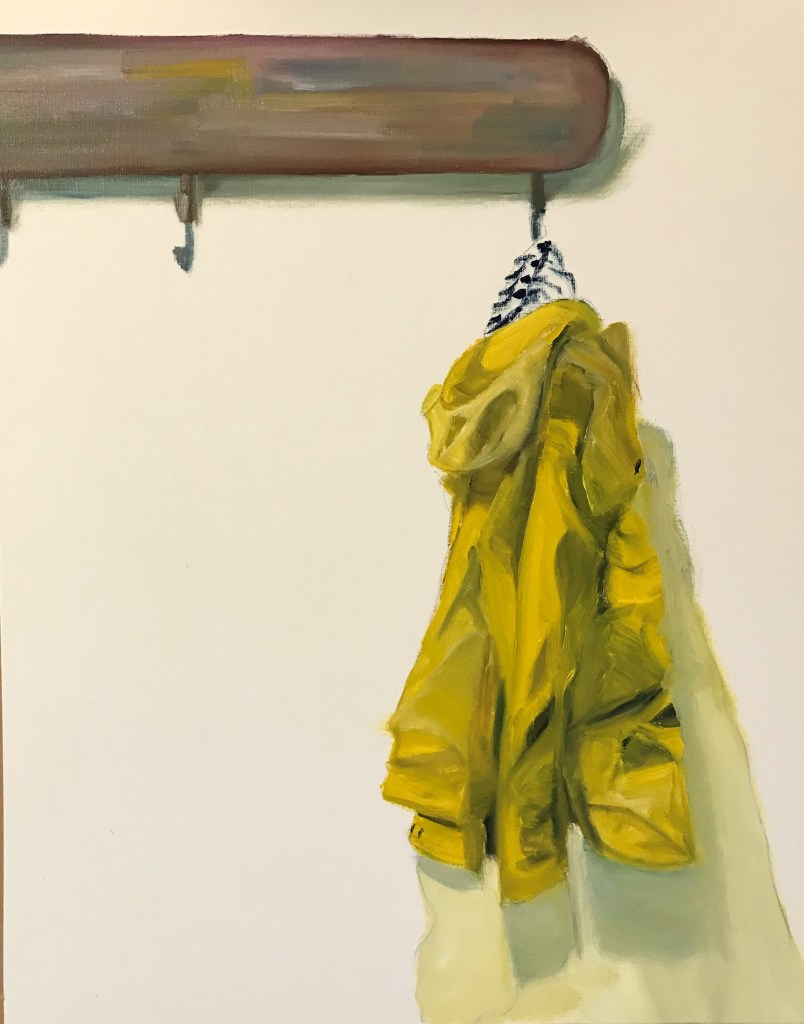
Oil on canvas
37.72 x 48 cm

Oil on canvas
47.90 x 37.80 cm
By mapping and recording my progress and reflecting on the work of other artists, I was able to conceptualise my thoughts to develop ideas. As a body of work, I felt that it demonstrated technical and visual skills through my handling of paint, use of colour, tone and shadows, and a composition that might evoke a dialogue with the viewer, regardless of interpterion. It is my intent to continue to develop this cannon either parallel to my next level 2 course or during level 3.
References
Chang, E., 2019. Esther Chang’s Ukiyo Translating Human Presence Into Non-Figurative Subjects – Numeroventi. [online] Numeroventi. Available at: <https://www.numeroventi.it/esther-changs-ukiyo-translating-human-presence-into-non-figurative-subjects/> [Accessed 2 August 2020].
Evans, S., 2017. Howard Hodgkin: Absent Friends At The National Portrait Gallery – The London Magazine. [online] The London Magazine. Available at: <https://www.thelondonmagazine.org/howard-hodgkin-absent-friends-national-portrait-gallery/> [Accessed 19 August 2020].
Halvorson, J., 2011. Presence Within Absence. [online] Scholarworks.rit.edu. Available at: <https://scholarworks.rit.edu/cgi/viewcontent.cgi?article=4312&context=theses> [Accessed 12 September 2020].
Helsinki School, 2020. Riitta Päiväläinen. [online] Helsinki School / Person Projects. Available at: <http://www.helsinkischool.fi/artists/riitta-pivlinen?x=texts&article=282> [Accessed 17 September 2020].
Jazayeri, A., 2020. Absent Presence. [online] AucArt. Available at: <https://www.aucart.com/artwork/absent-presence/> [Accessed 19 October 2020].
Kaikkonen, K., 2018. Kaarina Kaikkonen Interview: A Father, A Mother And A Child. Available at: <https://vimeo.com/268764422> [Accessed 7 October 2020].
Päiväläinen, R., 2014. About – Riitta Päiväläinen. [online] Riittapaivalainen.com. Available at: <http://riittapaivalainen.com/htdocs/about/> [Accessed 12 September 2020].
Mills, J., 2016. Paintings Create Their Own Reality. [online] Jennifer-millsartist.co.uk. Available at: <https://www.jennifer-millsartist.co.uk/?lightbox=dataItem-jqzl9ejk> [Accessed 2 August 2020].
Rosenfed, I. and Porcini, I., 2011. International Contemporary Sculpture. [online] Galleryrosenfeld.com. Available at: <https://galleryrosenfeld.com/usr/documents/publications/publication_document/2/memory-catalogue-low-res-1.pdf> [Accessed 2 August 2020].
Shiota, C., 2020. The Theatricality Of Chiharu Shiota’s Art | Brilliant Ideas Ep. 52. [image] Available at: <https://www.youtube.com/watch?v=ULpxdHy0eZc> [Accessed 7 October 2020].
Tarasyuk, J., 2020. Chiharu Shiota: Presence In Absence | COBO Social. [online] COBO Social. Available at: <https://www.cobosocial.com/dossiers/chiharu-shiota-presence-in-absence/?utm_campaign> [Accessed 19 August 2020].
Vasvani, B., 2020. Chiharu Shiota – Drawing An Interior Universe | COBO Social. [online] COBO Social. Available at: <https://www.cobosocial.com/dossiers/chiharu-shoita-interior-universe/> [Accessed 9 September 2020].
Waganari, M., 2020. Wire Sculptures Forming Illusionary Shadows By Moto Waganari – Art-Sheep. [online] Art-Sheep. Available at: <https://art-sheep.com/wire-sculptures-forming-illusionary-shadows-by-moto-waganari/> [Accessed 2 August 2020].
Watt, A., 2020. Video Transcript | Alison Watt | Absent Presence. [online] Nationalgalleries.org. Available at: <https://www.nationalgalleries.org/sites/default/files/transcriptions/Alison%20Watt%2C%20Absent%20Presence.pdf> [Accessed 19 October 2020].
Illustrations
Figure 1: Own image
Figure 2: Ibid
Figure 3: Ibid
Fifgure 4: Ibid
Figure 5: Ibid
Figure 6: Shiota, C., 2015. Infinity Lines. [image] Available at: <https://www.cobosocial.com/dossiers/chiharu-shoita-interior-universe/> [Accessed 28 October 2020].
Figure 7: Shiota, C., 2011. State Of Being (Metal, Black Threads And Dress). [image] Available at: <https://www.invaluable.com/auction-lot/chiharu-shiota-nee-en-1972-state-of-being-dress-2-8-c-88e41ea817> [Accessed 28 October 2020].
Figure 8: Own image
Figure 9: Ibid
Figure 10: Ibid
Fifure 11: Ibid
Figure 12: Päiväläinen, R., 2002. Vespertine II, 100 X 125 Cm, Ed 7, C-Print/ Diasec. [image] Available at: <http://riittapaivalainen.com> [Accessed 28 October 2020].
Figure 13: Jones, A., n.d. A Place In The Sun, Oil , 50.80 X 73.66 Cm. [image] Available at: <http://artgallery.co.uk> [Accessed 28 October 2020].
Figure 14: Own Image
Figure 15: Ibid
Figure 16: Ibid

