Explore Vincent Katz’s article for perspectives on Rauschenberg’s collaborations with musicians and dancers.
Do the Combines remind you of work by other artists? Kurt Schwitters, John Latham, the Dadaists and the Surrealists may be artists and movements you would like to investigate further. The contemporary artist Richard Tuttle works across the disciplines of painting, sculpture, textiles, printmaking and poetry, bringing together paint, ready-made and collage elements.
Let’s Do It Together, Vincent Katz insight into Robert Rauschenberg collaborations with other artists, performers and musicians of his time, explores the merging of genre’s and ideas to produce art that was not restricted to a single discipline. In doing so, Rauschenberg confronted Abstract Expressionism to venture beyond the boundaries of his own desire to see what Art could be.
He intentionally sought and embraced the use of found objects, combining the mundane with paint in a combination of two-dimensional and three-dimensional works. Whilst at Black Mountain College, and enthused by the unpredictability and excitement of collaboration, he began to explore collaborations across multiple disciplines such as music, dance and choreography.
In 1961, when in Paris his collaboration with Jean Tinguely, Niki de Saint Phalle, Daid Tudor and Jasper Johns called Homage to David Tudor (1961) encouraged each artist to act independently to make their own creation. Pelican (1963) was collaboration with Merce Cunningham and John Cage at a pop art festival in Washington. It combined art, dance, music and poetry in a ballet of found sounds; using roller skates and a parachute to dance around the stage. Rauschenberg’s choreographed roller skating was a result of an error in the catalogue, a randomness which he embraced to become part of the show.
Having rarely explored or researched art or artist who work with ‘combines’ in the past, my knowledge was limited and therefore my research into this movement and genre had been stimulating.
Whilst ‘combines’ is a term coined by Robert Rauschenberg in the early 1950s; the most famous example Monogram (1955–9) featuring a stuffed goat with a tyre around its middle, splashed with paint in a manner recalling Action Painting, other artists had previously included objects in their paintings:
Eileen Agar (1899–1991) was a leading British exponent of Surrealism during the 1930s. She incorporated shells, beads, pressed leaves, newspaper and photographs into her collage paintings, in a way that was more commonsensical than that of other Surrealists. An example of this is Woman Reading (1936) (see figure 1) which Agar describes as a woman in mourning; the dried leaves symbolise the passing of time, the sense of loss and death. (Museum of New Zealand Te Papa Tongarewa, n.d.)

Collages, drawings on paper 318mm x 227mm
(Museum of New Zealand Te Papa Tongarewa, n.d.)
Throughout my research of Combines, it was the works of Kurt Schwitters (1887–1948) that I felt I was able to conect with. Mz 601 (1923) (see figure 2) exemplifies the sorting and meticulous layering of paper, fabric and everyday materials suggest an in-grained aesthetic control and immense self-satisfaction. I could sense that the process was as important and enjoyable as the outcome, which resonates with my own approach.
In the wake of World War I, Schwitters was directly affected by the depressed state of the nation. Ultimately, his collages were a means to explore the links between unrelated objects and ideas. However, his use of rubbish and unwanted items from the streets within his art had aligned him with other branches of Dada. The resulting collages were characterised by their harmonious, sentimental arrangements and their incorporation of printed media, encouraging his audience to find their own meanings. (Kurt Schwitters, n.d.) His collaborations with other avant-garde artists would start with one object to which others were added, causing the whole piece to change and evolve over time, growing to great proportions that forced the viewer to actually experience, rather than simply view the art.

Colour and Collage
at the Princeton University Art Museum.
Kurt and Ernst Schwitters Foundation, Hannover,
Artists Rights Society (ARS), New York/VG Bild-Kunst, Bonn
John Latham (1921-2006) was a conceptual artist working in sculpture, painting, performance, installation, film and assemblage. He was not only controversial, but his catalytic concepts were without limits. (Richardson, 2007) Latham saw his work as making connections between art practice and science theory, using the former to expand the latter. He saw books as the means of the dissemination of knowledge but also of deceit. By destroying the knowledge or the culture which supports these books he aimed to radically oppose they views and teachings of academics (Tait, 2006)
André Masson’s (1896–1987) career spanned Cubism then Surrealism. Expressing that painting did not allow him enough freedom, from 1926 onwards he incorporated a mixture of sand and glue that he would throw at the canvas. When the canvas had dried, he would then use oil paint to enhance the shapes that naturally emerged from this ‘free expression’.
His work also included materials such as shells and feathers. The Great Lady (1937) was created from sand, stones, shells and feathers and illustrates a lady of class with a feather plume in her hair as well as a clam fan. The form of the figure suggests movement.
Richard Tuttle is a contemporary, post-minimalist artist known for his small, subtle, intimate works that incorporate found or discarded objects to make use of scale and line. Taking inspiration from the natural world, he engineers an idea or concept from nature and translates into the artificial. Colour is core to his process to take the viewer from their conventional knowns. His use of waste, plastic, cardboard, newspaper and wire is more than an exercise in recycling, all of which is grounded by his considered mark-making. 13 Angels for Jack (2018) (see figure 3) is a great example of his work; small, delicate and powerful, demonstrating his interests in bringing the natural to the artificial.

Aluminium, styrofoam, acrylic, roofing tar, and hardware 25.4 cm × 21.6 cm × 11.4 cm
at ANTRONAUT, 2020
Jean Tinguely (1925-1991) was a sculpture whose work extended beyond Dada traditions. His works are often described as kinetic and were centred on his preoccupation with the machine. His collaboration with Larry Rivers produced Turning Friendship of America and France (1962), oil on canvas painting, rotating on a pedestal made up from discarded bits of industrial machinery that Tinguely had found in the scrapyards and junk shops. (See figure 4)
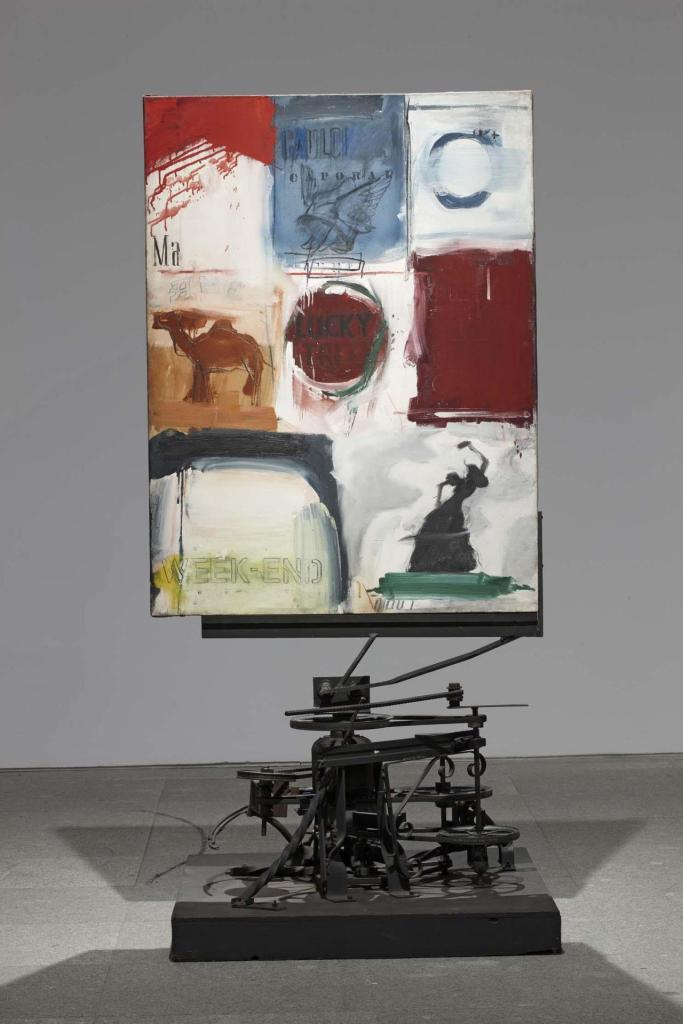
Oil, metal, wood, electric motor and canvas. 206.5 x 104 x 91 cm.
Reflect on your own approach; are there particular aspects of these artists work that you relate to?
There are aspects that I have drawn from other artists works. I like structure of Kurt Schwitters, Mz 601 (1923) which I can relate to. I feel that it is reserved, controlled and methodical. I think this said more about me than the artwork. I still feel as if I am holding back in my progress to produce a contemporary still life. This exercise has made me reflect on my approach – but will my approach change?
References
Katz, V., 2019. Let’s Do It Together – Tate Etc | Tate. [online] Tate. Available at: <https://www.tate.org.uk/tate-etc/issue-38-autumn-2016/lets-do-it-together> [Accessed 16 March 2020].
Moma.org. n.d. Moma | Théo Van Doesburg And Kurt Schwitters. Kleine Dada Soirée (Small Dada Evening). 1922. [online] Available at: <https://www.moma.org/learn/moma_learning/2562-2/> [Accessed 16 March 2020].
Moma.org. n.d. Moma | Word Play. [online] Available at: <https://www.moma.org/learn/moma_learning/themes/dada/word-play/> [Accessed 19 March 2020].
Nationalgalleries.org. n.d. Eileen Agar | National Galleries Of Scotland. [online] Available at: <https://www.nationalgalleries.org/art-and-artists/artists/eileen-agar> [Accessed 16 March 2020].
Nytimes.com. 2011. Versatile Collagist, Dangerous Times. [online] Available at: <https://www.nytimes.com/2011/04/01/arts/design/kurt-schwitters-exhibition-at-princeton-museum-review.html> [Accessed 18 March 2020].
Phaidon. 2016. The Meanings In Robert Rauschenberg’S Monogram | Art | Agenda | Phaidon. [online] Available at: <https://uk.phaidon.com/agenda/art/articles/2016/december/06/the-meanings-in-robert-rauschenberg-s-monogram/> [Accessed 16 March 2020].
Richardson, C., 2007. John Latham: Incidental Person. [online] MAP Magazine. Available at: <https://mapmagazine.co.uk/john-latham-incidental-person> [Accessed 18 March 2020].
Robert Rauschenberg Foundation. 2019. Combine (1954–64). [online] Available at: <https://www.rauschenbergfoundation.org/art/series/combine> [Accessed 17 March 2020].
Tait, S., 2006. John Latham. [online] The Independent. Available at: <https://www.independent.co.uk/news/obituaries/john-latham-6112609.html> [Accessed 16 March 2020].
Tate. 2005. John Latham In Focus – Exhibition At Tate Britain | Tate. [online] Available at: <https://www.tate.org.uk/whats-on/tate-britain/exhibition/john-latham-focus> [Accessed 16 March 2020].
Tate. n.d. Eileen Agar 1899-1991 | Tate. [online] Available at: <https://www.tate.org.uk/art/artists/eileen-agar-633> [Accessed 16 March 2020].
The Art Story. n.d. Kurt Schwitters. [online] Available at: <https://www.theartstory.org/artist/schwitters-kurt/> [Accessed 16 March 2020].
Tinguely.ch. n.d. Biography Jean Tinguely – Museum Tinguely. [online] Available at: <https://www.tinguely.ch/en/tinguely/tinguely-biographie.html> [Accessed 18 March 2020].
YouTube. 2016. Robert Rauschenberg – Pop Art Pioneer Full BBC Documentary 2016. [online] Available at: <https://www.youtube.com/watch?v=yELmPbQNx9M> [Accessed 16 March 2020].

