Exercise 3 – Explore the role of the title
Contextual focus point:
An Oak Tree (1973) by Michael Craig-Martin consists of a glass of water placed on a small glass shelf; the type normally found in a bathroom. It is accompanied by a series of questions and answers, in which the artist claims that the glass of water has been transformed into an oak tree. (Manchester, 2002)

Utterly confused and mentally perplexed it was a challenge to understand this piece of conceptual artwork, which reminded me of the tale of the emperor’s clothes. The artist describes the piece as an oak tree and assumes that the viewer must embrace his interpretation that this is indeed an ‘Oak Tree’. It has connotations with Marcel Duchamp’s declaration that ‘any existing object can be declared a work of art’. (Doorly, 2013, p. 200)
During an interview in 2015 it was suggested the ‘artwork was an act of faith, on the part of both artist and viewer and that conceptual art occupies the same space as faith and religion’. In response, Craig-Martin did not see art is a replacement for religion but observed that art may be a way we are all looking for ways to make sense of things. (Adams, 2015)
Having thought about this, the work may have religious connotations in the same way as Christian’s take Holy Communion to represent the body and blood of Jesus, in the form of bread and wine. Its physical form does not change but those who partake understand what it represents to their beliefs and faith.
Martin sees the artwork as two pieces and provides clear instructions as to how they should be displayed and viewed. (Artspace, 2018) Whilst all artists should have the right to display their work as they see fit, there is an overarching sense of control as to what the viewer sees, thinks and understands. Personally, I find this aspect a little unsettling, as if we are observing the complexities of a personality disorder. Does the artist genuinely believe this piece of work is an oak tree?
There will be many who absolutely love the genre of conceptual art, but I cannot claim to one of them. It could be argued that conceptual art is only really understood in the mind of the artist that divined it, especially when it encompasses a readymade object. It is surely for the viewer to decide how it is perceived. LeWitt wrote, “Different people will understand the same thing in a different way.” I find this a fitting statement for An Oak Tree. (Alberro and Stimson, 2002)
Do I see the work as an oak tree? No! However, it does raise questions about the issues of authorship, identity and even ownership as these things already exist in the real world.
References:
Adams, T., 2015. Michael Craig-Martin (Interview). [online] the Guardian. Available at: <https://www.theguardian.com/culture/2015/apr/26/michael-craig-martin-interview-everything-important-is-in-front-of-you–guru> [Accessed 5 August 2020].
Alberro, A. and Stimson, B., 2002. Conceptual Art. Cambridge: MIT Press, p.13.
Artspace, 2018. Turning Water Into… An Oak Tree: Michael Craig-Martin Discusses Performing A Miraculous Act Of Conceptual Art. [online] Artspace. Available at: <https://www.artspace.com/magazine/interviews_features/book_report/turning-water-into-an-oak-tree-michael-craig-martin-discusses-performing-a-miraculous-act-of-55188> [Accessed 5 August 2020].
Craig-Martin, M., 2019. Early Works — Michael Craig-Martin. [online] An Oak Tree (1973). Available at: <https://www.michaelcraigmartin.co.uk/early-works/0lexq7wn6fey0y9nedl5qxn6ps6b2l> [Accessed 5 August 2020].
Doorly, P., 2013. The Truth About Art. Winchester: Zero Books, p.200.
Manchester, E., 2002. ‘An Oak Tree’, Michael Craig-Martin, 1973 | Tate. [online] Tate. Available at: <https://www.tate.org.uk/art/artworks/craig-martin-an-oak-tree-l02262> [Accessed 5 August 2020].
Exercise 3.1 – ‘dates series’ of work by On Kawara
On Kawara: Today series/date paintings
Finishing each work on the day it was begun formed a ritual for almost 50 years for On Kawara, and if not completed by midnight – it was destroyed. Each painting is rendered in the same sans serif-style differentiated simply through colour, date and the language of the country in which it was made. (Art Agenda, n.d.)
When travelling, Kawara made a cardboard box for each painting and lined it with all or part of a page from that day’s local newspaper, with no apparent consideration to what had been reported on it. (See figure 2) This prompts us to think about time, place, events. Equally, different dates will hold different memories, akin to a private number plate. (Schjeldahl, 2015)
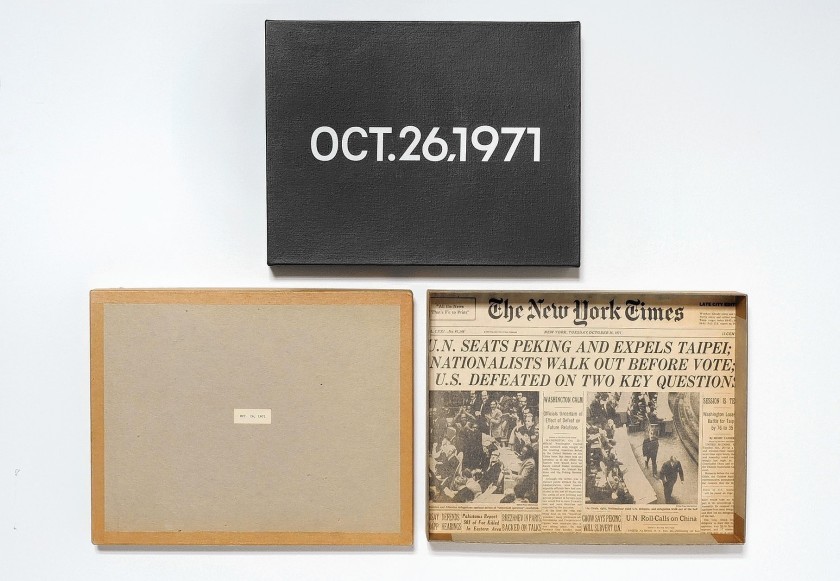
(Lee Stalsworth / National Gallery)
https://www.latimes.com
As a series of works it becomes a record of time and place. The events or occurrence of that day become superfluous or very personal, an oxymoron of extremes, depending on the significance of the date; a birthday, wedding, holiday or historic events that attract our attention. The repetitive nature of this series reflects a self-disciplined and meditative process that may resonate with Kawara’s spiritual and religious beliefs in Buddhism and Existentialism.
References
Phaidon. n.d. On Kawara’s Date Paintings Explained | Art | Agenda | Phaidon. [online] Available at: <https://uk.phaidon.com/agenda/art/articles/2014/july/14/on-kawaras-date-paintings-explained/> [Accessed 6 August 2020].
Schjeldahl, P., 2015. A Painting A Day. [online] The New Yorker. Available at: <https://www.newyorker.com/magazine/2015/02/16/painting-day> [Accessed 6 August 2020].
Review your use of titles to date in the light of the ideas explored so far. Choose a number of works you have produced during this course that are currently untitled and that you would like to title. Alternatively review your titles. Approach this activity as a ‘trying it on for size’ exercise.
“What’s in a name? That which we call a rose. By any other name would smell as sweet.” (Shakespeare, 2019)
What Shakespeare alludes to is that names of things do not affect what they are. An Oak Tree (1973) by Michael Craig-Martin being an example of this. But is this the same for all artwork? As articulated in the course material ‘titles can be purely descriptive or obscure, puzzling, playful or poetic’. Titles are a means of engaging and communicating with the viewer, or potential buyers, curators, art consultants and gallery owners.
‘Psychology studies have suggested that viewers pay less attention or poorer understanding of artworks that are untitled’. Nevertheless, “Untitled” appears to have become a title. Artist’s such as Donald Judd left many of his works untitled, although even the most minimal Judd works acquired descriptive nicknames like The Lifeboat and Letter Box. (Ables, 2019)
Reviewing some of the pieces I produced during the cut-up exercise it would have been easy to use titles that restated exactly what the painting was already communicating – which, as it happened was what I had done. Revisiting this I wanted the title to provided something new or at least different.
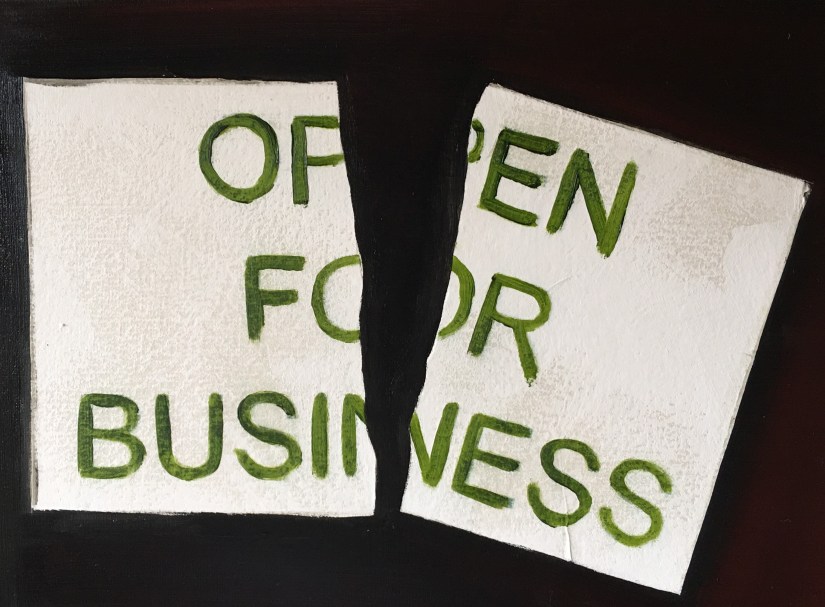
The torn sign open for business was a response to a news report I had heard. The inevitable increase in unemployment, shops and business closing and recession looming. Producing a title to reflect this experience or feeling was taxing (no pun intended). The title ‘closed for recession’ (see figure 3) has a sense of irony, that may present the image of a shop being closed for a stocktake and cleaning. The title, The answer is still the same (see figure 4) was more literal.

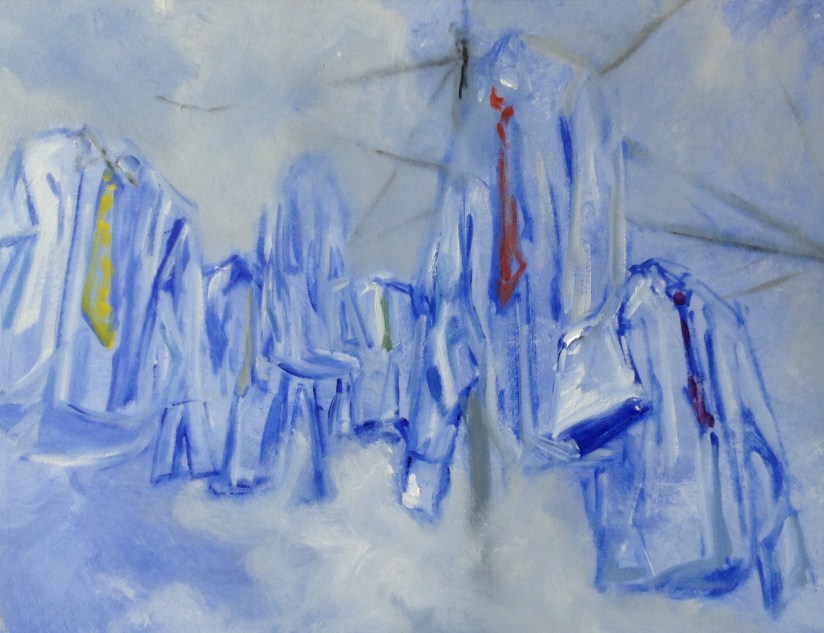
To appeal to a wide and varied audience I understand that the title should be expansive, thereby allowing the viewer to draw their own interpretation. The original title for the work shown at figure 5 was Study 4. This was supported with a short film clip called Rushing nowhere.
This piece was one of many that explored the presence of the human form without physical presence. When considering a title for this exercise I considered what the image conveyed without a title or insert card to provide an explanation. Double-cuffed shirts, no cufflinks, some shirts with ties. Predominantly blue in colour with a yellow and red tie. A suggestion of ambiguity.
When showing this piece to a close friend and asking what they though it conveyed, I got an altogether different response. They felt it was trying to convey the difference between feeling alone and feeling lonely – and how you can feel lonely in a crowd of people, but quite peaceful and content when alone. Using this and the implied ambiguity, I came up with the title Together in Isolation, itself an oxymoron that allows others to find their own personal meaning or interpretation. I also considered the title Crowed in Isolation.
Through my research of locating titles and having reviewed my learning log during this exercise, I contemplated whether using the prefix Fig. for ease of reference constituted a title? I decided not.
References
Ables, K., 2019. Why Are So Many Artworks Untitled? [online] Artsy. Available at: <https://www.artsy.net/article/artsy-editorial-artworks-untitled> [Accessed 13 August 2020].
Yeazell, R., 2015. Picture Titles. Princeton, N.Y.: Princeton University Press, pp.2-12.

