Exercise 1 – Cut-up technique
Take one or more texts; this could be any text and cut the text up into words and phrases and put everything into a container. Randomly take out pieces of text and lay them out in the order they are selected. From these random combinations begin to construct a new text. Repeat this process several times until you find a stream of words that interest you.
Sketchbook 1, pages 52-59
The concept or technique of ‘cutting-up’ can be traced to at least the Dadaists of the 1920s, but was popularized in the late 1950s and early 1960s by writer William S. It has been used extensively by artists and art movements to create and/or respond to political, economic and social events. (BBC magazine, 2015)
In 1920, Tristan Tzara, one of the Dadaist movement’s founders argued, that by cutting out the words from a newspaper article and pulling them at random from a bag – the result would make you “a writer of infinite originality and charming sensibility”. (Yinger, 1970)
The writer William S Burroughs and artist Brion Gysin collaborated and experimented with how tape recorders and cameras could recombine words and images. Burroughs recorded the manuscript of his book The Naked Lunch and in doing so, established that he could distort structural language, narratives and conventional logic or perception.
Lenka Clayton used the cut-up technique to sequence alphabetically the speech of George W Bush’s 2002 State of the Union address. It articulated a statistical frequency of certain terms, such as “America” and “terrorism”, in what has become known as Bush’s “Axis of Evil” speech. (BBC magazine, 2015)
In the 1980s, the evolution of twin tape decks meant that musical artists and producers (and every teenager taping the top 40 hits) could incorporate cut-up to create a genre of different music, such as hip-hop and rap. Artist’s such as David Bowie used a computer to randomly select words from a chosen book / poem to generate ideas.
There can be little doubt that the proliferation of digital platforms has created a global audience in the twenty-first century, but it has also narrowed the divide between reality an illusion, or what could now be construed as ‘fake news’.
For this exercise, the following poems were selected:
- Break of Day in the Trenches by Issac Rosenburg
- In Flanders Fields by John McCrae
- The Road not Taken by Robert Frost
The reason for selecting these poems was because the first two look at war from different, and almost romantic perspectives, as implied by their titles. The Road not Taken was somewhat self-reflective poem. All three are relatively short.
Having printed and cut up each poem, they were put into their own respective piles and turned so they were facing down and jumbled up. Using the poem In Flanders Fields, words were randomly selected to form a stanza. This was a poem that I was familiar with, and despite repeating this exercise several times, the steady rhythm lingered as I read aloud. Burrough’s argued that the internal dialogue as a process, a ‘word virus’ could be halted through the cut-up method. Although he also argued that this was of value to neurotic people who cannot help but obsess over emotionally charged negative thoughts. Removing the words Flanders aided in disguising the poem from those less familiar with it – but not for me personally. A selection of cup ups can be seen below. (See figure 1 and 2)

Fig. 1 Cup-up sample 1 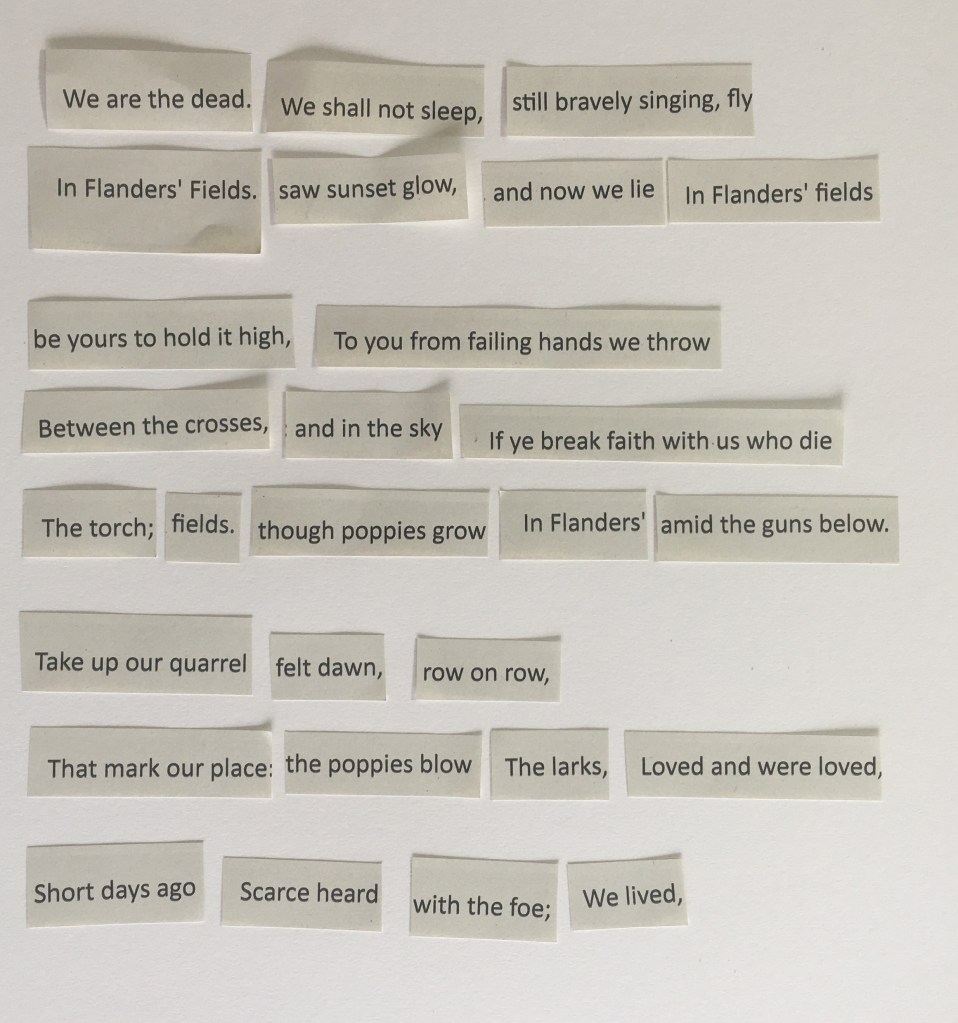
Fig. 2 Cut-up sample 2
This process was repeated using the poem Break of Day in the Trenches by Issac Rosenburg. In its original text, it is a classical war poem. The rats, the trenches, the symbolic poppy firmly resonate an association with WWI, partially in thanks to McCrae’s ‘In Flanders Fields’. In contrast, rather than using the rhyme schemes and regular metre, the verses are freer, and thus cutting up made for some interesting verses. (See figure 3)

In Flanders Fields, Macrae writes on his views about what happens after dying in war. It’s very personal as emphasised using personal pronouns, we and our, as if to include the reader in the poem. Rosenberg provides a glimpse into the mind, and darkest thoughts of a soldier stood in a WW1 trench.
Combing the two felt awkward, perhaps even disrespectful but, by printing each poem on different paper they somehow retained their personal identity – hypothetically.
Each poem was cut-up and placed face down into seperate piles. The intent was to select strips of words alternately from each poem, but the number in each pile meant that it did not work out equally. (See figures 4 and 5 )
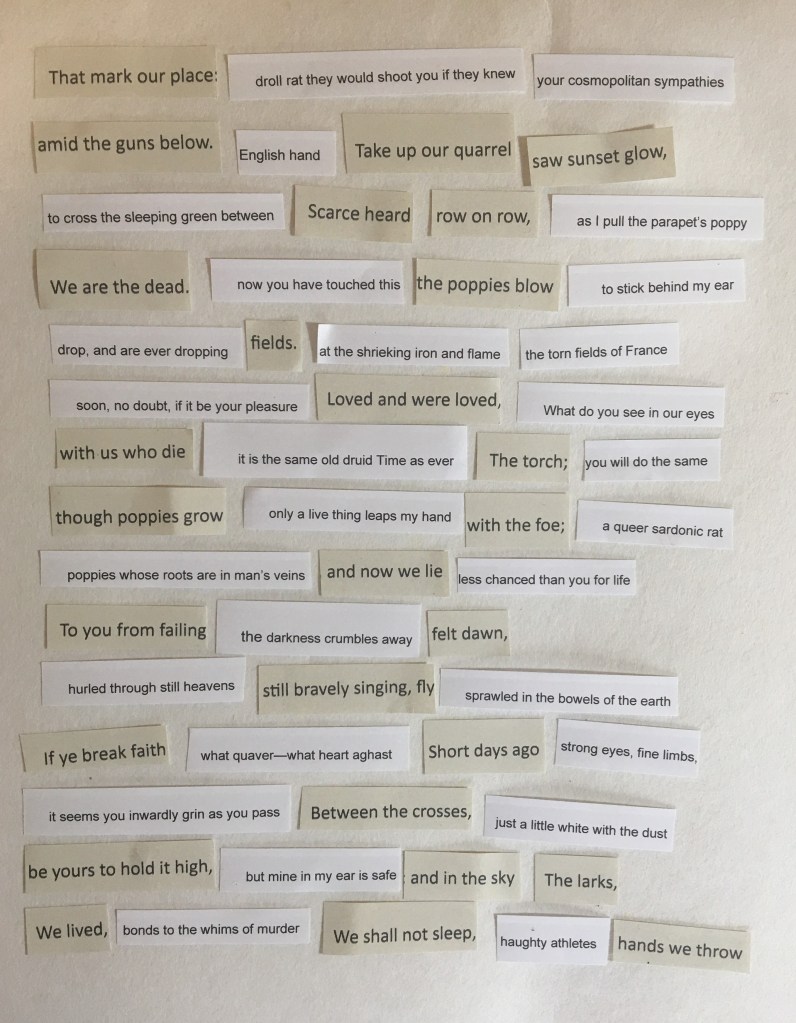
Fig. 4 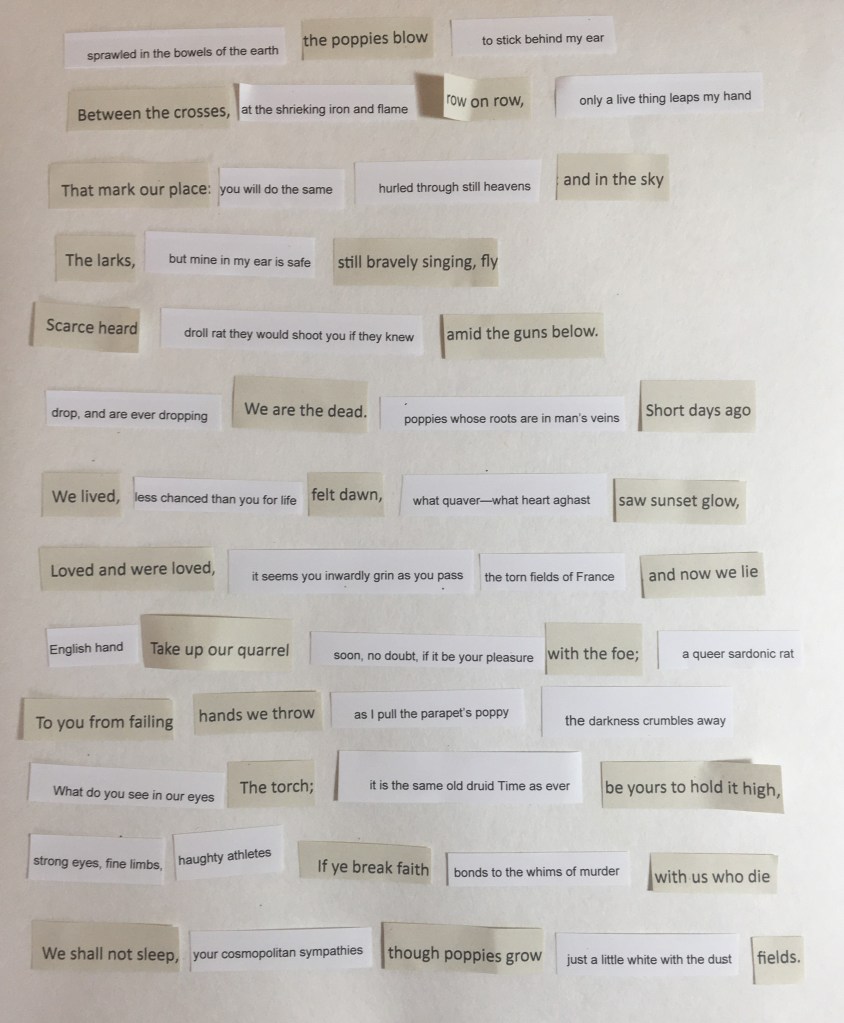
Fig. 5
The combinations were fascinating, creating an oxymoron of dialogue between the past and present that were fascinating, thought provoking and sometimes a little harrowing.
Transferring this to a canvas, a white oil paper support was stretched over MDF board. A 50:50 mix of linseed oil and solvent was added to burnt umber an applied to the support with a wide brush and linen cloth.
Both poems refer to the poppy, a flower that has become symbolic with Remembrance. The text conveys hardship beyond imagination, and untold lost lives. To convey the darkness that resonates through these poems, careful consideration was given to the use of line brush marks and alizarin crimson oil paint.
The varied size of brush marks was to create an illusion of depth and perspective. They are intentionally aggressive, explosive and at the same time reflect the barricade of barb wire between the opposing forces.
Yellow ochre oil paint thinned with 50:50 linseed oil and solvent medium was added to further conceal the words to bring the viewer close into the picture frame before being able to read the text. The white ghostly figures were intended to be just that – human existence – memories. But the impact nor effect was as I had visualised.

38×48 cm
Mixed media cut up
The Road not Taken by Robert Frost is somewhat ubiquitous, it’s been used in numerous TV advertising campaigns, the Superbowl and “appears as a title, subtitle, or chapter heading in more than four hundred books by authors other than Robert Frost, on subjects ranging from political theory to the impending zombie apocalypse“. (Orr, 2015)
The poem is something of a metaphor and reflection of my own travels and decision making. Rather than cut up, I decided to cut out. Each strip was randomly (blindly) selected and then placed in order as it appeared in the original poem. Some words had been translated to reflect the language and cultures I had encountered.
The support was oil paper stretched over MDF board with an undercoat 50:50 linseed oil and solvent mix, and grey oil paint. Extracts from an ordnance survey map were printed on recycled paper and then cut into varied rectangle sizes. The text was printed in red to replicate major roads on the map. Wallpaper paste was used to secure both to the support.
Allured by the words yellow wood, a diluted yellow cadmium oil paint was washed over the support. This, along with removing words and changing the dialect created an element of ambiguity and sentiment to the work; an aspect I felt complimented one another – and was something I liked about the finished piece.
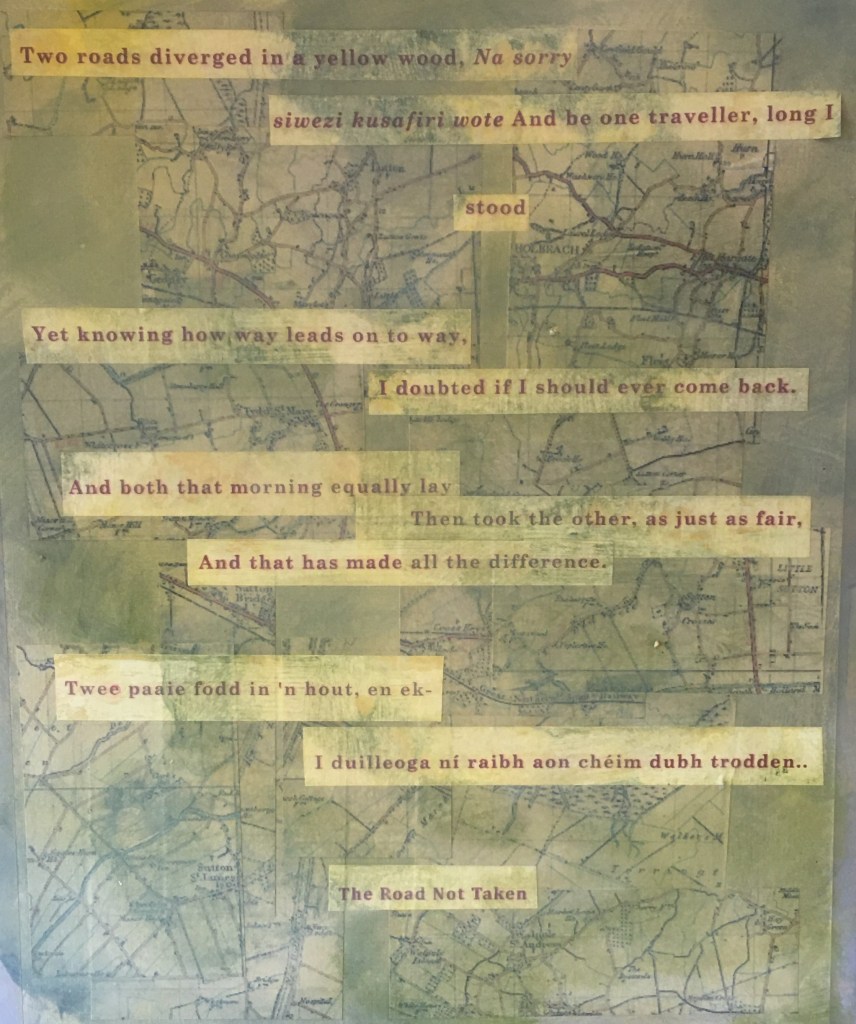
38×48 cm
Mixed media cut up
Reflection
Throughout this exercise I had deliberately combined text, imagery, events or colours that may resonate with the viewer as they had with me during the process of creating. I felt that this element added a layer of depth, meaning and narrative, and was something that I shall employ during this assignment. Reflecting on figure 6, The Advance, I was left contemplating if the ghostly white figures detract from the text, or whether I could have created layers with tracing paper, alternating the text size which would be obscured by the layers of tracing paper. I propose to include texture into my parallel project so this may be a means of doing so.
Slowly, the Country appeared to be emerging from the darkness of a global pandemic; shops, restaurants and public places stared to open. It was short lived as the resurgent virus forced pockets of the population to be locked down once again; amenities closed, and only essential travel was permitted.
Inspired to revisit this exercise, two simple signs were produced to reflect my sentiment and understanding of the situation. The first was a cut-up of the word open to create the word NOPE. The use of traffic light colours signifies go and stop.
The second piece was to replicate a torn and discarded sign. The black background reflecting the cavernous void and uncertainty and shops and business close – some permanently.

Fig. 8. Closed, 2020
36×23.5 cm
Mixed media cut up
Fig. 9 Not by any means, 2020
36×23.5 cm
Mixed media cut up
References
BBC magazine, 2015. What Is The Cut-Up Method?. [online] BBC News. Available at: <https://www.bbc.co.uk/news/magazine-33254672> [Accessed 31 July 2020].
Burroughs, W., 2017. William Burroughs’ Cut Up Technique. [online] YouTube. Available at: <https://www.youtube.com/watch?v=MLghchFkttM> [Accessed 31 July 2020].
Orr, D., 2015. The Most Misread Poem In America. [online] The Paris Review. Available at: <https://www.theparisreview.org/blog/2015/09/11/the-most-misread-poem-in-america/> [Accessed 3 August 2020].
Yinger, J., 1970. Countercultures. New York: Simon and Schuster, p.136.
Reading Point – Gus Van Sant’s use of cut-up techniques in Buck Kahler’s
paper
Gus Van Sant is an acclaimed independent and mainstream filmmaker who unflinchingly tackled gay themes and homoerotic imagery. The forbearer of American Queer Cinema, he was described as “a gay director of films rather than a director of gay films”. (Kahler, 2014)
Away from the film set, Van Sant was also an artist who was influenced by the works of Kenneth Anger and William S. Burroughs. Kahler notes that the best example of Van Sant’s use of this cut-up technique is My Own Private Idaho; using three different scripts to create the movie, combining stories on street hustlers in Portland, two men looking for their parents in Europe and Orson Welles Chimes at Midnight . (Kahler, 2014, p. 3)
The cut-up technique was also used in the film, forcing the viewer to see the story from the viewpoint of three different characters to illustrate their desires and conflicting struggles. Scenes and images of sexual acts were incorporated as fleeting memories which Kahler described as being aware that “sex has just occurred, but our memory of it is fleeting” (Kahler, 2014)

https://en.wikipedia.org/wiki/My_Own_Private_Idaho
Van Sant’s uses the cut up like a trademark, and it features in many of his works; scripts, films and artwork. Notably, was his long-lasting desire to remake Hitchcock’s Psycho shower scene which he produced for the Our Lady of Laughter theatre group – albeit for a shampoo advert. I found that I had imaged with the image but also wondered how much the title or knowing the film had influenced my allure. (See figure 2)

References
Evangelista, C., 2017. In Defense Of Gus Van Sant’s Psycho Remake. [online] Film. Available at: <https://www.slashfilm.com/in-defense-of-gus-van-sants-psycho-remake/> [Accessed 12 August 2020].
Iconoclast image. n.d. GUS VAN SANT – Iconoclast Image. [online] Available at: <http://www.iconoclastimage.tv/usa/talents/gus-van-sant/> [Accessed 12 August 2020].
Kahler, D., 2014. Gus Van Sant. GLA605 Motion Picture Theory & Style. [online] pp.1-12. Available at: <http://file:///C:/Users/roger/Downloads/Gus_Van_Sant_Cut-Up_Cinema.pdf> [Accessed 22 July 2020].
Van Sant, G., 2018. Gus Van Sant: My Own Private Studio – ELEPHANT. [online] ELEPHANT. Available at: <https://elephant.art/61832-2/> [Accessed 22 July 2020].
YouTube. 2016. Director Gus Van Sant Looks Back At His Best Films. [online] Available at: <https://www.youtube.com/watch?v=ig4edyOdVGU> [Accessed 22 July 2020].

