Absence of Presence
How do artists use or depict items of clothing to convey a sense of human presence, despite a physical absence and how can this evoke memories and emotions with its audience?
The absence of presence conjures both a physical a spiritual assertion, encompassing loss, trauma, departure, omission and erasure in its narrative. Having spent several years working away from my family home for extensive periods, both overseas and in the United Kingdom, I find the canon of absent presence a constant in my artwork, be that deliberate or subconscious. Most recently memories and emotions were evoked from reflecting on garments used on my travels which now form the basis of my current practice. The American curator, writer and art historian Nina Felshin in her article Clothing as Subject considers that ‘Clothing more than any other object or possession is closely identified with the body of the absent wearer’ (Felshin p. 20). Is it why something so universal in our daily lives communicates to us on so many levels, to elicit intense emotional responses and evoke memories?
Philosophers and scholars have long debated the idea of ‘absent presence’ and the ‘fundamental states of being’ (Bell, 2020). The scholar, Professor Hung Wu stated that its ‘lack of substance gives absence a quality that is at once timeless and immediate, fleeting yet permanent’ (Wu, 2012). The philosopher Jacques Derrida argued that the terms [Absence/Presence] were mutually implicated, that each bears a trace within it of the other (Spikes,1992). In the 1960s and 70s, Robert Rauschenberg and Jasper Johns used their art as a platform to portray the absent human body perhaps most notably Rauschenberg’s Bed (1955). Contemporary artists such as Louise Swärdshammar reflect on persona and Absent Presence as a ‘symbolic reflection of how we often become absent on the inside and eventually lose touch with ourselves’ (Swärdshammar, 2020). The Iranian artist Ala Jazayeri (b.1981) now living in London, was born three years after the Iranian Revolution and one year after the onset of the Iran-Iraq War. She reflects on Absent Presence as ‘the relationship between place, memory, and dislocation concerning the emotional and affective investments they provoke and generate’ (Jazayeri, 2020). The Scottish artist Alison Watt moved away from working directly from life so that her paintings became more about what she was thinking, rather than just what she was seeing. She states that ‘although in these paintings the body is not explicitly represented, it’s still echoed in the landscape of the cloth. So for me, the paintings are about an absent presence – you are taking away something, in this instance the fabric from its original narrative, which is normally used as a support for the figure’ (Watt, 2020).
In the context of this essay, I shall relate to absent presence as a state of representation in which thing(s), in this case, the human body, are not physically present but are brought to life through imaginations employing artistic impressions and through the use of garments. To explore this, I have selected the works of Kaarina Kaikkonen, Chiharu Shiota and Riitta Päiväläinen. They are all cited for negotiating the absent presence of human form from their different perspectives based on their life experiences, genres, use of materials and interaction with their audience.
The artist Riitta Päiväläinen (b. 1969) creates site-specific sculptures made of old clothing purchased from flea markets and second-hand shops that she photographs in rural landscapes. Bringing these two elements together symbolically recreates the aura of their former owners, a call to memory, lost identity and an ‘unwritten history’ that speaks both directly and indirectly to the presence of humanity. According to Päiväläinen ‘clothes are the vestiges of human beings, symbolising a person’s history, which in the absence of the person, impregnates the discarded garments. Therefore, old and used garments represent both the presence and the absence of their former owner’ (Päiväläinen, 2009, p. 5). However, the artist also acknowledges that she can never know the actual stories and personal histories behind these clothes and thus they can never be fully discovered to the viewer. The relics therefore act as catalysts for the viewer to create their own narrative and reflect on personal memories.
Päiväläinen’s series of works entitled Vestige placed used monochromatic garments within different landscapes. The garments, described by journalist and curator Andrea Holzherr as ‘actors within a setting’ (Holzherr, 2009, p. 5), appear delicate and transient which, augmented by climatic conditions bring the garments to life, creating movement, mood and atmosphere. The title of this work ‘Vestige’, meaning a trace or remnant of something that is disappearing or no longer exists, embodies the artist’s ideas surrounding absence, presence and memories. The artworks Northern Wind (2000) and Vespertine II (2002) are examples of this.
Memory is an important part of Päiväläinen’s art, in that she wants the viewer to visualise people through the clothes or them to create their own narrative or to reflect on personal memories. Leaving the artwork open to interpretation entices the audience to explore further, thereby creating a dialogue with time and space.
Her images have an appearance of being from a previous era, a passing of time that draws the mind of the viewer back to the past. In doing so, a connection is developed by imagining that the clothing was worn by someone who is no longer present. The images of people long gone are therefore recreated in the mind of the viewer as they reminisce on times past or induced memories.

90 x 160 cm
Photograph curtesy of riittapaivalainen.com
For the artist Riitta Päiväläinen, “clothes are the vestiges of human beings, symbolizing a person’s history, which in the absence of the person, impregnates the discarded garments. Old and used garments therefore represent both the presence and the absence of their former owners.” (Holzherr, 2009)
Kaarina Kaikkonen (b. 1952) uses clothes to create public installations. She describes her use of old clothes as containing the former user’s presence, a dialogue about life and death, the environment, consumerism, and gender, although the latter three topics will not be discussed as part of this essay. She states that ‘in every shirt, there is a story because someone with a warm heart has been wearing it’ (Kaikkonen, 2020).
The momentum behind her use of the old clothes derived from her father’s death, whose wardrobe remained a source of solace after his passing. Indeed, her first project, on display from 1987 to 1988, utilised jackets like those her father used to wear. After her mother’s passing, Kaikkonen revisited this connection with the past by using dancing shoes similar to those once worn by her mother in creating Mother (1999). Kaikkonen studied medicine and physics for 6 years before becoming an artist and now talks of her ‘art as medicine‘ ((Kaikkonen, 2018, 00:08:33) and that by being honest with herself she can connect with her audience ((Kaikkonen, 2018, 00:06:33).
During a study of material thinking, Professor Nithikul Nimkulrat noted a development of human connection, especially when remembering fond memories shared by the person whose clothes are depicted in the artwork (Nimkulrat et al. 2016, n.p). Kaikkonen’s artwork explores this theory to stimulate debate around life and death, especially when using the clothes worn by those who have died or have been donated by the public in the town where the installation will be displayed. In 2015 visitors to the Didrichsen Museum of Art in Helsinki donated towards the 2000 shirts to create A Waltz to Life. In doing so, old garments are given a new meaning, they are reborn to create a personalised connection with the audience.
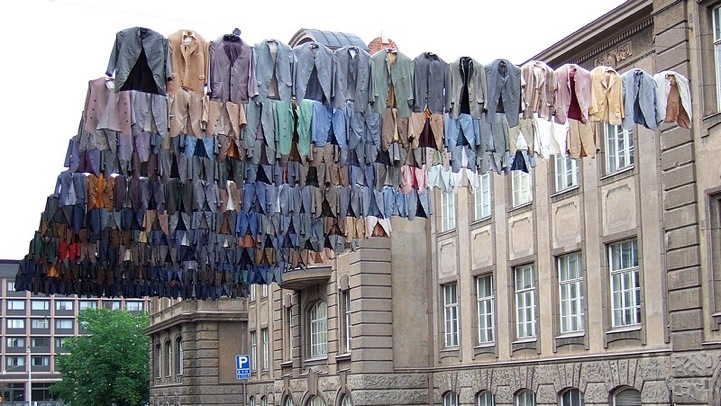
Photograph courtesy of mymodernmet.com
Shadow was an installation above a street in the Finlayson area of Tampere, Finland, first displayed 1999. The Finlayson is significant in Finland’s design history an area where former textile factories operated. Each garment individually tells a story as an extension of its past wearer, and as a group, they come together to create a history and visual retelling of their space.
The work of Chiharu Shiota (b. 1972) is embedded in personal and often idealised memories of displacement, relationships and belonging. Her architectural installations use either red, black or white yarn as a medium that entangles everyday objects such as keys, dresses, shoes and chairs, as well as the human figure, thereby challenging the viewer to think about ‘spaces, the environment, and their relation to objects and human figures’ (Greslé, 2013).
Shiota tries to create human connections in her works while at the same time, relying on memories. For instance, in her installation Dialogue from DNA (2004), she collected shoes and asked the owners to add notes, explaining their memories connected with the shoes (Bogdan, 2019). In an interview with Yvette Greslé, she recalled ‘I see the thread symbolically for human relations. In most of my thread installations, the thread forms a three-dimensional web – in the end, everything is connected’ (Greslé, 2013, n.p). Shiota expands on this concept of human relationships saying that ‘the red yarn depicts blood as a symbol of relationships between people’ (Shiota, 2020, 00:04:02). I would agree that the yarn creates an instant impact that immerses, indeed allows the audience to walk through the art, reflecting on personal experiences that evoke emotions and memories.
Shiota bases her artworks on ‘memory in absent things’ (Shiota, 2020, 00:01:35), forgetting and remembering processes to create a nostalgic feeling, which has everything to do with individual memories. This might refer to her background as a Japanese national now living in Germany, reflecting on different languages and cultures coexisting together but also a window to her past and memories of home. Shiota alludes to her own displacement between two countries as when in Germany she wants to go home [Japan], but when in Japan feels as if she no longer belongs (Shiota, 2020, 00:10:28).

white dresses, black wool
Stadtgalerie Saarbrücken, Saarbrücken, Germany
photo by Sunhi Mang
Conclusion
This essay has specifically looked at how these artists suggest the presence of human form in its physical absence and how this notion evokes memories and emotions in its audience. It would be difficult to dispute that imagery of garments, or the physical presence of a garment does not stimulate memories, be they personal or of the absent wearer. However, this experience is unique to each viewer so not every piece of clothing has this capacity. I would also argue that creating artwork that uses things that are necessary to human livelihoods, such as old garments, makes it easy to visualise a person’s presence, even in their absence. That said, the artist must create the conditions to bridge a connection between garments and the audience. In the case of Päiväläinen’s images, I feel that the scenery and climatic conditions are vital in creating mood, atmosphere and movement of ghostly clothing to convey both presence and absence. Another component of Päiväläinen’s photographic approach is that the viewer never sees the installation first-hand but as copies, records or documents of reality. Keeping the viewer at arm’s length the images create a perception that her installations are reliquaries. This is in stark contrast to the artworks of Kaikkonen or Shiota that invite the viewer to participate on a personal level.
Kaikkonen and Shiota draw on personal experience and memories of loss and displacement. Their installations are accessible and in part interactive with their audience and public spaces further heighten the connection between garments and the audience.
The way Päiväläinen and Kaikkonen present their garments is crucial to the efficacy of their works. Visible signs of wear and ageing are an essential criterion in the selection of the pieces. New, unspoiled items would not leave the same impression and would likely dilute the narrative to reflect on memories.
Shiota’s motif of threads interconnects people by inviting viewers to wander through her cocoon-like spaces. Shiota views the presence or absence in terms of the cultural background, as a state of constant negotiation with an outer and inner identity and one that is perhaps pertinent in the current climate of mass immigration and refugees.
A theme that runs through all three artworks is one to evoke memories and emotions. To create an emotional connection that can be forged or communicated from inanimate objects or images to the viewer. I would agree that these artworks convey a strong sense of human presence, despite its absence. As a painter, my work encompasses a similar theme whereby personal everyday objects evoke memories of my time absent from the home. The key differences to my own work are that the objects used to create my composition are personal, a lived and known experience that has created memories.
Through my analysis of these selected artists and artworks, I have concluded that Absent Presence in art is an expansive and unbounded topic, the surface of which I have barely scratched during this essay.
Biography
Bell, A., 2020. Absence/Presence. [online] Lucian.uchicago.edu. Available at: <https://lucian.uchicago.edu/blogs/mediatheory/keywords/absence-presence/> [Accessed 19 September 2020].
Greslé, Y., 2013. Chiharu Shiota: Other Side – FAD Magazine. [online] FAD Magazine. Available at: <https://fadmagazine.com/2013/11/18/chiharu-shiota-other-side/> [Accessed 20 September 2020].
Halvorson, J., 2011. Presence Within Absence. [online] Scholarworks.rit.edu. Available at: <https://scholarworks.rit.edu/cgi/viewcontent.cgi?article=4312&context=theses> [Accessed 12 September 2020].
Helsinki School, 2020. Riitta Päiväläinen. [online] Helsinki School / Person Projects. Available at: <http://www.helsinkischool.fi/artists/riitta-pivlinen?x=texts&article=282> [Accessed 17 September 2020].
Holzherr, A. and Päiväläinen, R., 2009. Riitta Päiväläinen. Heidelberg: Consortium Book Sales & Dist., p.5.
Mills, C., 2009. Materiality As The Basis For The Aesthetic Experience In Contemporary Art. [online] Scholarworks.umt.edu. Available at: <https://scholarworks.umt.edu/cgi/viewcontent.cgi?article=2308&context=etd#:~:text=Just%20as%20art%20forms%20a,are%20sensed%2C%20interpreted%20and%20understood.> [Accessed 18 September 2020].
Nimkulrat, N., Seitamaa-Hakkarainen, P., Pantouvaki, S., and de Freitas, N., 2016. Studies In Material Thinking. [online] Materialthinking.org. Available at: <https://www.materialthinking.org/sites/default/files/papers/0176_SMT_V14_P00_FA.pdf> [Accessed 16 September 2020].
Päiväläinen, R., 2014. About – Riitta Päiväläinen. [online] Riittapaivalainen.com. Available at: <http://riittapaivalainen.com/htdocs/about/> [Accessed 12 September 2020].
Tarasyuk, J., 2020. Chiharu Shiota: Presence In Absence. [online] COBO Social. Available at: <https://www.cobosocial.com/dossiers/chiharu-shiota-presence-in-absence/?utm_campaign> [Accessed 23 September 2020].
List of Illustrations
Figure 1: Päiväläinen, R., 2000. Northern Wind, 2000. [Photograph, 90 x 160 cm].
Figure 2: Kaikkonen, K., 1999. Shadow. [image] Available at: <https://mymodernmet.com/kaarina-kaikkonen-clothes-installations/> [Accessed 23 September 2020].
Figure 3: Shiota, C., 2015. Seven Dressess. [image] Available at: <http://seven-dresses-1> [Accessed 21 October 2020].

