Exercise 1.1: Body as canvas
Explore processes of enactment, appropriation and transformation through the restaging of an image using your own body.
Research
Scientific research has found that the control of speech and hand movements are linked to the same place in the brain, which could explain why we use hand gestures when we are speaking. (Bergland, 2013)

The hand is unique to humans. It serves as eyes for the blind, the deaf talk with it, and it has become a symbol of salutation, supplication, and condemnation. Our hands can express a range of feelings and emotions from confusion, despair and frustration to joy, relief, understanding and compassion. (McCurry, 2019)
Our hands often reveal what we really think – but don’t say. At a recently televised criminal investigation in New York City, the camera focused on the hands of a witness, revealing that the hands expressed feelings that man has taught his face to disguise. (Alpenfels, D.Sc., n.d.)
We often use our hands to gesture or communicate, and although some hand gestures are universal, many are not and could be inappropriate or offensive if used incorrectly. To illustrate this, the hand gesture at figure 2 in Italy means small or little, in Congo beautiful or good and in Turkey just a moment.

Photograph: Florian Bong-Kil Grosse
https://www.theguardian.com
In the Middle East communal eating with shared dishes is common practice and is widely recognised as an expression of friendship. Hand-to-mouth eating is an important custom in many Muslim countries. However, guests should not eat with their left hand, which is considered unclean. (UAE Embassy, 2020)
Our hands may also provide an insight to our occupation, lifestyle and character. As an example, my father was a farm work whose hands were as tough as old leather, with lots of deep scars. As he aged, he suffered from arthritis and liver spots covered the back of his hands – but they never softened.
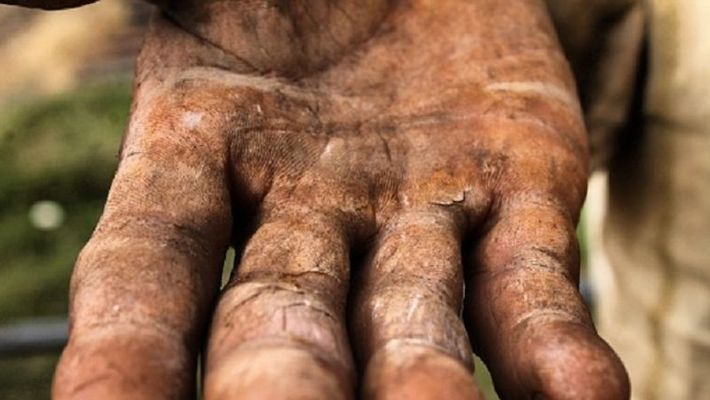
https://newsable.asianetnews.com
Studies of the hand have long appeared in the traditions of Western art, although it wasn’t until the fifteenth century that hands were drawn anatomically correct. Albrecht Durer (1471-1528) devoted a lifetime to the study of anatomy, and in his studies of hands the lines, the curves, the veins, the wrinkles delineate the complexity of the human hand (See figure 4). The French sculptor Auguste Rodin (1840-1917) created works that deliberately communicated as forcefully as the human face.

29.1 cm × 19.7 cm
Albertina, Vienna
The foot has special meaning in many societies. In Arab culture the shoe is considered dirty because it is on the ground and associated with the foot, the lowest part of the body. Showing the sole of your shoe has long been an insult and hitting someone with a shoe shows that the victim is regarded as even lower. When Saddam Hussein’s statue was toppled in Baghdad in April 2003, Iraqis swarmed around it (Gammell, 2008)
Muslim, Hindu, and Buddhist temples all require entrants to remove their shoes. Buddha is often represented by a pair of intricately adorned feet or footprints, and some Hindus worship a footprint believed to belong to the god Vishnu. Many Indians also show respect to their parents or grandparents by touching their feet. (Palmer, 2008) In the Bible the kissing of feet was a sign of being humble, a great love and selfless service as seen at figure 5 (below) which shows Cardinal Alencherry, kisses the feet of a parishioner.

https://international.la-croix.com
Artists frequently use various methods and techniques to accentuate the hands in a piece of work, thereby making the hands the focus of the picture. Such methods may include the positioning of lighting to create a chiaroscuro effect, perspective, colour, an act of doing, distortion or disfiguration. John Singer Sargent paid careful attention to his sitters’ hands, using pose and gesture to enhance his portraits. (See figure 6) (Herdrich, 2015)
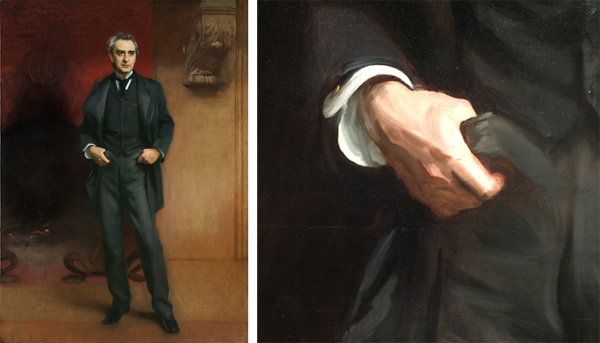
https://www.metmuseum.org
Equally, hands could be the canvas as seen in the work of Shirin Neshat, both in an active and passive space. This will be explored further during Research point 3.
Staging the body
In researching a piece of work to integrate my own body, I wanted to experiment (or at least explore) how I might use light on a painting that had already used light and tones to accentuate the hands.
During the process I viewed numerous options, ranging from sixteenth-century paintings of old masters through to POP and contemporary art. The image I selected for this exercise was Aristotle (1637) by Jusepe de Ribera. (See figure 7) The scene depicts Aristotle portrayed as a beggar-philosopher. Aristotle was one of the most important philosophers and thinkers in history. He was the first to investigate logic. He promoted systematic observation and thought in biology, physics, law, literature and ethics. Jusepe de Ribera portrays Aristotle in a dark room. His clothes are torn and there are only books, a quill and ruler visibly to hand on his work bench. The title beggar philosopher is apt, suggesting that Aristotle did not seek recognition through wealth or fortune. It reminds me of the saying – never judge a book by its cover.
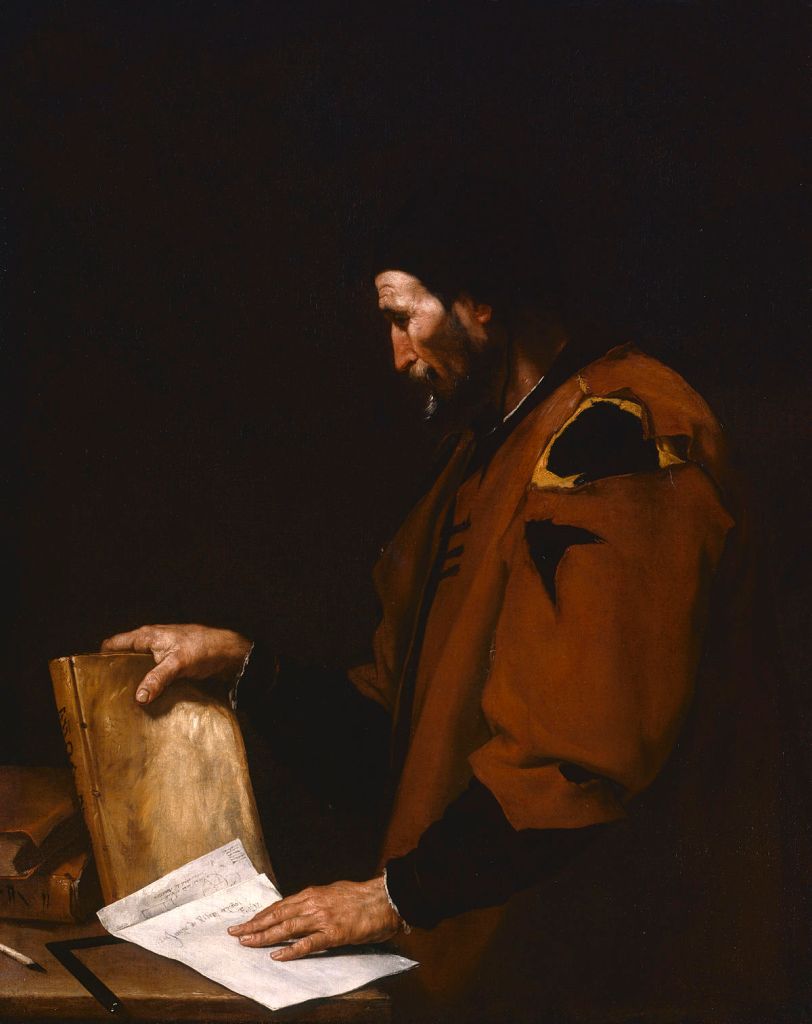
Oil on canvas, 120 cm × 99 cm
Indianapolis Museum of Art, Indianapolis
https://en.wikipedia.org
Once I started the preliminary painting and introduced my own hand, I was able to develop an understanding of perspective, which was a revealing discovery of the artist perception as to how the work might be viewed, and from which angle. During the preliminary process of painting (trial and error) I felt I needed to include both hands, the right hand of Aristotle and my left hand.
One of the challenges for this exercise was creating depth and perspective and the transition to a three-dimensional piece of work. To address this, and as the background was in darkness, I incorporated other props, a lamp to provide directed light (and many reworkings of the painting). In the original painting, a light source highlights Aristotle’s left hand, the loose documents, and the surface of the table. By incorporating the documents under Aristotle’s left hand as props, and bringing them over the edge of the table, I felt this added to the sense of perspective by bringing the foreground out of the picture plane. (See figure )
One of the challenges for this exercise was creating depth and perspective and the transition to a three-dimensional piece of work. To address this, and as the background was in darkness, I incorporated other props, a lamp to provide directed light (and many reworkings of the painting). In the origional painting, a light souce highlights Aristoles left hand, the loose documents and the surface of the table. By incorporating the documnetnts under Aristoles left hand as props, and bringing them over the edge of the table, I felt this added to the sense of perspective by bringing the foreground out of the picture plane. (See figure 8)

Although I used the same medium, colours and tones to replicate the focussed area of the original painting, it was inevitably that skin tones would be different. Although there was no personal sentiment or connection to the piece, I was determined to make it appear believable. On reflection – to achieve this I felt a contemporary piece of artwork would have been more suited to this exercise.
The fundamental change to the image is the transition from a flat surface to a three-dimensional artwork. The viewpoint and visual impact of the paper folding over the forward edge of the desk really brings the image into the viewers space. I really enjoyed creating the painting, but this illusion of entering the viewers space changes the impact of the painted image (rather than the whole painting of Aristotle).

Reflection
By focussing on just the hands I did not feel that the image created the same impact as when it depicts Aristotle’s weathered face and torn robes. It is the whole painting that tells the storey of the beggar philosopher, not just the hands. This made me question my selection of the image to replicate.
As previously suggested, the image has now been transformed to a three-dimensional image, both by introducing my own body part and connecting the painting with the props and the hand.
With my selected painting, I had not viewed this exercise as evoking memories or with any nostalgia. However, on reflection and quite unconsciously, my selected painting of Aristotle does bare some significance to my own life. Whilst I am most certainly no philosopher, the fact that I wore a dinner jacket and white shirt to stage this exercise late into the evening seems far removed from my childhood as a farmers boy who left school with only one GCSE to his name.
References
Alpenfels, D.Sc., E., n.d. The Anthropology And Social Significance Of The Human Hand. [online] Oandplibrary.org. Available at: <http://www.oandplibrary.org/al/pdf/1955_02_004.pdf> [Accessed 14 April 2020].
Bergland, C., 2013. The Neuroscience Of Speaking With Your Hands. [online] Psychology Today. Available at: <https://www.psychologytoday.com/us/blog/the-athletes-way/201307/the-neuroscience-speaking-your-hands> [Accessed 14 April 2020].
Ceurstemont, S., 2019. Link Between Music And Speech Rhythm In Brain Could Provide Language Insight. [online] Horizon: the EU Research & Innovation magazine. Available at: <https://horizon-magazine.eu/article/link-between-music-and-speech-rhythm-brain-could-provide-language-insight.html-0> [Accessed 15 April 2020].
Embassy, U., 2020. Traveling In A Muslim Country. [online] UAE-embassy.org. Available at: <https://www.uae-embassy.org/about-uae/travel-culture/traveling-muslim-country> [Accessed 14 April 2020].
Gammell, C., 2008. Arab Culture: The Insult Of The Shoe. [online] Telegraph.co.uk. Available at: <https://www.telegraph.co.uk/news/worldnews/middleeast/iraq/3776970/Arab-culture-the-insult-of-the-shoe.html> [Accessed 14 April 2020].
Herdrich, S., 2015. John Singer Sargent’s Portrayal Of Hands. [online] Metmuseum.org. Available at: <https://www.metmuseum.org/exhibitions/listings/2015/sargent-portraits-of-artists-and-friends/blog/posts/sargent-portrayal-of-hands> [Accessed 15 April 2020].
McCurry, S., 2019. Silent Language Of Hands. [online] Steve McCurry Curated. Available at: <https://stevemccurry.blog/2019/01/08/silent-language-of-hands-2/?fbclid=IwAR3mBcaKzFc0ZVLdk1nGKiNgUbURcwgcgdSkG5fe0ZmvUzyWc0GdwYHmFfM> [Accessed 12 April 2020].
McGavin, D., 2014. The Incredible Human Hand And Foot. [online] BBC News. Available at: <https://www.bbc.co.uk/news/science-environment-26224631> [Accessed 12 April 2020].
Metmuseum.org, 2020. The Clenched Left Hand (Study For Hand Of Pierre De Wiessant). [online] Metmuseum.org. Available at: <https://www.metmuseum.org/art/collection/search/207496> [Accessed 14 April 2020].
Neshat, S., n.d. Shirin Neshat – Gladstone Gallery. [online] Gladstonegallery.com. Available at: <https://www.gladstonegallery.com/artist/shirin-neshat/#&panel1-16> [Accessed 14 April 2020].
Palmer, B., 2008. Voting With Their Feet. [online] Slate Magazine. Available at: <https://slate.com/news-and-politics/2008/12/what-do-iraqis-find-so-insulting-about-shoes-and-feet.html> [Accessed 16 April 2020].
Stieglitz, A., 2020. Georgia O’keeffe. [online] Metmuseum.org. Available at: <https://www.metmuseum.org/art/collection/search/271640> [Accessed 15 April 2020].
W Young, R., 2003. Evolution Of The Human Hand: The Role Of Throwing And Clubbing. [online] Ncbi.nlm.nih.gov. Available at: <https://www.ncbi.nlm.nih.gov/pmc/articles> [Accessed 11 April 2020].

