Exercise 1 – Smallest to largest reach
Aim: Explore your physical and sensory relationship to the act of drawing. These activities call for continuous and repeated mark making, exploring the quality of line – continuous, dotted, dashed, heavy light, straight curved etc. Try to focus on what you are doing rather than the visual qualities of the marks. Repeat the exercise a number of times sustaining the activity as long as possible. Each time focus the activity through one of the following: movement in relation to your breath; sound and rhythm of graphite as it makes contact with the paper; the relationship of your whole body to the surface of the drawing – the stretch needed, proximity of your body to the picture surface etc; the nature of the experience if you draw with both hands.
Sketchbook pages – NA
Having already acquainted myself with the expressive artworks of Jackson Pollock, Tony Orrico, and Shen Wei it was important to keep an open mind for this exercise. During a recent conversation with my tutor, she reminded me that it was important to experiment without worrying about the outcome, and to sometimes break away from the ‘norm’, although the latter can be difficult when following a prescribed curriculum. That said, as I discovered during Level 2 it’s important that your art, and artistic creativity surprises and excites you, otherwise what is the point of it!
You don’t need a hammer to crack a nut. However, having rolled out a piece of Fabriano paper along the wall of my studio – that’s what sprang to mind. As the exercise was progressive, in so much as applied pressure and movement I felt it important to distinguish each act – and although my heart wanted to go large from the off, such a simple exercise required a degree of self-control.
Experimenting with different drawing media created different marks, mostly as a result of how contact was made on the surface, either through the angle of the drawing media against the surface and as a result the pressure applied.
Trying to use an implement or tool with your fingers only, and without exercising the dexterity in your wrist was difficult, requiring concentration to override natural instincts to bend or rotate the wrist, whilst the brain was telling the hand that this was an un-natural activity. With brain training and repetition the outcome may have been different. With such restricted movement the length of each mark was limited; predominately to vertical lines and small rotational marks.
Incorporating the use of the wrist and elbow extended the range of movement and variation of marks that I was able to make. The most significant and visual impact came as a result of using a full range of movement from the hand through the shoulders to the back muscles.
For the final element of this exercise I returned to the piece of Fabriano paper (180×150 cm) I had secured to the wall of my studio. With a graphite stick in each hand, standing at the centre of the paper and approx. 12 inches from the wall, I started to draw; using both hands in unison in a rotating gesture. This mirrored my breathing and as the exercise progressed my actions and breathing become more controlled. It felt as if my action were a reflection of my breathing rather than the other way around. Was I in a state of mediation!
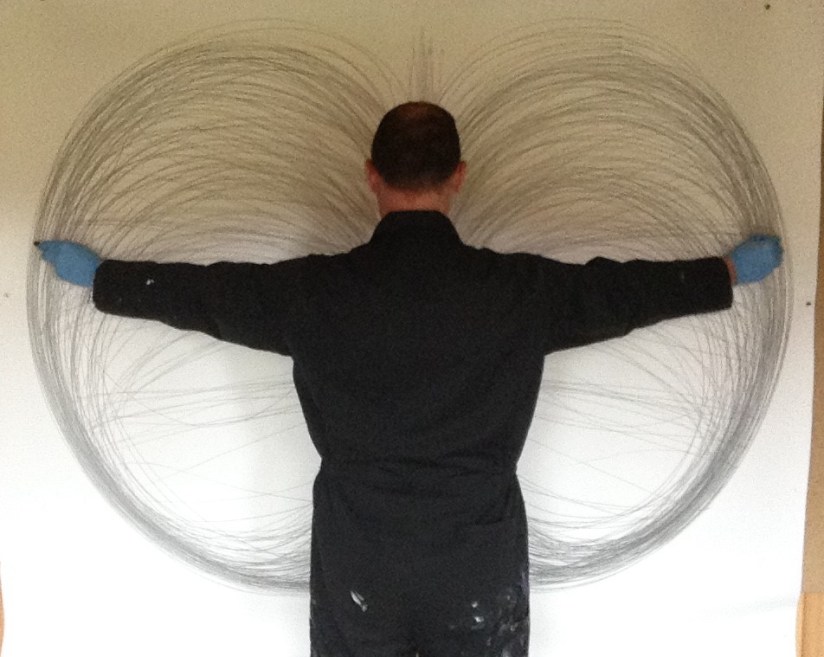
Becoming conscious of my actions I noticed the sound of graphite as it made contact with the paper softened or hardened dependent on my rhythm, and the pressure being applied.
Stepping back from the wall a further 12 inches I reduced the limit of my reach, alternating arm movements that overlapped in the centre of the support. This felt somewhat awkward, less rhythmic; forced and requiring more effort. Being closer to the support and using both arms at the same time was comfortable, and rhythmic. I felt that I could have maintained this for some time.
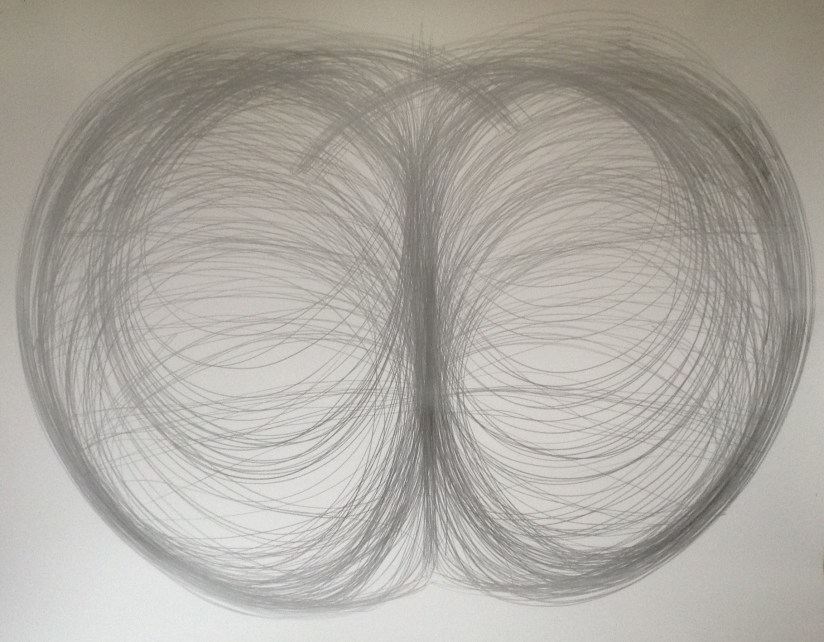
I repeated this exercise using charcoal and graphite sticks, and different movement gestures that returned to the centre of the support after each stroke. This action required more physical exertion to punch out with both arms simultaneously. The charcoal sticks were quickly worn down and I noticed that I was applying more pressure with what I would consider my weaker arm. This may be a result of having greater control on the more dominant hand.
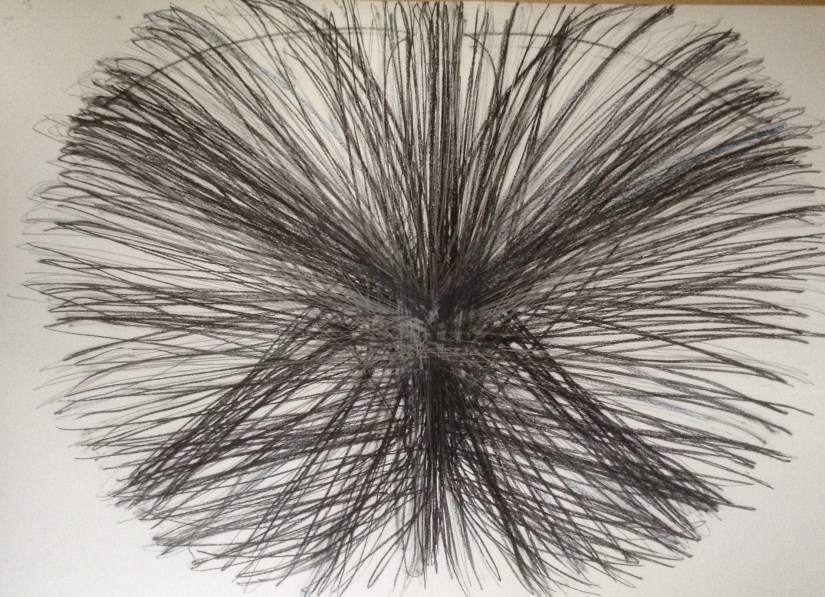
This was an interesting exercise. I had previously developed an interest and enjoyment in the process of painting, and this excise explored that further. To think about the act of drawing, rather than the outcome, breathing, relaxation and clearing the mind. Working on a large piece of paper certainly facilitated the flexibility to open up the body and be expressive. This performance, performed in your own private space, becomes just that – private.

