Artists such as Robert Smithson, Robert Morris, Dan Graham and Anish Kapoor have used mirrors and mirrored surfaces. Find examples of their works online, in books or in journals. Reflect on the ways in which these works cut out and consume space within an environment. What is the viewer’s relationship to these works? Compare this to the position of the viewer in relation to Manets’ A Bar at the Folies-Bergere.
Reflected images have a long history of symbolism in art, the most common of which is arguably Narcissus, who gazed into a lake and fell in love with his own likeness, a scene that has been recreated by everyone from Caravaggio, Narcissus (1597-99) (See figure 1) to Salvador Dalí Metamorphosis of Narcissus (1937).

Courtesy of www.Caravaggio.org (2020)
The mirror, found in an immeasurable number of paintings, is also a way of expressing the iniquities of vanity or to concealed messages, such as the vanitas hidden within the background of the Jan van Eyck’s Arnolfini Portrait (1434).
In contemporary art, the mirror an immanent instrument to convey an allegory of self-reflection and the complexity of identity, (Black, 2019) although the symbolic meaning of mirrors in art remains ambiguous – and is left to the interpretation of artist of viewers to draw their own conclusions.
Robert Smithson (1938–1973) is perhaps best known for his monumental earthworks that both exploit and manipulate the natural landscape. Corner Mirror with Coral, (1969) (see figure 2) was an example of what the artist called “non-site” … “Instead of putting a work of art on some land, some land is put into the work“. By placing three mirrors in the corner of a room, two on adjoining walls and one on the floor, the reflected surfaces transforms a quarter of coral in a circle. The viewer’s perception shifts as they move through space, displacing the solidity of the landscape and breaking up its forms. (Graziani, 2005, p. 78)

(www.moma.org, 2020)
Smithson’s Ithaca Mirror Trail, (1969) was a series of photographs documenting a walk with a mirror outside the city of Ithaca, New York. The reflections are both continuous and refracted within the landscape in which they appear. They are conjoined opposites of sky and ground, rocks and snow, dark shadows and light. Smithson as the photographer manipulates the angle of view thereby disrupting a sense of order and challenging our senses.
Chalk Mirror Displacement (see figures 3 and 4) is another of Smithson’s site/non-site pieces. In its transition from a site to a non-site location, the process purposefully blurred the boundaries between art and its environment/ (Chalk-Mirror Displacement | The Art Institute of Chicago, n.d.) For the viewer, they are left to contemplate the rupture of space, confusion between reality and reflection, the illusion of depth and the connection between past and present.

© Estate of Robert Smithson, VAGA, New York/DACS, London 2012
(www.tate, 2020)
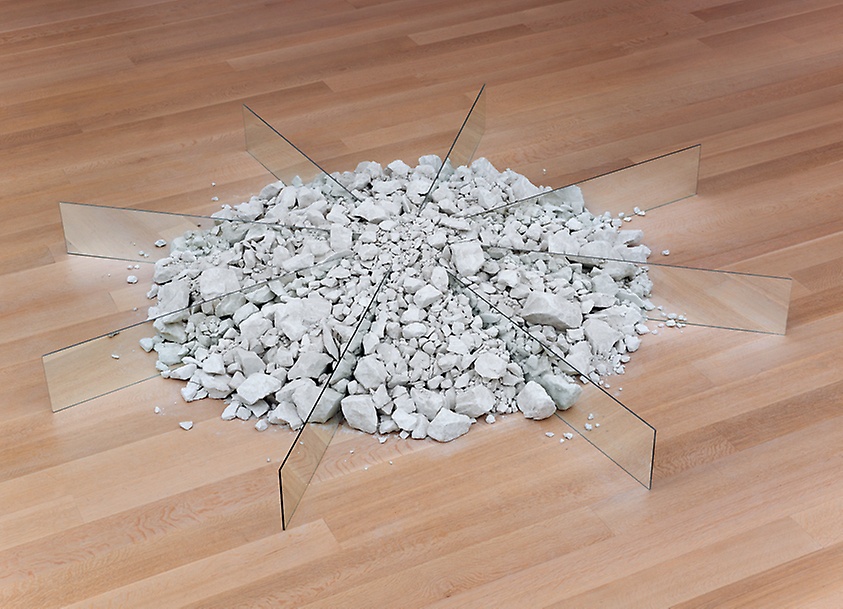
Art © Estate of Robert Smithson / Licensed by VAGA, New York, NY
(www.artic.edu/artworks/93345/chalk-mirror-displacement, 2020)
The early works Robert Morris (b. 1931) explored notions of space and movement, often incorporating mirrored surfaces. Untitled (1965), was an asymmetric arrangement of four mirrored cubes measuring exactly three feet square, which reflected both the surrounding exhibition space and the body of the viewer within it. Refractions, (see figures 5 and 6) was a solo exhibition featuring a sequence of six works produced at various points during Morris’s career, displaying his unconventional handling of sculptural forms to create dynamic and sensory relationships between object, space, and viewer. (A.R.M, 2016)
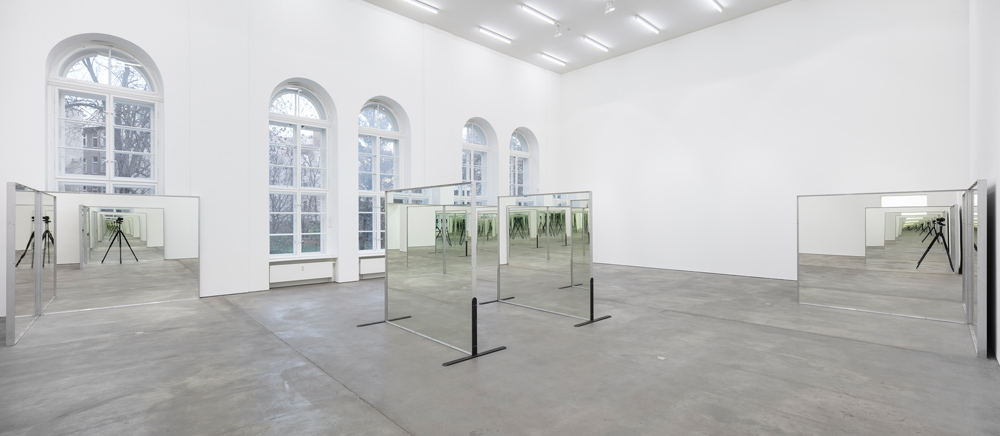
( http://www.spruethmagers.com/exhibitions/418@@viewqex5, 2020)

( http://www.spruethmagers.com/exhibitions/418@@viewqex5, 2020)
Having not seen either of these installations in person, I was left contemplating how this installation was experienced by viewer’s as they moved around the cubes, or weaved in and out of the Refractions installation, and how this changed when viewed in the gallery space. Compacting and reflecting light to distort the illusion of space and depth as surfaces reflect upon each other, further distorting the viewer’s image.
Dan Graham (b. 1942) Public Space / Two Audiences, (1976) was an installation of two opposing mirrors that reflect both sides of its subjects; creating an opportunity to observe a stranger, albeit only for an instant, before recognizing the stranger as oneself. Octagon for Münster, (1987) (see figure 7) was a mirrored octagonal pavilion. With no windows and only one side serving as a hinged door, it enabled visitors to step into the structure. The reflective two-way mirrored glass of the walls completely shielded visitors from view, but also distorted their view of the outer world.
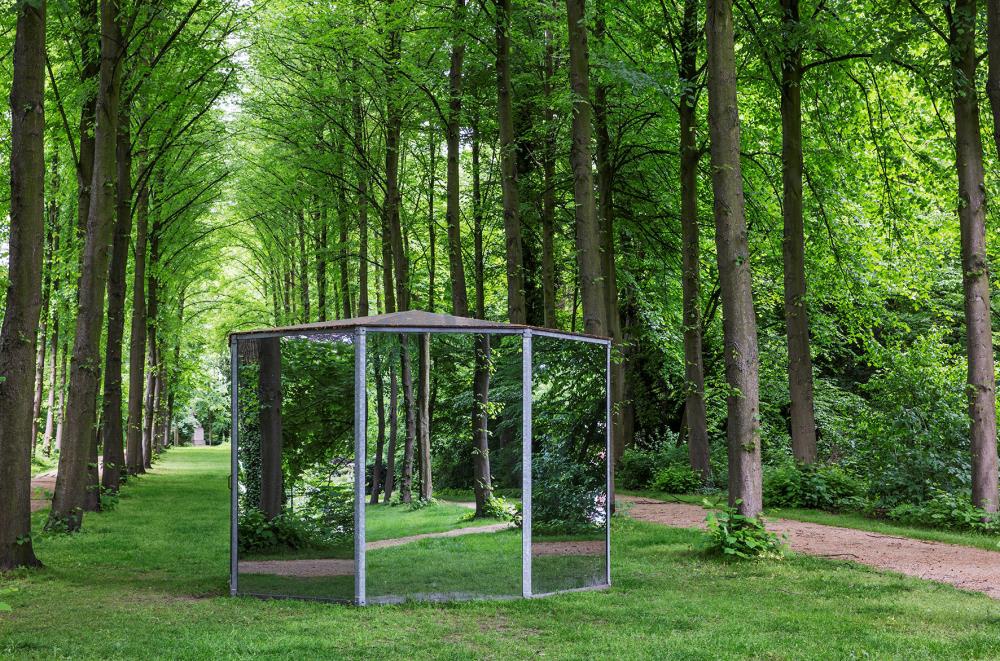
Photo by Hanna Neander, 2017. Available at: <https://www.skulptur-projekte-archiv.de/en-us/1987/projects/50/> [Accessed 3 May 2020].
Anish Kapoor (b. 1954) creates sculptures using reflective material; manipulated, organic forms that use elements of both art and design to produce meditative or serene atmospheres. (Jackson, 2018)
Kapoor’s mirrored surfaces, such as Cloud Gate (2006) (see figure 8) and Sky Mirror (2001), which reminded me of Rene Magritte’s The False Mirror (1928), are presented as sculptures that invite the viewer to touch and experience a disorientating and distorted reality that is somehow familiar. This disconnect from reality allows the viewer a narcissistic view – without discomfiture. Kapoor literally holds up a mirror to the complexity of our understanding of our identity and our place in the world.

https://www.dailyartmagazine.com/anish-kapoor-scale-sculpture/ (2020)
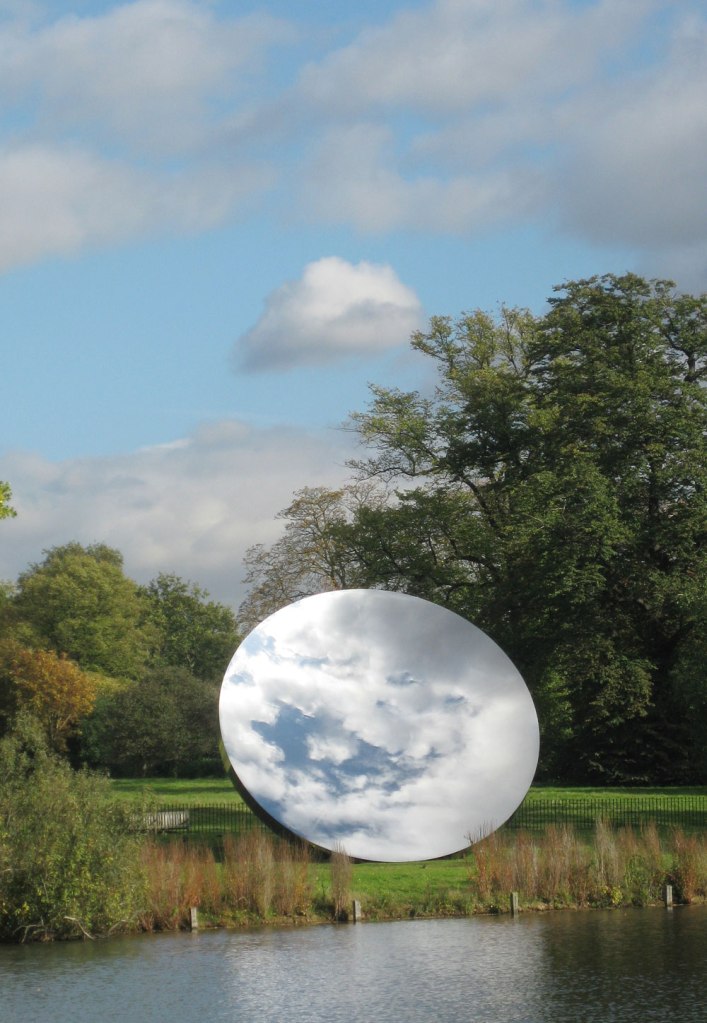
http://anishkapoor.com/273/sky-mirror-3 (2020)
Many mirrored art installations or sculptures, particularly those that cut through or become part of a public space, require audience participation. Further to those artist works previously mentioned, Lucas Samaras’ Room No. 2 (1966) also known as Mirrored Room, encouraged viewers to enter and experience rather than passively view. (Lucas Samara “Mirrored Room” 1966, 2016) (Zhang, 2015)
In Edouard Manet’s A Bar at the Folies-Bergère, (1882) (see figure 10) the position of the barmaid suggests that the viewer, standing directly in front of the barmaid, should expect to see her reflected image in the mirror behind her. However, Monet deliberately mispresents the reflection and replaces the viewer with the figure of a man. Similar visual illusions within the painting create ambiguity and confusion.

Courtauld Gallery, London
@ wikipedia.org (2020)
In a similar manner, albeit somewhat disturbing yet equally intriguing is Rene Magritte’s Not to Be Reproduced (1937). By deliberately not portraying the man’s reflection, while the book is reflected in the mirror, the viewer is left disconcerted.

Courtesy of www.ReneMagritte.org (2020)
References:
A.R.M, 2016. Art Research Map – Robert Morris ‘Refractions’. [online] Art Research Map. Available at: <http://artresearchmap.com/exhibitions/robert-morris-refractions/> [Accessed 2 May 2020].
Black, H., 2019. Reflecting The Self: Mirrors In Contemporary Art – ELEPHANT. [online] ELEPHANT. Available at: <https://elephant.art/reflecting-the-self-mirrors-in-contemporary-art/> [Accessed 1 May 2020].
Cotilletta, J., 2017. [online] Academicworks.cuny.edu. Available at: <https://academicworks.cuny.edu/cgi/viewcontent.cgi?article=1694&context=cc_etds_theses> [Accessed 3 May 2020].
Elcultural.com. 2004. Robert Smithson | El Cultural. [online] Available at: <https://elcultural.com/Robert-Smithson> [Accessed 1 May 2020].
Enright, R. and Walsh, M., 2009. Dan Graham: Mirror Complexities. [online] Bordercrossingsmag.com. Available at: <https://bordercrossingsmag.com/article/dan-graham-mirror-complexities> [Accessed 2 May 2020].
Everything is Temporary. 2016. Lucas Samara “Mirrored Room” 1966. [online] Available at: <https://everythingistemporary2016.wordpress.com/2016/11/09/lucas-samara-mirrored-room-1966/> [Accessed 3 May 2020].
Goddard, D., 2005. Robert Smithson – Review By Donald Goddard. [online] Newyorkartworld.com. Available at: <https://www.newyorkartworld.com/reviews/smithson.html> [Accessed 2 May 2020].
Goscilo, H., 2010. The Mirror In Art: Vanitas, Veritas, And Vision. [online] New Prairie Press. Available at: <https://doi.org/10.4148/2334-4415.1733> [Accessed 1 May 2020].
Graziani, R., 2005. Robert Smithson And The American Landscape. Cambridge University Press, pp.78-79.
Jackson, K., 2018. Artdependence | Symbolism In Art: Anish Kapoor – Mirrors. [online] ArtDependence. Available at: <https://www.artdependence.com/articles/symbolism-in-art-anish-kapoor-mirrors/> [Accessed 2 May 2020].
Jackson, K., 2018. Artdependence | Symbolism In Art: Anish Kapoor – Mirrors. [online] ArtDependence. Available at: <https://www.artdependence.com/articles/symbolism-in-art-anish-kapoor-mirrors/> [Accessed 3 May 2020].
Manevskaya, A., 2017. Reflecting The Invisible Or Distorting The Visible: Mirrors In Art – Dailyartmagazine.Com – Art History Stories. [online] DailyArtMagazine.com – Art History Stories. Available at: <https://www.dailyartmagazine.com/reflecting-the-invisible-or-visible-mirrors-in-art/> [Accessed 1 May 2020].
Selvin, C., 2019. Yayoi Kusama ‘Infinity Room’ Heads To Toledo Museum Of Art As Part Of ‘Multi-Sensory Experience’ Push. [online] ARTnews.com. Available at: <https://www.artnews.com/art-news/news/yayoi-kusama-infinity-room-toledo-museum-13326/> [Accessed 1 May 2020].
Smithson, R., 1969. Artworks | Holt/Smithson Foundation. [online] Holtsmithsonfoundation.org. Available at: <https://holtsmithsonfoundation.org/artworks-robert-smithson> [Accessed 1 May 2020].
Smithson, R., 1996. Biography | Holt/Smithson Foundation. [online] Holtsmithsonfoundation.org. Available at: <https://holtsmithsonfoundation.org/biography-robert-smithson> [Accessed 2 May 2020].
The Art Institute of Chicago. n.d. Chalk-Mirror Displacement | The Art Institute Of Chicago. [online] Available at: <https://www.artic.edu/artworks/93345/chalk-mirror-displacement> [Accessed 2 May 2020].
The Courtauld Institute of Art. 2020. Édouard Manet, A Bar At The Folies-Bergère – The Courtauld Institute Of Art. [online] Available at: <https://courtauld.ac.uk/gallery/collection/impressionism-post-impressionism/edouard-manet-a-bar-at-the-folies-bergere> [Accessed 3 May 2020].
Zhang, J., 2015. New Mirrored Infinity Room Immerses Viewers In Mesmerizing World Of Endless Reflections. [online] My Modern Met. Available at: <https://mymodernmet.com/lucas-samaras-mirrored-infinity-rooms/> [Accessed 3 May 2020].
 Painting 2 - Studio practice

