Exercise 1.1 Painting without the brush
Aim: Set up a series of experiments that allow you to work with paint, apply it to a surface and expand the idea of the gesture. Work at a large scale either on the floor or on the wall; consider what seems appropriate to the tools and actions you are using.
Sketchbook 1. Pages 1-3
As tempting as it was to roll out a large sheet of Fabriano paper and start throwing down paint in the style of Jackson Pollock, I started with notes and doodles (yes, doodles) in my sketchbook. Whilst the exercise expanded on gesture and centred on the application and manipulation of paint without using a brush, I wanted to explore this further; controlled and uncontrolled actions, pressure and gravity nestled amongst my initial thoughts.
Before starting this exercise its worth considering the viscosity of paint as this will inevitably affect paint behaviour. Without oversimplifying the therapy, high viscosity paint will smooth out more slowly than low viscosity paint, it will flow more slowly, and drip more slowly, and it will retain the details of a brush impression for longer.
My selection of objects for this exercise included, string, balloons, eggs, a ruler, plastic containers, pegs…..and the list goes on. One aspect I hadn’t given much thought too was the time it took to prepare and set up each experiment, drying time etc.
Starting with a simple experiment I mixed oil paint with turpentine and linseed oil which I funnelled into balloon. Placing the balloon in an upturned box (see figure 1) over an oil paper support. I burst the balloon (an air burst). Most of the paint was propelled up inside the box leaving the area directly below the burst clear. (See figure 1) This is a natural reaction as a blast (or force) will find the weakest area to reealse pressure.
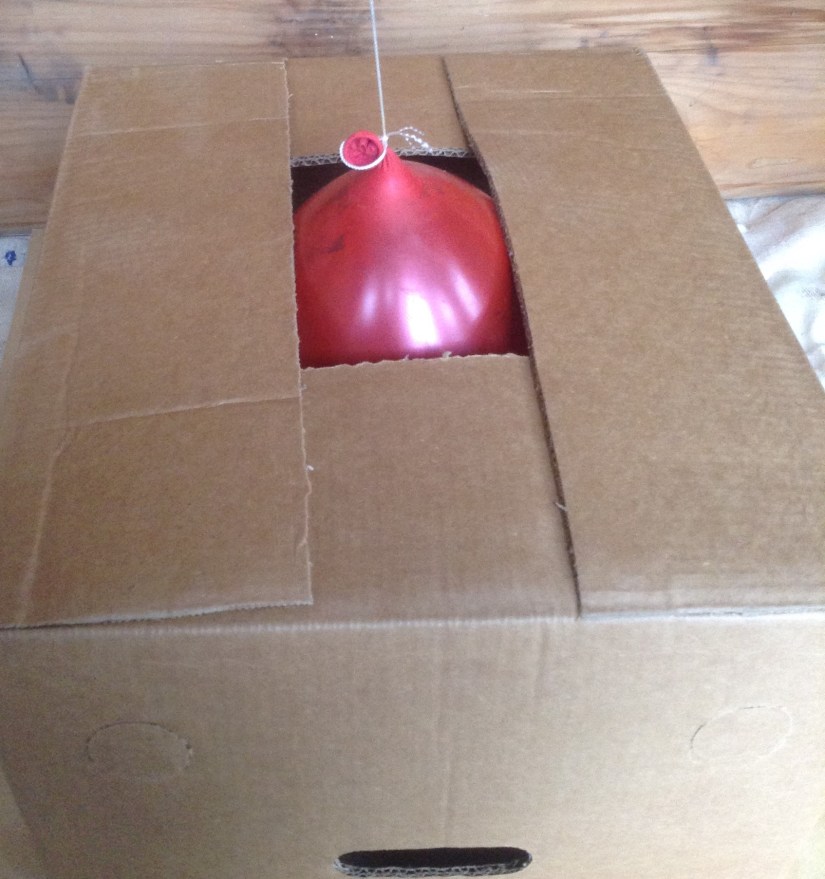
Fig. 1 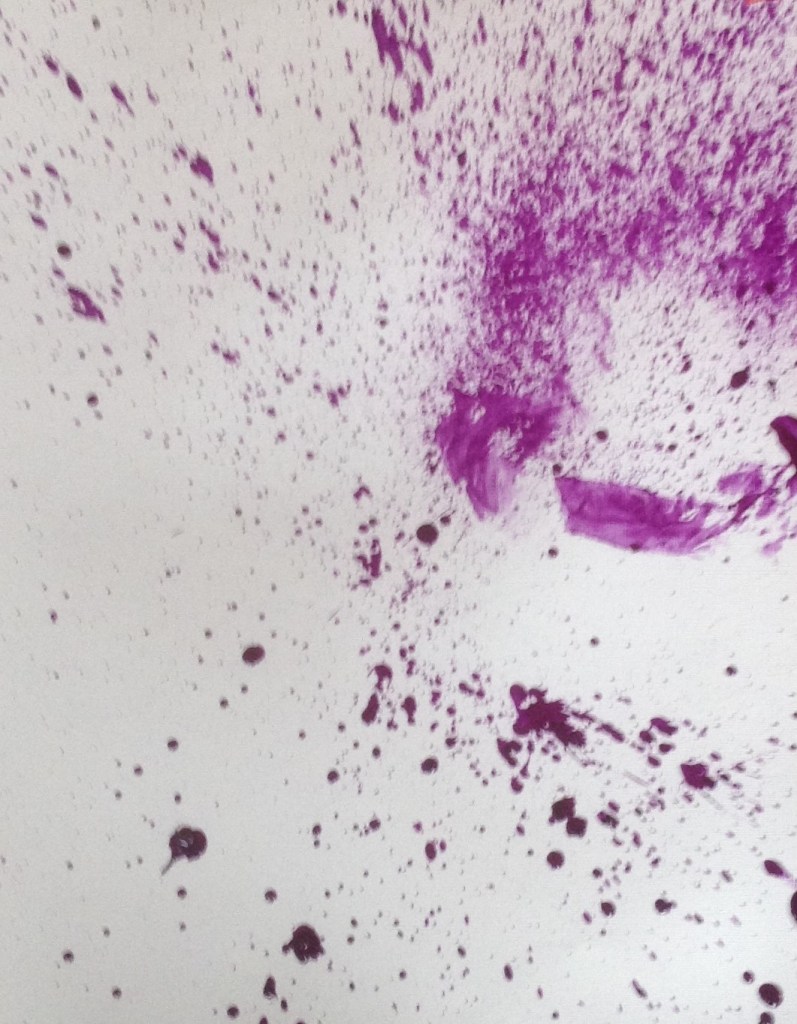
Fig. 2
I placed a drawing pin under the support and dropped a balloon onto it (ground burst), immediately releasing the paint to surge, uncontrolled across the support. (See figure 3)
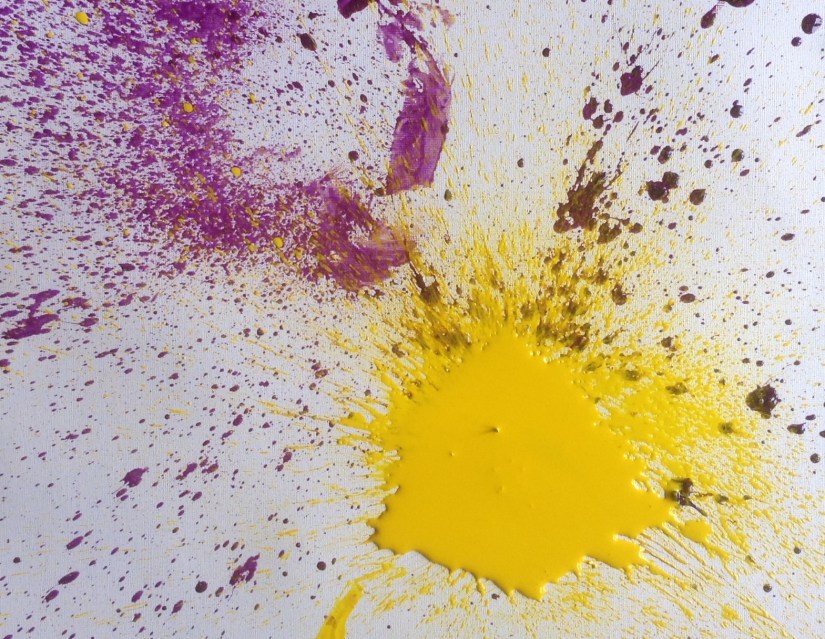
From this initial experiment the viscosity of paint, size and scale of the support would require further consideration and adapting for each experiment.
Gravity – paint filled balloons
Having secured a piece a Fabriano paper (151×81 cm) to a trestle table I stood this vertically in the garden. I added diluted acrylic paint to three balloons which were placed side-by-side and pinned to the support/trestle. The balloons were burst, and paint poured down the support. (See figure 4) The impact wasn’t as dramatic as I had anticipated but on reflection the reason for this was that ratio of fluid to air.
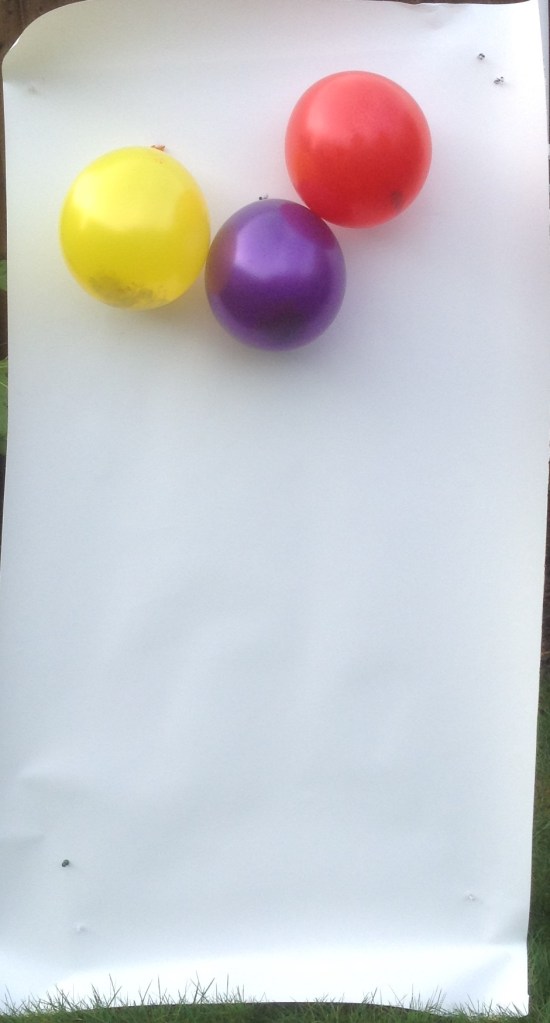
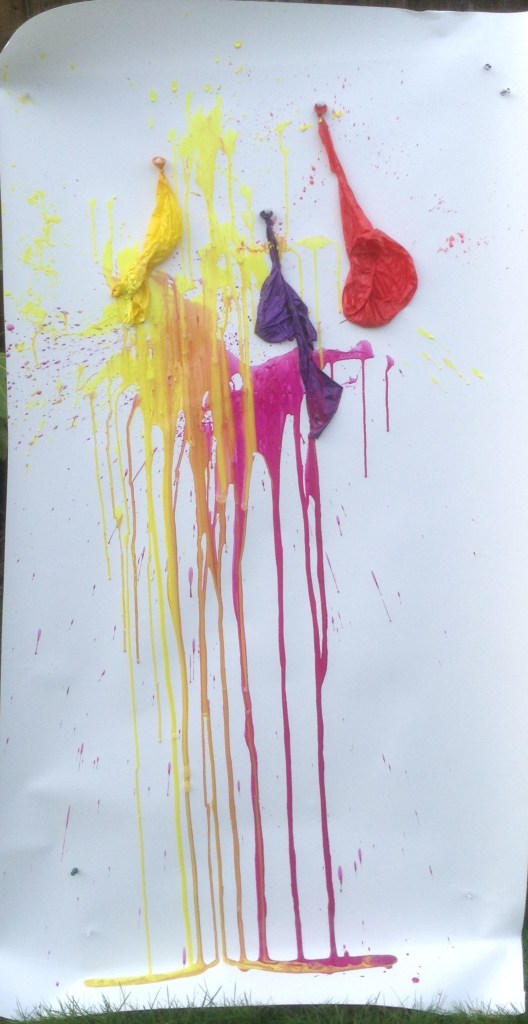
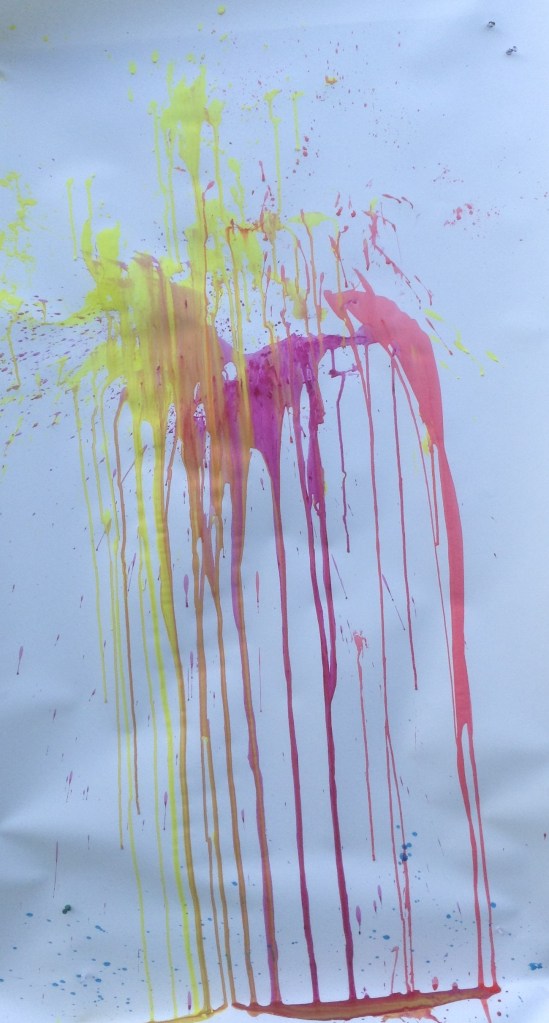
Diluted acrylic paint on paper 151 x 81 cm
Mop head strands
Strands of a mop head were dipped in water based paint and soaked for a couple of minutes. The support was watercolour paper (42×60 cm) and taped to an MDF board. After removing the excess paint from a strand I used each in turn as a painting tool; slapping, dragging or dropping to create marks. (See figure 5) With this exercise I physically had to engage in the act of making each mark. As the material became void of paint there was a noticeable difference to the mark being made; requiring more physical exertion, but he the marks were lighter, subtle and pattered.

Emulsion paint on paper 42 x 60 cm
Mop head strands – dripping
With most of the paint removed during the previous exercise I pinned the mop strands to a piece of MDF board and sprayed them with water. (See figure 6) There was still a sufficient amount of paint retained in the mop strands to release thin trickles of paint down the support.

Strands of a mop head dipped in emulsion paint 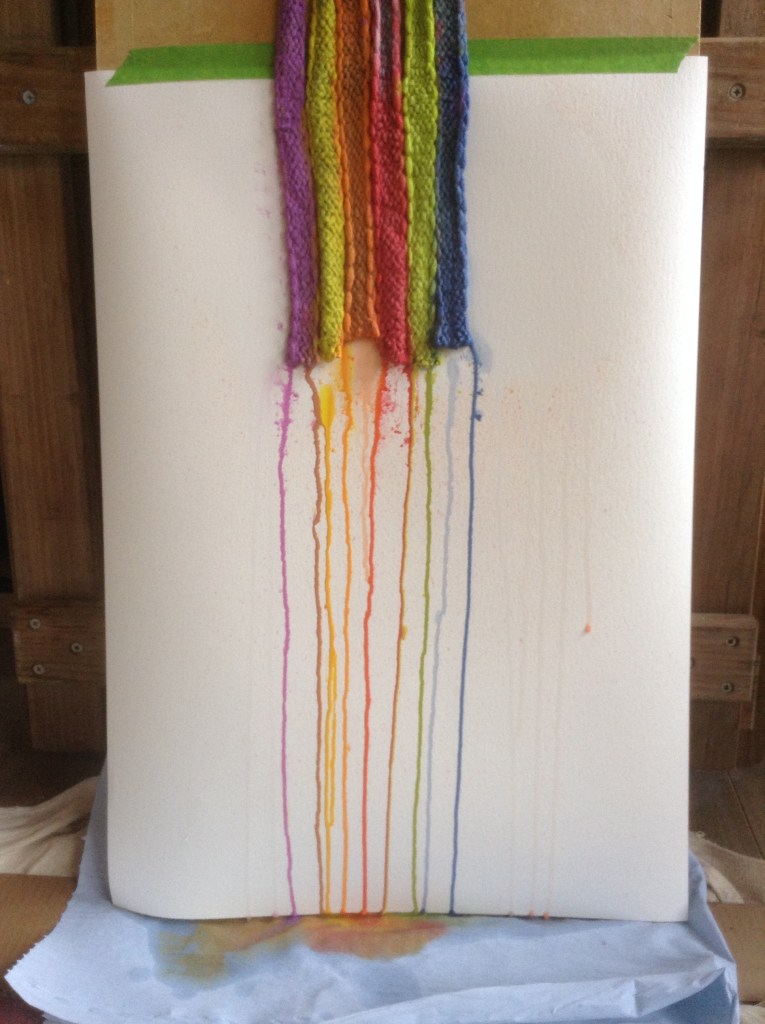
The sprayed with water
Impact
I pierced and drained the yoke of a chicken egg (which went to good use) leaving just a shell which was half filled it with a diluted acrylic paint. The support (60x42cm) was watercolour paper secured to a piece of MDF board. The support was lay flat on the floor and the egg dropped from about five feet. (See figure 7) There was no science as to how far the contents of the egg may spread in relation to the height from which it was dropped. The paint spread beyond the frame of the support and MDF Board which I felt gave a sense of energy and force to push beyond the boundaries. I left the broken eggshell on the support which I felt provided a visual concept to this piece.

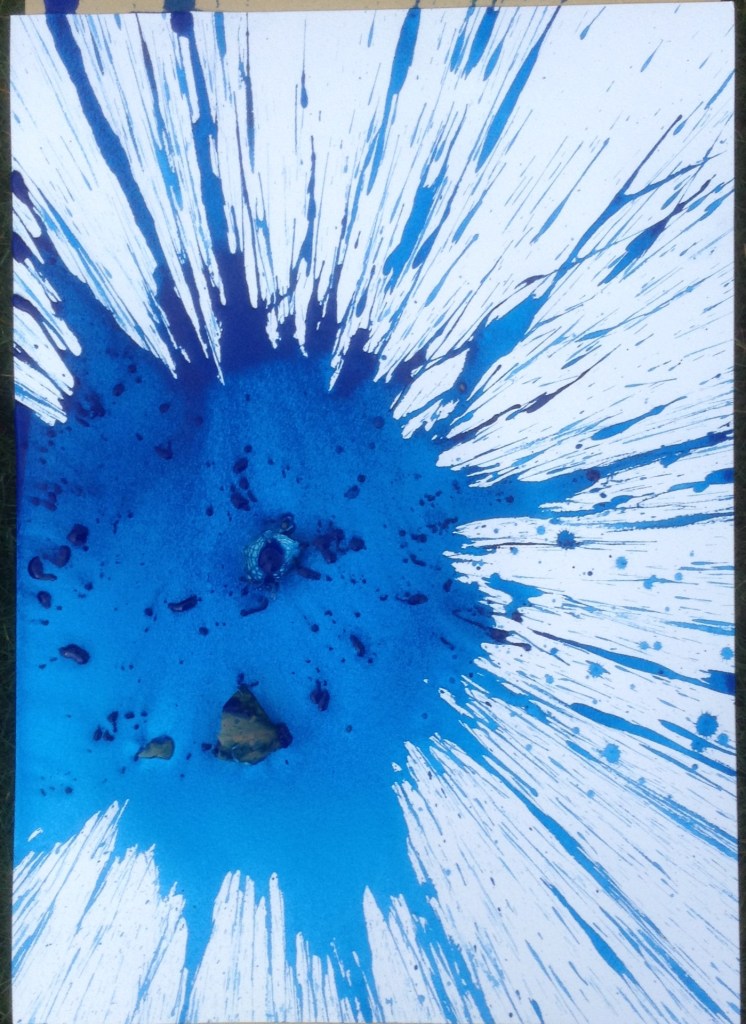
Diluted acrylic paint on paper, 42 x 60 cm
Pendulum
It would be fair to say that the outcome of this experiment was not what I had anticipated. The tools and method can be seen below. (See figure 8a.) The medium was black acrylic paint diluted with matt paint and water which was poured into a plastic milk container. As a result of the hole in the container being too large, paint quickly poured out and the momentum of the pendulum stopped. The paper support rippled and to create puddles of paint. Although the outcome wasn’t what I expected, it neither was it complete disaster. (See figure 8b.)
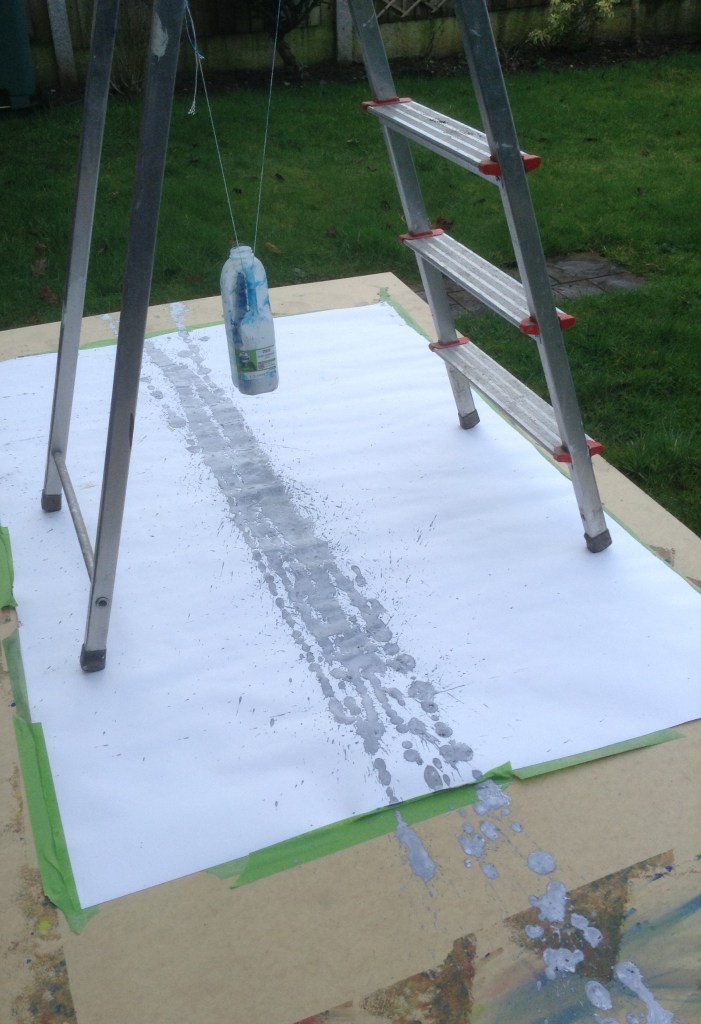
Fig. 8a. 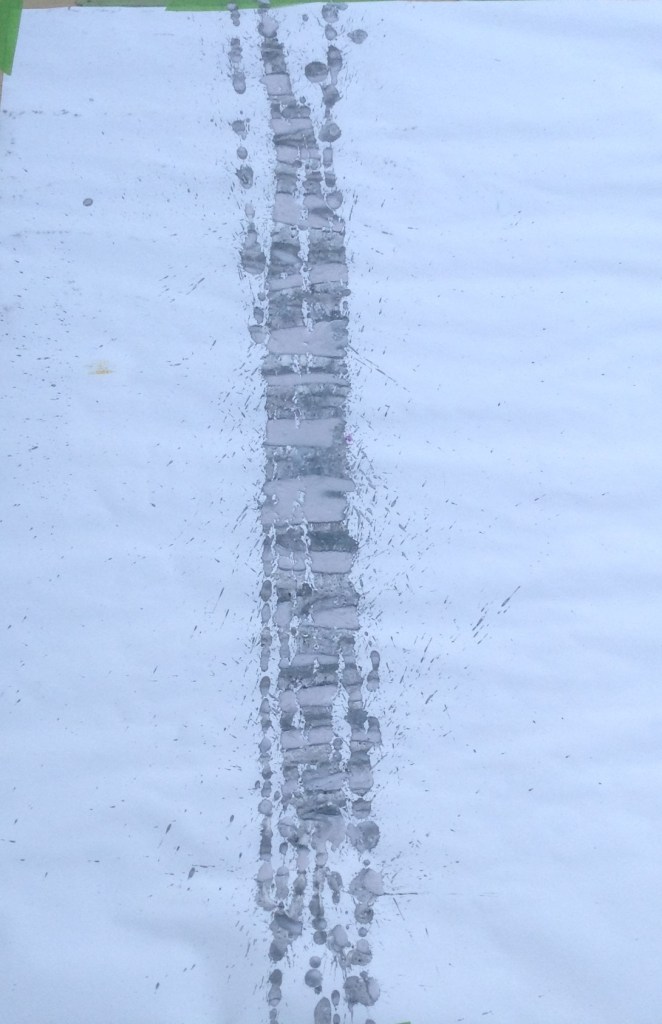
Fig. 8b.
Reflection
The forces involved i.e. gravity, velocity, inertia, action and reaction. The force applied in painting, or the force used to apply a medium has the potential to create a range and variety of outcomes, to create unique and unpredictable marks. In this instance I also believe that the means of applying are also significant to the outcome.
Movement of the body; role your body plays. In the context of Performance artists, the role and movement of the body plays a significant role in the artist’s mind-set and outcome of their art. Jackson Pollock’s technique of Action Painting placed considerable value on the rhythmic movement, getting into the canvas in a Chi like state and Janine Antoni used her body to apply paint. What I find fascinating with this is the subconscious synchronisation of body, mind and breathing to put one self in a place without distraction. For me this often relates to losing all track of time.
The role chance plays in the work. Chance is defined as the absence of any cause of events that can be predicted, understood. Something that happens unpredictably without discernible human intention or observable cause. The Dadaists embraced chance as their avenue to expression in their works of art, merging random occurrence with conscious creation. Akin to Jackson Pollock’s Action Painting, at the point paint is thrown, splashed or dribbled, it is inevitable that chance plays a weighty part in mark-making.
How does sustaining these actions over a period of time extend the possibilities? (Re-written after completing Assignment One). My original response to this questions was based on the degree of control when applying a medium. Having completed Assignment One my view has since changed. Through sustaining an action I was able to develop an understanding as to how mediums, tools, methods and even the viscosity of paint acted or responded to how it is applied to extend the possibilities of one’s own creativity.
Which becomes more significant to you, the painting itself, or your action in making it? I feel as if this is a loaded question and I am expected to say the painting itself. However, whilst I believe there has to be some significance applied to outcome, I currently apply more significance to the process or action of making it.
Do any of these actions have associations for you? What are the associations made by the artist Janine Antoni in her work Loving Care? Janine Antoni’s Loving Care expresses a sense of power, freedom, defiance and vulnerability. Expressing her dominance in a space that has been occupied primarily by male artists. (Pollock’s Action Painting and Yves Klein’s use of female models as paintbrushes) with the transformative difference that in her enactment she was both model and master). Her performance is observed by a gathered crowd which suggests that Loving Care was just more than an act of painting.
References
Shimamoto, S: “Theory of the Curse of the Brush” extract from ed, Petra Lange-Bernt, 2015, Materiality, Documents of Contemporary Art, London: Whitechapel Gallery and the MIT Press, p65-66. PT5SP_P22_Materiality, Documents of Contemporary Art_Theory of the Curse of the Brush_ P65.pdf
Tate. (n.d.). Gerhard Richter born 1932 | Tate. [online] Available at: https://www.tate.org.uk/art/artists/gerhard-richter-1841 [Accessed 18 Jan. 2020].
Winsornewton.com. (n.d.). Techniques and Materials in Abstract Painting. [online] Available at: http://www.winsornewton.com/na/discover/articles-and-inspiration/techniques-and-materials-in-abstrac-painting-us [Accessed 15 Jan. 2020].
 Painting 2 - Studio practice