Exercise 1.2: Before and after
Use either an image created in Exercise 1 or 1.1. Imagine this image as a still from a film or animation, what would the frames before and after this image look like? Using the format of a film or comic strip construct a series of painted images that imagine a narrative inspired by, and including, your original painted image.
Sketchbook 1. Pages 26-29
My understanding of a narrative is a structure that includes a beginning, middle and an end. A simple concept which sounds relatively straight forward – and in theory it is. The reality was that I struggled to develop a narrative around my props.
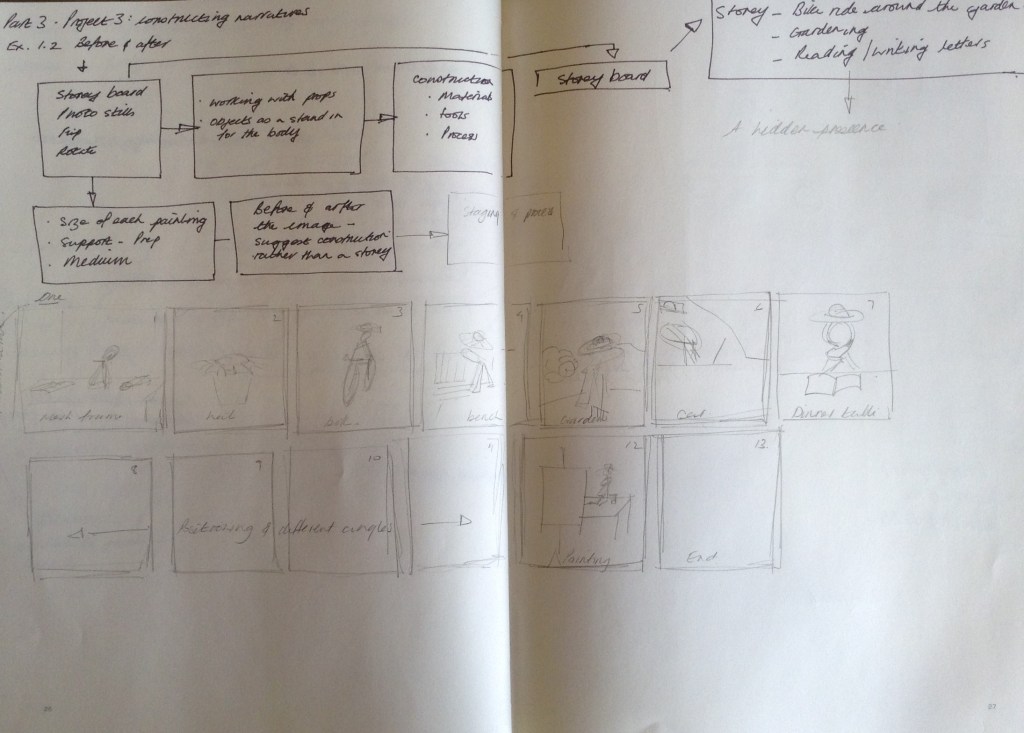
I worked through several options, (see figure 1) during which the props seemed to take on a life of their own (metaphorically) as I created different stories which if I had pursued, I would probably still be writing and painting.

I eventually worked on the narrative of the setting the stage (beginning) the finished painting (middle) and then removing the props from the setting (the end). After working through some options in my sketchbook, I settled on the six images shown at figure 2.
For the support I stretched oil paper (48×38 cm) on an MDF board. Once dry, I drew six equal rectangular boxes (each 18×15 cm) and an outline sketch of my scene in each one. (See figure 2)

Using acrylic paints, colours were pre-mixed on a damp paper palette. To avoid getting too tight with the detail I only used a #12 round and #2 filbert brush. The paint was diluted with water and applied quickly – like a wash. Once dry, I retraced some of the initial outline marks with a HB leaded pencil. (See figure 3)

With the six paintings set on a dark coloured mount, my intent was to add captions under each one. However, on reflection I felt that it may be more effective if they were presented in a linear fanfold and with no text captions. (See figure 4)
I felt that by adding text or captions it might look ‘comic strip’ which is what I wanted to avoid.

If time permitted and I was to repeat this exercise I would include different scenes into the narrative, ones which I had already developed in my sketchbook but was unsure how it would be viewed. This would include the making of the prop and being stowed away in my studio.
That said, I do feel that I managed to create a little vignette to illustrate a sequence of events; the where, who and general idea.
Following my research of Amy Sillman and Jutta Koether, I returned to this exercise to explore the possibilities of constructing narrative without a linear or chronological sequence. Inspired by Koether’s ‘Seasons and Sacraments’, my intent was to create a narrative by building layers like a performance that you could walk through. I had explored this idea previously but had rejected the idea as I was unable to think through a solution as to how I might execute this.
Reading James Elkins essay, he argues that because a painting or photograph is not a film or written text “the order of occurrence may not exist”, or “the order of telling is not clear”. In a painting or photograph this allows the viewer to interpret and visualise their own narrative.
Referring to my original sketches and paintings the aim was to create a narrative that blurred the boundaries between a still picture and scene in a movie, the transition from one scene to another. In Shillman’s ‘Draft of a Voice-Over for Split-Screen Video Loop’, lines of the poem are repeated, although the image constantly changes, flicking between the two screens. Using the concept of repetition, I included each item or figure twice or more; from varying angles or viewpoints. I embraced the idea of using visual techniques by zooming in and out, and using different colours to emphasis or reduce certain elements.

Fig. 5. Developing the narrative 
Fig. 6. Developing the narrative

Acrylic on paper, 48.5×36.5 cm
I was pleasantly surprised with the outcome – which I really liked. The image is abstract as objects interact or dissect across one another requiring the viewer to decode the painting by looking through it rather than at it.

