Review sketchbook and project work completed during Part One. Think about the ideas and approaches explored and what you have thought about and learnt to develop a series of pieces, based around the ideas, approaches and reflections explored in Part One.
Sketchbook 1. Pages 10-11

Reflection of Part One
On reflection of Part One, there were a number of strands that I was keen to explore further. Alternative painting tools and the use of tools in the creation of my artwork, the relationship between positive and negative space in an abstract or expressive piece of work, and how I might feel or connect with the finished piece(s). Inspired by the conceptual ideas of Jackson Pollock, Sougwen Chung, Akira Kanayama and Rebecca Horn’s, I wanted to see how I could create a piece of work without controlling the outcome – and on a large scale.
The use of paint filled balloons (burst), eggs (impact) and containers (gravity/pendulum) to apply paint had produced some interesting results, as had the use of a fan to move painting tools across a support to create marks; although this had also presented numerous challenges.
I had previously experimented with different viscosity of paints. With the intent of using a large support for this assignment, I opted for a water based matt paint (the type you buy in a DIY store) as it dried quickly. I was also keen to add other mediums to the paint including, PVA glue, modelling paste and ready mixed filler. For preliminary studies and experiments I used decorates lining paper as a support, which not only retained its shape when wet but was also a fraction of the price of Fabriano paper.
Preliminary studies
After much contemplation I felt that an electric power drill would make a suitable mechanical arm. I had initially attached a mixing paddle, but the circumference was too wide to fit in the paint pots. Instead, I had a selection of alternative tools/objects that I could insert into the chuck of the drill, which included, garden bamboo canes, strands of a mop head, a paint brush and strips of sandpaper (see figure 1).
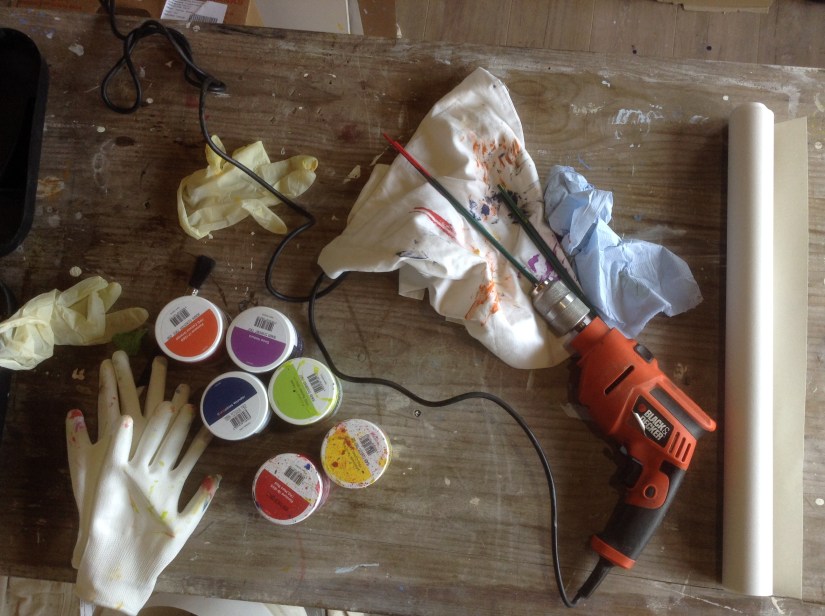
To compensate for the way paint was applied, I placed a roll of paper to cover the inside a mixing bucket. The bucket had vertical sides, so it didn’t taper at the base. For the first study I inserted a half-inch wide paint brush into the chuck of the drill. The brush was dipped into paint and held inside the bucket; horizontally central to the support. I repeated this multiple time with different coloured paints. The varying viscosity of paints and by alternating the drill speeds produced different marks. The volume of paint on the brush also had on effect on the marks which at times was akin to Pointillism, but without form (see figure 2).
By adding PVA glue, modelling paste and a ready mixed filler with Process Cyan acrylic paint, I was able to create texture. By loosely mixing these mixed mediums, when applied with the drill and brush, the grey filler and white modelling paste had retained some of its original colour; contrasting against the cyan. Whilst wet I applied a red water-based paint. Once dry to touch, the texture was lovely, and I really liked the undulating outcome (see figure 3).

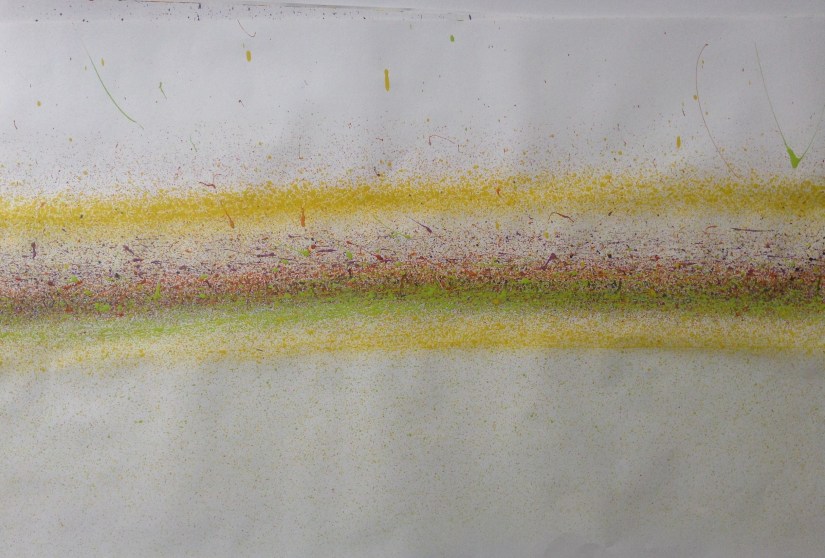
By fortune, in that the ends of the paper did not fill the circumference inside the bucket, I had created an image that was quite by accident. The outcome was nothing spectacular, but it did give rise for thought about positive and negative space, and the impact this may have on abstract artwork. The positive space in this equation is the place occupied by form, while negative is what remains between and around the form’s shapes. Further to this was the sense of positive in a negative atmosphere. In this case the vibrant palette evoking a positive atmosphere (see figure 4).

This was explored further with a series of studies one of which is below (see figure 5). In this case I had crudely cut a 2 cm strip in the support. Using the drill fitted with a half-inch brush a selection of coloured water-based paints was applied. Mounting the finished piece on different coloured cards created a different perspective of the negative space.

Water based paint on paper, 84×54 cm
Having exhausted the possibilities that I could conjure up with a drill and paint brush (not all of which are shown), I replaced the brush with bamboo canes. Attaching three bamboo canes of slightly different lengths [this was to vary the amount of paint on each cane] the tips were dipped into a blue water based matt paint. I had underestimated the length of the canes in relation to the circumference of the bucket and as the speed of the drill was increased, the bamboo splayed and tore through the paper support. Despite the support taring, the mark making in relation to the paintbrush was more sporadic (less control). Changing the angle of the drill also created different marks (see figure 6).

Using a single bamboo cane, I repeated this study with a selection of water-based coloured paints, applied wet-on-wet. The blue dominated but the mark making wasn’t dynamic (see figure 7).

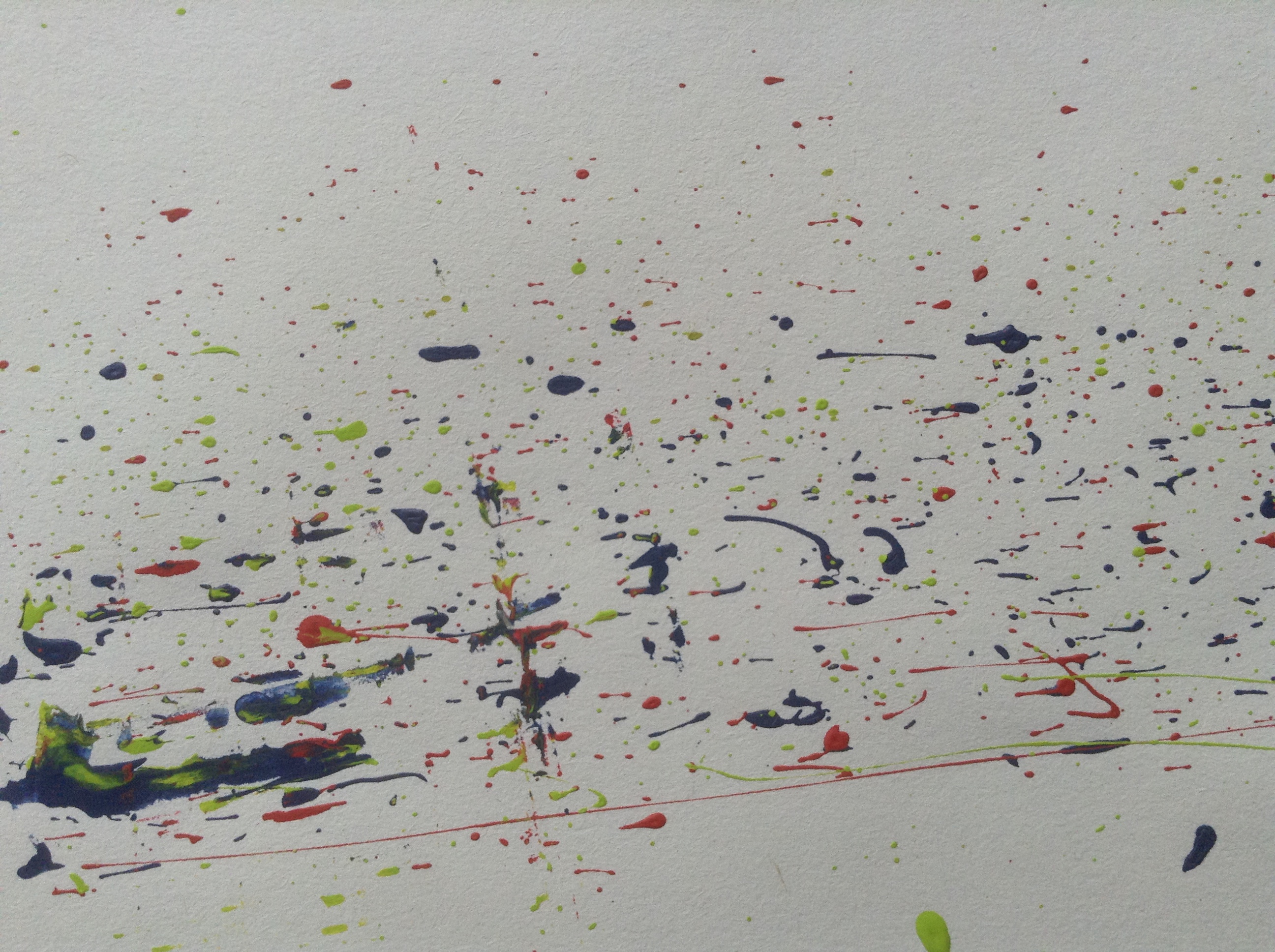
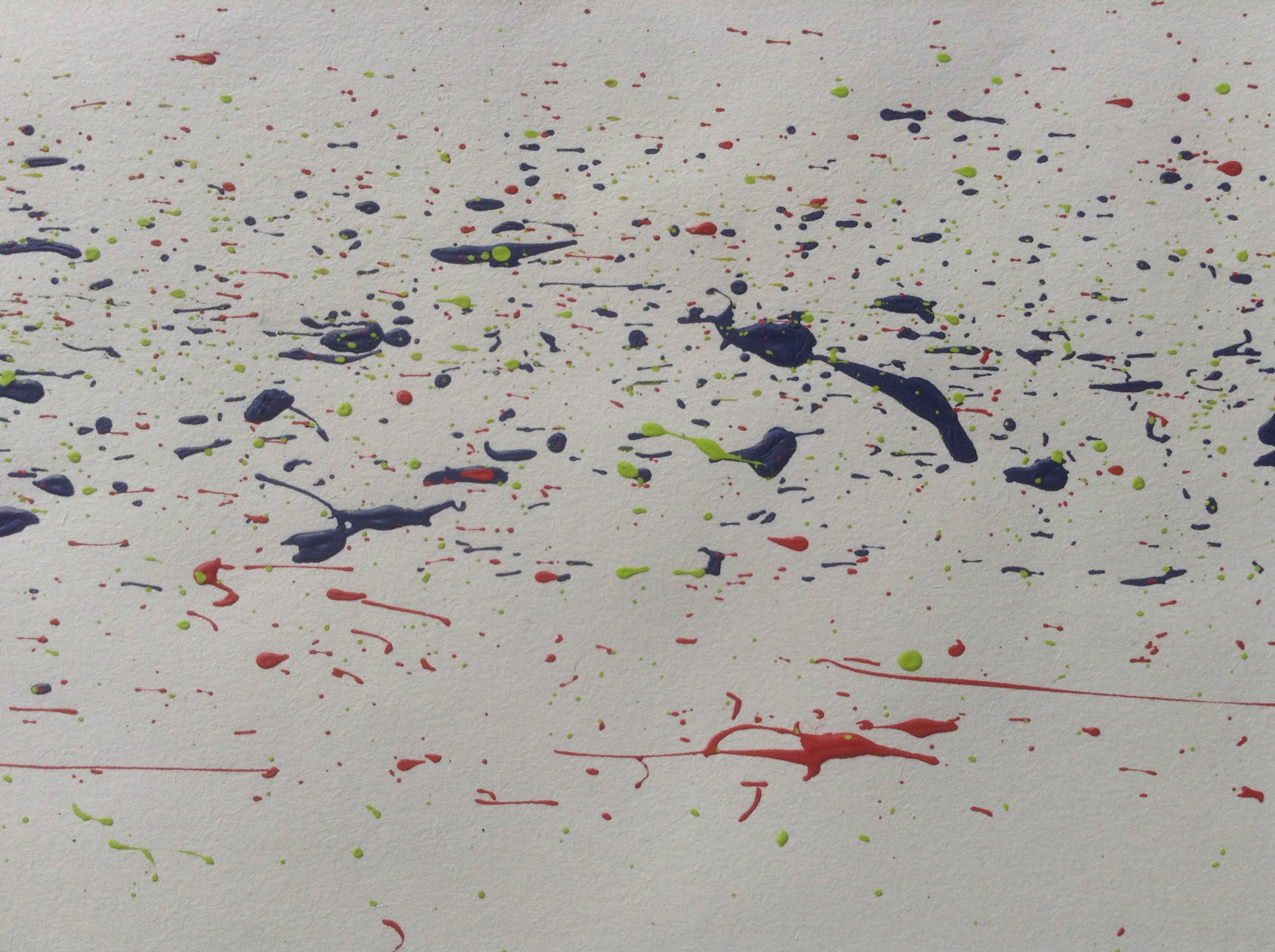
Placing three bamboo canes [each of a slightly different length] in the chuck and dipping all three into the same colour paint meant that more paint was retained and as a result produced a more dynamic outcome. I feel that this really accentuates the viscosity of paint in mark-making. The orange, purple and red paints reflecting energy whilst the blue, yellow and green paints reflecting a calm stillness (see figure 9).
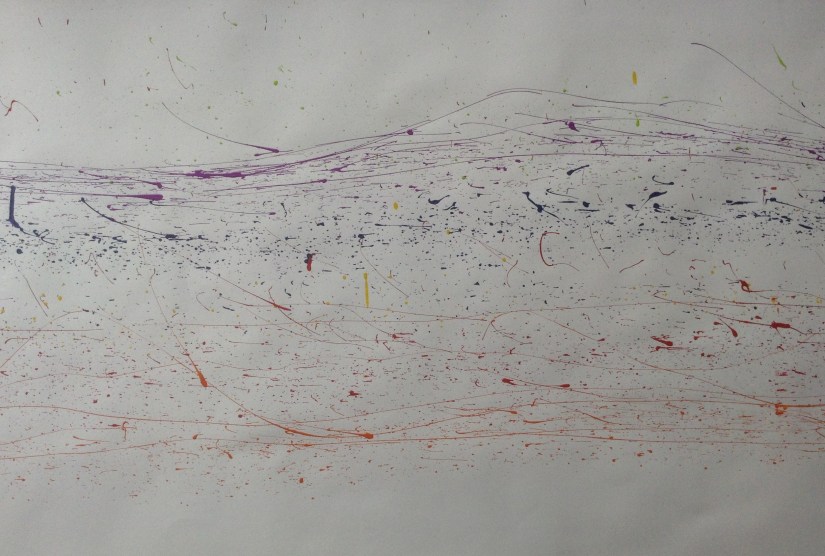


In order to increase the size of the support I explored several options that revolved around the support keeping a cylinder shape. Questioning my own thought process as to why it needed to be cylindrical, I experimented with objects that could act as a non-conventional easel. The one below was placed inside an open-ended cardboard box, and the drill (with different tools attached to the chuck) was held in random positions and angles. The support was then taken out of the box and laid flat on the floor on the studio. Using the drill and a single bamboo cane paint was applied by dripping and the rotating action of the drill (see figure 12).
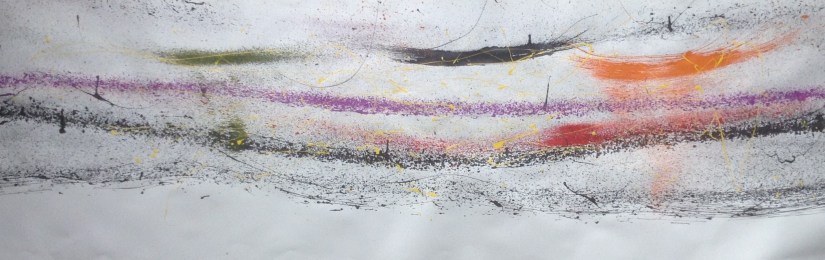
Reflecting on the exercises during Part One and the pieces developed during this assignment, I wanted to incorporate elements into my final piece, including texture, both through the viscosity of paint, adding other mediums and the tools or methods used in which it was applied. I replaced the wall lining paper with Fabriano paper as this was thicker than wallpaper lining and held its shape when formed into a cylinder. Having applied the first few layers of mixed mediums I knew that I wanted to increase the size and be able to manipulate the support to create less linear marks. That said the mark-making on the Fabriano paper was fascinating; unique and inquisitive to the eye (see figure 13).

Outcome
For my final piece I had purchased the largest width of wallpaper lining available at my local DIY store. This was cut and rolled in into a cylinder shape and taped at the closed ends. Using plastic pint cups to prevent the paper from tearing, string was feed through the cylinder shape and secured at both ends to the ceiling beams of the studio. With the underside of the support resting on a table this changed the shape from cylinder to a triangular circle (see sketchbook for diagram). This meant that I was physically able to get my head and shoulders inside the form.
The initial marks were made using a half-inch brush attached to the chuck of the electric drill. The bristles of the brush, which had been used for the previous studies and experiments, were splayed in all directions, adding to the concept of having no control how or where marks would be made on the support. The mixed medium consisted of PVA glue, modelling paste, ready mixed filler and ultramarine acrylic paint. When the brush was seemingly void of paint, I moved the position of the drill and brush to the extremities of the support. This was repeated using 1 to 3 bamboo canes at a time to create different marks (see figure 14).
I really liked the process and outcome of this assignment. The process of developing strands has clearly informed my decision making and the outcome of the final piece. I still question the relationship between positive and negative space in an abstract or expressive piece of work, in so much as that do the smallest marks on the extremities of the work (top or bottom) form a positive space?
Because I was so engaged in the process and the fact that I developed an understanding of how the different tools and paints would respond, I really felt connected to the finished piece. When starting this exercise, I said that I wanted to see how I could create a piece of work without controlling the outcome – and on a large scale. Through a process of experiments and studies I felt that I was able to do that.

Mixed medium on paper 170×100 cm
Reflection
The various exercises during part 1 explored gesture, alternative painting tools and things that perform for you as an artist. I felt that the ‘gesture’ exercise demonstrated how something I had previously considered as warm-up exercises could develop into an artwork, arouse emotions and a physical connection
Ideas around the extent of input and control an artist has on an outcome led me to consider the equilibrium between gravity and force, and the effect each had on the mark making. Another aspect to this was the relationship between positive and negative space and what this conveyed.
As I see myself as a painter with an interest in human form, this initiated thoughts around our personal footprint, physical and digital, our presence when transiting through life and the marks we leave in our wake. At the time of writing I was unsure how I might develop these conceptual thoughts, but I am keen to explore this further.
References
Harvardartmuseums.org. (2015). The Next Chapter for the Rebecca Horn Exhibition. [online] Available at: https://www.harvardartmuseums.org/article/the-next-chapter-for-the-rebecca-horn-exhibition [Accessed 1 Feb. 2020].
Only Human: Sougwen Chung. (2018). [film] https://vimeo.com/268448066: New Inc.
Puric, B. (2016). What Is Space in Art? Examples and Definition. [online] Widewalls. Available at: https://www.widewalls.ch/space-in-art/ [Accessed 3 Feb. 2020].
The Museum of Modern Art. (2019). Franz Kline. Chief. 1950 | MoMA. [online] Available at: https://www.moma.org/collection/works/78319 [Accessed 2 Feb. 2020].
Review against Assessment criteria
Demonstration of technical and Visual Skills: My choice of materials had been a conscious decision during each exercise and the assignment for part 1. Experimenting with scale has been fundamental to this, both to explore the parameters of my own reach but also to experiment with man-made objects and the amount of control applied to achieving an outcome. Whilst some of these were quick studies, others developed over time. Reflecting the exercises led to exploring and developing ideas around spatial awareness, scale and our own presence through the marks and traces we make or leave in our wake – human matter.
Quality of Outcome: I do feel that my research and enthusiasm to explore and experiment has influenced the outcome of my work. I particularly enjoyed Assignment One, embracing creativity by chance, and seeing how spontaneous ideas developed. On reflection, all these elements played a role, and whilst I may not have always be happy with the outcome, the process was never dull.
Conceptualisation of thoughts, communication of ideas: An insight to my thought process is articulated in my sketchbook. However, as some experiments were set up and conducted over several days my log maps a progression of ideas.
Context: Inspired by the conceptual ideas of Jackson Pollock, Sougwen Chung, Akira Kanayama and Rebecca Horn’s, I have produced a series of studies and works that reflect varying degrees of controlling the outcome – and on a large scale. This was parallel to my intent to reflect upon the marks we [humans] make as we transit through our environment.

