Look at the work of Angela de la Cruz, Dianna Molzan and Sarah Crowner. Notice the particular ways in which they deal with the canvas as a surface and its relationship to the stretcher.
Angela de la Cruz (b. 1965)
“Mangled stretchers, slashed canvases, twisted and violated, are hung on the wall like macabre trophies.” (Contemporary Society, 2020) At first glance, this might be the viewers initial response, and yet it is this deliberate desecration of the canvases which informs the outcome of each piece of work.
Conventionally, the artists’ canvas and stretcher go hand in hand. Whilst many artists have explored subject, shape, line and colour, De la Cruz breaks this notion of dependency by removing the canvas from its stretcher. In doing so she takes painting from two-dimensional representation to three-dimensional sculpture, which fundamentally changes the role of the paint and the painting.
To the artist, their altered and diminished states have an air of abandonment, challenging the view that canvas and stretcher are as one, or that one needs the other. To illustrate this, I selected two artworks that I particularly admired and viewed with interest.
The first was Deflated IV (White) (2009). (See figure 1) The way in which the artist retains the presence of the stretcher that confronts this notion of dependency on each other. We were one – but now I don’t need you type of attitude. The white canvas emphasises this, so the viewer is left with no ambiguity

Oil on canvas, 153 x 180 cm
Courtesy the artist and Victoria Miro, London/Venice; © Angela de la Cruz
@ https://www.apollo-magazine.com/surface-work-women-abstraction-victoria-miro/ (2020)
The second artwork was Ready to Wear (1999). (See figure 2) At first glance I was taken by the juxtaposing vertical and horizontal textured marks but what this does is bring the dimensions of the canvas into to picture plane. The piece is like a seductive striptease as the canvas is peeled back. In doing so the gap that emerges becomes central to the paintings, exposing the relationship between canvas and frame.

Photograph: Angela de la Cruz/Lisson Gallery
@ http://www.telegraph.co.uk
Sam Gilliam (b. 1933)
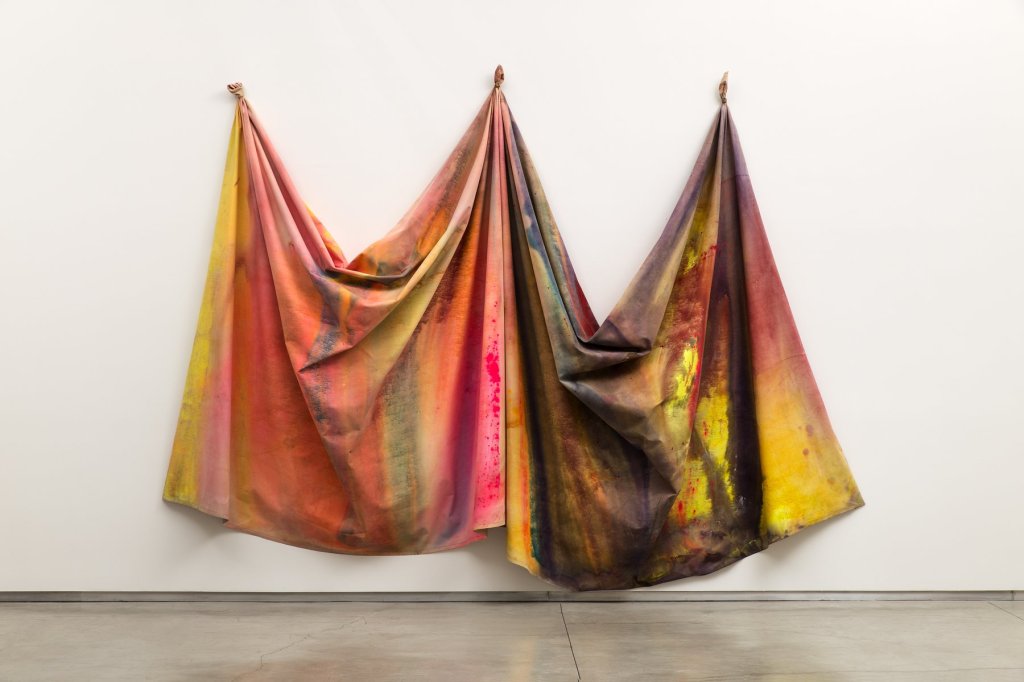
In merging the techniques of Angela de la Cruz and Lynda Benglis, Sam Gilliam spread a canvas out on the floor and covered it with diluted acrylic paint in layers, so colours mixed within the fibres of the canvas. Free of a frame, the canvas is then suspended from a wall and applied drips and splashes of thicker paint. Released from a traditional square or rectangular format, the work hangs in folds from the wall. Gilliam explains that the work was an attempt to ‘deal with the canvas as material … using it as a more tactile way of painting.’ (Tate, n.d.)
Diana Moltzen
Diana Moltzen generally adheres to painting’s conventional components – canvas or linen, wooden stretchers and paint which are manipulated or deconstructed to create sculptural forms thus breaking the convention of the picture surface as single, uninterrupted plane. (Kitamura, 2011) (Griffin, 2013)
Revealing the wooden supports and gallery walls beneath an unravelled canvas presents a three-dimensional facet. Her works are often wall-mounted allowing the gallery wall to fill the negative space making the space itself becomes a part of her work thereby exploiting the theatre of the gallery space. (Kitamura, 2011) I have selected two pieces to convey this sense of theatre (see figure 4 and 5), although there are many more examples that I could have selected to fill this space.

Figure 4 
Figure 5
Sarah Crowner (b. 1974)
Sarah Crowner’s practice includes a diverse range of materials and mediums, many of which incorporate forms found in architecture, nature, and in the history of twentieth-century art and design.
Crowner’s abstract use of vivid colours and geometric shapes reminded me of Matisse. Unlike Matisse, Crowner composes painted swatches of canvas on the floor of her studio and intuitively stitches them together with an industrial sewing machine before stretching them onto a frame. Crowner will stretch a painting ‘six or seven times’, altering its components until it’s deemed ‘successful’. (Klingelfuss, 2019)
Blue Wings (Ochre Backlight), (2019), (see figure 6) really caught my attention. Not just because of her use of the vivid blue and yellow ochre pallet, but also because of the title. Without knowing the title of this piece, I was drawn to the crisp ochre shapes that appeared to penetrate the blue canvas. But the yellow ochre is the background (or backlight as the artist called it). This presents a different perspective to the viewer that only makes the viewer see the piece as the artist intended, but in doing so it takes the blue wings beyond the frame of the canvas. The subtle tonal variations creates an illusion of depth and form that takes it in the realms of being three-dimensional.

Acrylic on canvas, sewn
76.2 x 61 cm (30 x 24 in.)
Courtesy of the artist and Simon Lee Gallery
I felt that Crowner’s Sliced Stems, (2016) (see figure 7) spoke more about the artist and her method of composing painted swatches of canvas on the floor of her studio. Her use of colour, tone and form, and their relationship to one another creates a real sense of abstract structure – if that’s at all possible. I absolutely love it and I would have loved to have seen the artist working this through as a piece of work.

Acrylic on canvas, sewn
243.8 x 198.1 cm (96 x 78 in.)
Courtesy of the artist and Simon Lee Gallery
References
Brennan, M., n.d. New Abstract Painting And Sculptural Form. [online] Modernedition.com. Available at: <http://www.modernedition.com/art-articles/new-abstraction/new-abstract-painting.html> [Accessed 29 May 2020].
Contemporary Society, 2020. Angela De La Cruz – Contemporary Art Society. [online] Contemporary Art Society. Available at: <http://www.contemporaryartsociety.org/artist-members/angela-de-la-cruz/> [Accessed 29 May 2020].
Cormack, E., 2012. Angela De La Cruz’S “Transfer” – Features – Art-Agenda. [online] Art-agenda.com. Available at: <https://www.art-agenda.com/features/233501/angela-de-la-cruz-s-transfer> [Accessed 29 May 2020].
Davidkordanskygallery.com. n.d. Sam Gilliam – Artist – David Kordansky Gallery. [online] Available at: <https://www.davidkordanskygallery.com/artist/sam-gilliam> [Accessed 8 June 2020].
Griffin, J., 2013. Dianna Molzan. [online] Jonathan Griffin. Available at: <https://jonathangriffin.org/2013/01/08/dianna-molzan/> [Accessed 29 May 2020].
Kitamura, K., 2011. Focus: Dianna Molzan. [online] Frieze.com. Available at: <https://frieze.com/article/focus-dianna-molzan> [Accessed 29 May 2020].
Klingelfuss, J., 2019. Sarah Crowner Binds Painting And Performance In Her Vibrant Stitched Canvases. [online] Wallpaper*. Available at: <https://www.wallpaper.com/art/sarah-crowner-paintings-for-the-stage-simon-lee-gallery-hong-kong> [Accessed 30 May 2020].
Lissongallery.com. n.d. Angela De La Cruz | Artists | Lisson Gallery. [online] Available at: <https://www.lissongallery.com/artists/angela-de-la-cruz> [Accessed 29 May 2020].
Pace Gallery, n.d. Pace Gallery | Sam Gilliam. [online] Pacegallery.com. Available at: <https://www.pacegallery.com/artists/sam-gilliam/> [Accessed 8 June 2020].
Searle, A., 2010. Angela De La Cruz’s Brush With Death. [online] the Guardian. Available at: <https://www.theguardian.com/artanddesign/2010/apr/05/angela-de-la-cruz> [Accessed 29 May 2020].
Simon Lee Gallery, n.d. Sarah Crowner. [online] Simon Lee. Available at: <https://www.simonleegallery.com/artists/sarah-crowner/> [Accessed 30 May 2020].
Tate. n.d. Robert Holyhead Born 1974 | Tate. [online] Available at: <https://www.tate.org.uk/art/artists/robert-holyhead-15525> [Accessed 3 June 2020].
 Painting 2 - Studio practice