Exercise 1.3 Studio reflections
Consider your relationship to your work or studio space. Consider the usefulness of a studio in relation to the direction your practice takes. The studio can have many functions; amongst which it is a place where a network of connections and interconnections can occur and mutate. It gives permission to a different – it is a place of constant returning and of picking up where one has previously left off.
Sketchbook 1. Page 13


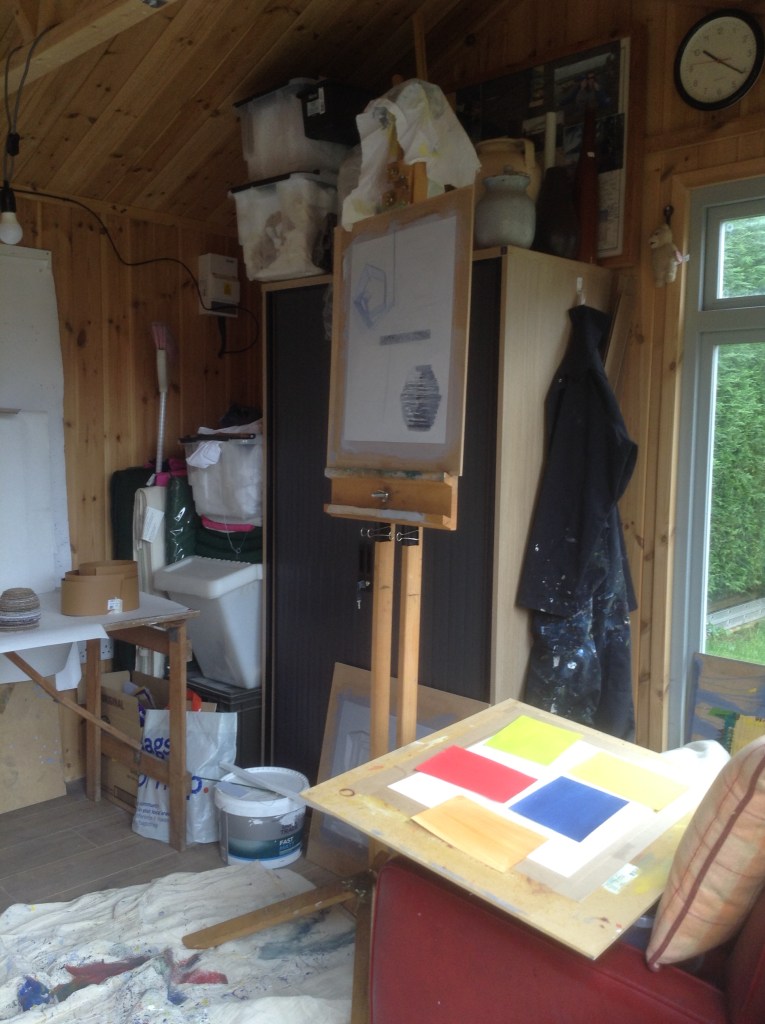
I am fortunate to have a dedicated working space. A wooden structure with a glass frontage at the bottom of my garden. The glass doors seemed like a good idea when it was being installed, but in the summer, I spend most of the time trying to keep the direct sunlight out. To the left as you enter is an old architect/map draw, a chest of drawers and fridge. Hanging on the wall is a 1950s Raleigh bicycle with rod brakes, which is too damaged to ride but too nice to throw out. A computer sits on the chest of drawers covered with cardboard box to protect it from paint and alike. At the other end of the room is a tall cabinet with roller doors that protects my small book collection. A small armchair, easel and folding table occupy various positions around the studio. Artwork and notes are pinned to the walls until such time as I need to create more space for more artwork. Depending on the nature of each project, there is generally enough room in the studio to work on different projects simultaneously.
I can’t say that I suffer from the procrastination as conveyed by Valérie Mréjen. Whilst my studio can be a place of solitude to think and contemplate, it is also a space in which to experiment with concepts and my own ideas, the unknowns and what ifs, which whilst exhilarating can also be very time consuming. It is also a quite space to read and research on-line.
At present, my working practice and routine are structured by the content of the OCA course. Inevitably there are deadlines to meet and this does impact on how far, or how long is spent on each project. I am fortunate to have the studio space in which to work on multiple projects simultaneously, although this creates havoc with my sketchbook.
My job is very demanding, intense and stressful, and one where I am constantly at the end of a phone, always available and therefore always a potential distraction. That said, the studio is a space where I try and switch off from work, a place without tension, stress, noise or pressure. The studio is place where I want to be, even when I am not. A place where creativity and spontaneity will ebb and flow naturally, or at least until the phone rings!
My relationship with my workspace is both practical, and to a lesser degree – sentimental. Practically, it provides a space that can be whatever I want it to be; without worry of spilling paints or damaging surfaces. Where else could you attach a paintbrush to an electric drill to create an abstract painting, leave an unfished piece of work to return to when it suits, or pin notes to the walls! From a sentimental perspective – the comfort of my red armchair, books to hand, paintings and drawing to reflect on, and my 1950s bicycle. Or as my wife calls it – stuff I don’t want to throw away.
At the time of writing this review the space works. I am a methodical person with a touch of OCD so most things in the studio has its place, and its kept relatively tidy. What this review had made me consider was if the space could be used more efficiently, and with less stuff. Too early to comment but I will revisit and reflective on this point at the end of the Studio Practice course.


